

Major U.S. technology firms accelerating their investments in artificial intelligence (AI) have raised worries about possible adverse effects on worldwide financial markets, as the volume of corporate bonds they issue rises. Three years after the AI boom began with the release of ChatGPT in late 2022, the global AI sector has transitioned from a technological race to a “battle for capital.” The Korea Center for International Finance noted, “Worries are increasing regarding the effect on financial market stability as U.S. companies depend more on debt financing while pursuing AI initiatives.”
◇Amazon and Four Other Companies Issue $121 Billion in Bonds
As reported by Bank of America Securities and other entities on the 2nd, five so-called “AI hyperscalers” — firms that manage extensive data centers and offer cloud and AI services — namely Amazon, Alphabet, Meta, Microsoft, and Oracle — issued corporate bonds totaling $121 billion (around 175 trillion South Korean won) just last year. This amount is more than four times the average annual issuance between 2020 and 2024, which was $28 billion. Oracle particularly caught the market’s attention with a significant $18 billion bond issued in one deal in September of the previous year. Should this trend persist, these companies are projected to issue corporate bonds worth $140 billion each year for the next three years. Some analyses indicate that the scale could possibly surpass $300 billion annually.
Although they have significant cash reserves, these companies are choosing to issue bonds instead of raising capital through stock to prevent a drop in share prices and possible dissatisfaction from current shareholders. Neofeed, an economic media source, stated, “Opting for the bond market rather than equity financing such as rights issues helps avoid diluting the value of existing shareholders.” Another reason is tax advantages, as interest costs on debt lower taxable income. Moreover, many of these companies have high credit ratings (AAA–AA), which enables them to issue bonds at reduced interest rates.
◇”Internet Bubble or 2008 Crisis Possible”… Profitability Needs to Be Confirmed
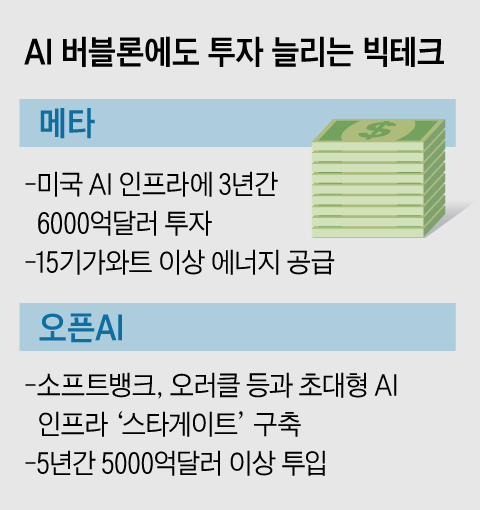
The problem stems from how this bond offering might disturb the general supply and demand equilibrium in financial markets. An increase in significant bond offerings could push long-term interest rates higher. As AI firms mainly issue long-term bonds for investments, this may lead to higher rates for government bonds and top-tier corporate bonds, resulting in a “crowding-out effect” that increases financing expenses for other companies.
Bloomberg cautioned, “Although the extra interest (spread) that borrowing companies are currently facing is minimal, a rapid increase in bond offerings from AI companies could lead to a sharp rise in interest rates, causing widespread turmoil in the financial market.” The Korea Center for International Finance noted, “Investors are more worried about the overall effect of large-scale bond issuances on the corporate bond market rather than the financial risks of individual companies.”
These issues are also connected to stock market performance. Conversations regarding whether AI can produce returns that match its expenses have sparked a “AI bubble” discussion. James Ferguson, a partner at the U.K.’s Macro Economic Survey, cautioned, “AI is still expensive, energy-consuming, and susceptible to errors,” implying that the current AI trend might conclude in a manner similar to the 2008 financial crash. Bloomberg also mentioned, “Investors are seeking concrete proof that the billions invested in AI are resulting in real profits.”

On the 29th of the previous month, Microsoft’s stock dropped by 10% in one day because of worries about the uncertain profitability of its large-scale AI infrastructure investments, leading to a loss of around $380 billion in market value over two days.
Nevertheless, certain analyses suggest that the current circumstances have not reached a critical level that would cause extensive financial turmoil. The Korea Center for International Finance noted, “Although it is important to keep an eye on possible credit market instability related to bonds issued by financially weak AI companies, the overall financial condition of leading AI firms is stable and does not present a systemic threat.”




 jasdooit
Leave a comment