
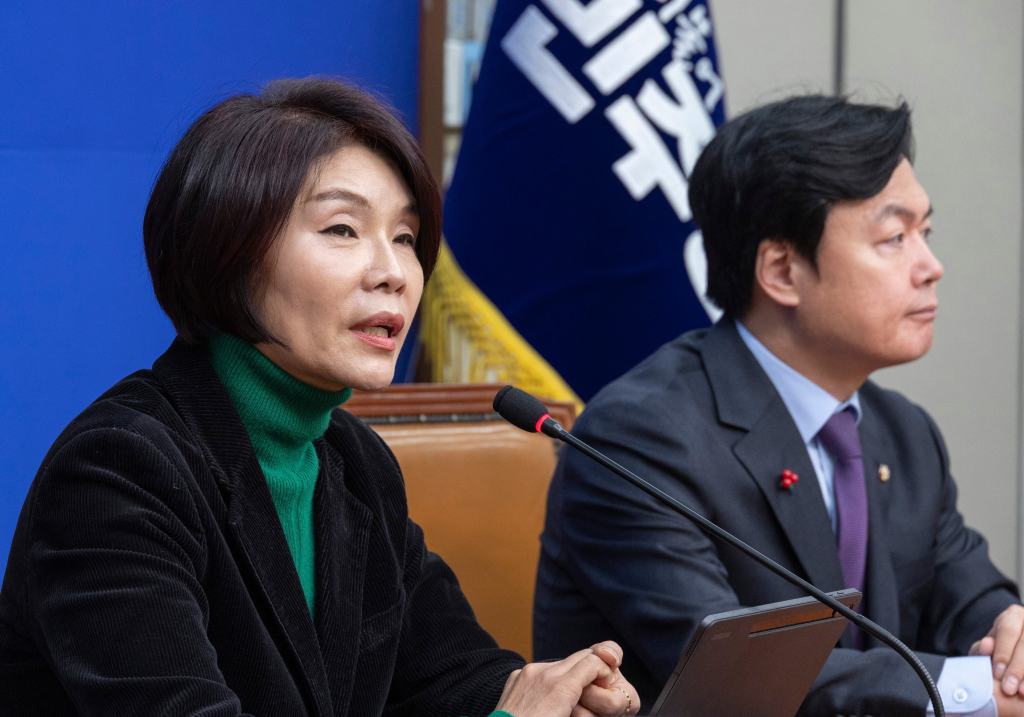
The South Korean Democratic Party stated on the 1st that it intends to enact more than 80 outstanding living-related bills in the National Assembly prior to the Lunar New Year holiday.
Han Jeong-ae, the party’s policy director, mentioned during a press conference at the National Assembly on the same day, “At present, 85 (livelihood) bills are under consideration in the plenary session. I believe it would be beneficial to address all pending livelihood bills in the National Assembly before the Lunar New Year and then extend holiday greetings.”
Previously, on the 27th of last month, President Lee Jae Myung remarked during a Cabinet meeting, “The National Assembly is progressing too slowly to accomplish anything,” which led the legislature, controlled by the Democratic Party, to quickly pass 91 stalled bills related to people’s livelihoods, including the Semiconductor Special Act. The party intends to address the remaining bills in the near future.
At present, the National Assembly is considering several pending bills related to livelihood, including the so-called “emergency room round-robin” prevention act, the essential medical care enhancement bill, and the wage claim protection bill.
Han stated, “The party and the leadership of the floor are in agreement on continuing discussions to advance the remaining bills as swiftly as possible. There is no alternative strategy—we need to engage in negotiations to the fullest extent, and we will ask the Speaker of the National Assembly to assist in handling these bills.”
She stated, “It would be challenging for any citizen to understand why bills approved by both parties and approved in standing committees are not addressed during the full session. Therefore, when we ask the Speaker for support, we will stress that bills passed in standing committees should not be prevented from moving forward in the full session.”
Concerning judicial reform bills, including the amendment to the Criminal Act that introduces the concept of “law distortion crime” and the Constitutional Court Act amendment (which has caused debate regarding a “fourth trial system”), Han said, “We will handle them before it’s too late,” but did not provide a specific schedule. Nevertheless, she mentioned, “The party’s goal is not to go beyond February.”
Regarding the timing for handling the Special Act on Investment in the U.S., which is a subsequent bill to the Korea-U.S. tariff negotiations, she stated, “We believe it is feasible to process it in late February to early March. We will make every effort to stick to this timeline.”
Nevertheless, concerning the U.S. efforts to accelerate the Special Act on Investment in the U.S., Han stated, “The U.S. should acknowledge the procedures of the relevant country to ensure that the memorandum of understanding (MOU) is maintained through mutual respect and comprehension. I can’t help but feel disappointed with this method.” She further mentioned, “If discussions proceed in a manner that abruptly reinstates tariffs due to the bill not being handled promptly, I can’t help but fear whether the MOU and joint fact sheet between South Korea and the U.S. will remain in effect going forward.”
Previously, U.S. President Donald Trump cautioned on the 26th of the previous month that he would reinstate tariffs, saying, “The South Korean legislature has not ratified the trade agreement.” As a result, the government and the ruling party are speeding up the legislative process for the Special Act on Investment in the U.S.


 jasdooit
Leave a comment