
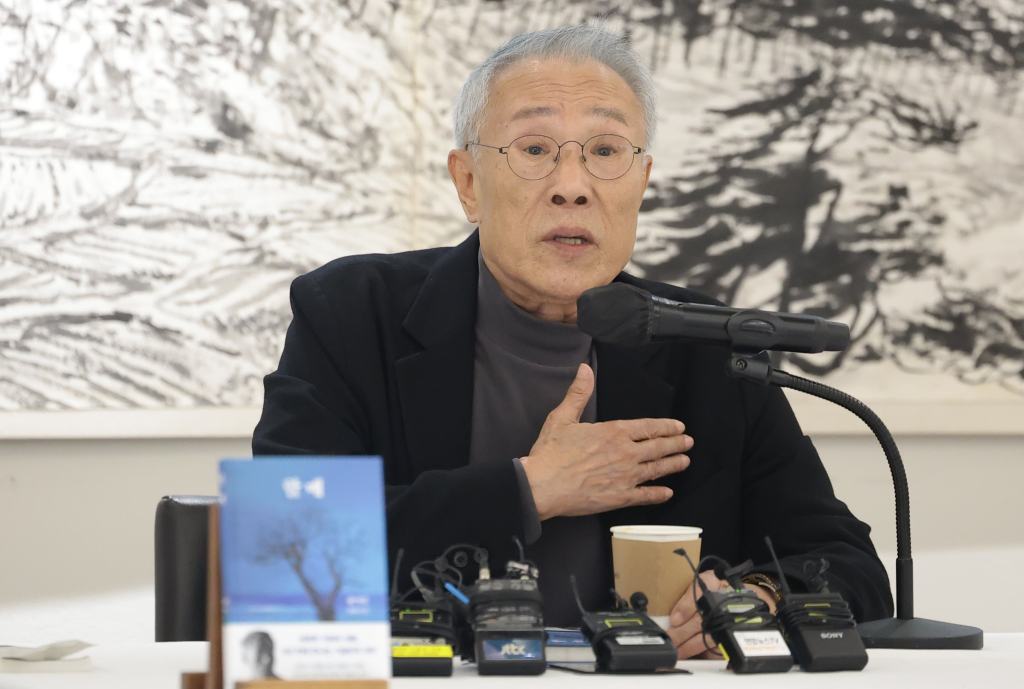
Writer Hwang Sok-yong, who has just published his new book *Halmae*, participated in a YouTube live stream and mentioned, “I utilized ChatGPT as a helper,” explaining, “I entered around five or six components—like a 600-year-old zelkova tree, historical setting, and writing techniques—and engaged in discussions with the AI.” He referred to this approach as “the foundation of the novel.”
Although experienced authors openly talk about using AI, many literary competitions—opportunities for emerging writers—still clearly ban AI usage. Conversations regarding the application of AI are also becoming more prevalent in literary and publishing communities.
This year, a winning novel in a regional newspaper’s New Year’s literary competition raised concerns about AI usage when the text contained ‘**’ symbols, typically seen in AI-generated responses, in two instances. The newspaper had not previously outlined rules against using AI. In contrast, major publishers have updated their submission policies, stating, “Works created with AI are not eligible for submission” (Changbi New Writers’ Award) and “If a submission is entirely or partially generated using generative AI, the award will be withdrawn” (SF Korean Science Literature Award). These actions seek to keep AI from taking over creative fields. A representative from Publisher A mentioned, “AI can be utilized for research or reporting, but assigning fundamental creative tasks to AI is not allowed.”
Nevertheless, based on investigations by this newspaper, there are currently no distinct systems or technologies available to check for AI usage in submissions. A spokesperson from Publisher B stated, “While we ban the use of AI, there is no effective method to determine if a piece was created by AI.” The burden ultimately rests on editors’ instincts and authors’ integrity. A representative from Publisher C mentioned, “Although the overall quality of submissions has increased, many works seem uniform, prompting us to suspect AI involvement, though this is still just an assumption. We continue to depend on ‘human judgment.’”
Is there a way to detect the use of AI, much like how Copy Killer identifies plagiarism in academic documents? Publishers are reluctant to submit unissued manuscripts to open-source tools such as ChatGPT because of possible copyright issues. A representative from a book publishing company mentioned, “Certain authors now clearly mention in their agreements that their writings should not be utilized for AI proofreading or editing. How can we check unissued works using AI?”
Some people question, “Why not allow AI-generated works and create two separate paths: traditional literature and AI literature?” An editor-in-chief from Publisher D stated, “We can’t keep discussing this in hushed tones forever. We need to introduce categories such as ‘AI collaboration’ to set the stage and differentiate the areas.”

 jasdooit
Leave a comment