
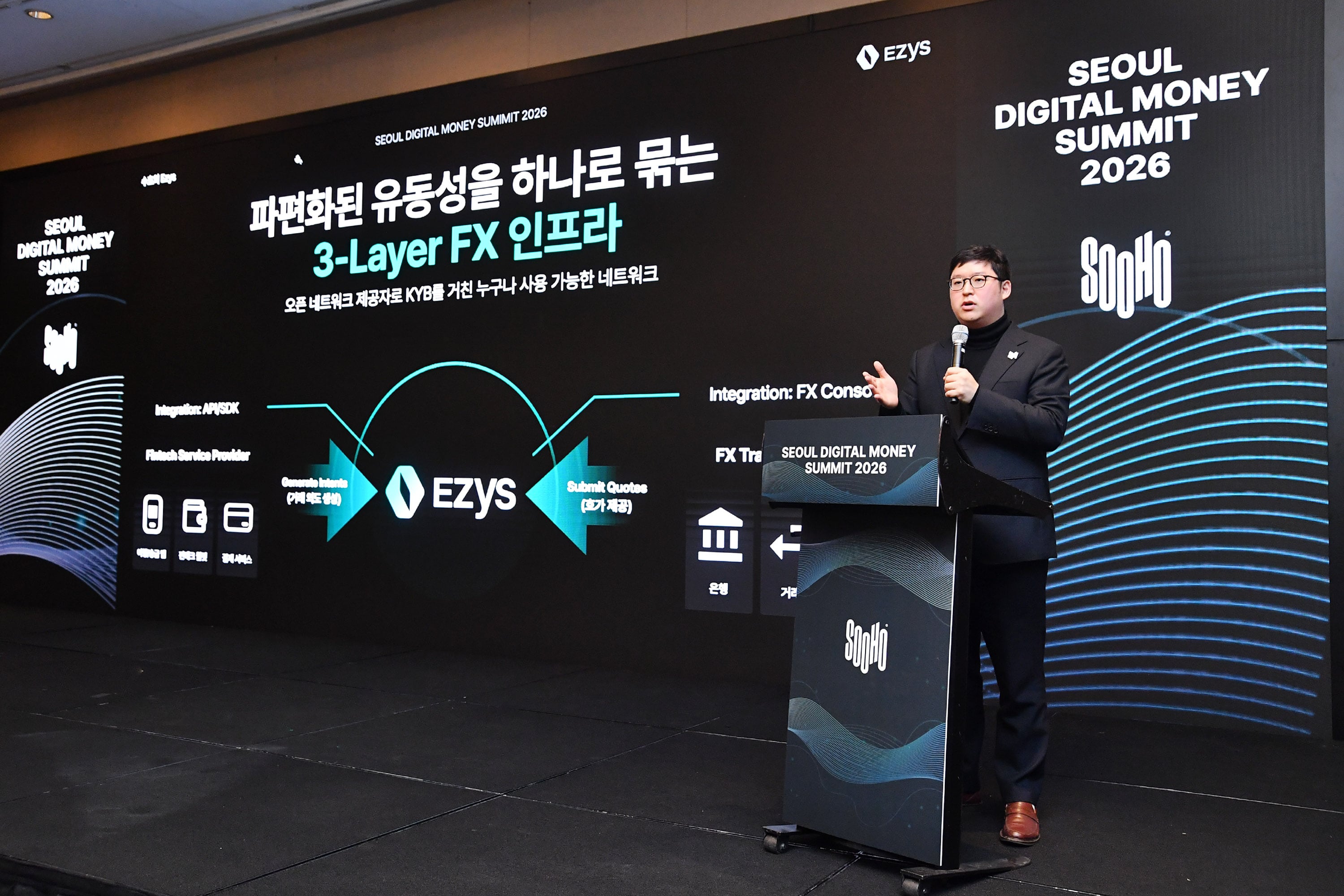
With expectations of the ‘Digital Asset Basic Act (Stablecoin Regulatory Framework)’ being enacted during the first quarter (January-March) of this year, local financial institutions and fintech companies are intensifying their efforts to gain an early advantage in the market. As the introduction of Korean stablecoins, which had been delayed due to regulatory loopholes, approaches its final phase, partnerships between fintech firms possessing technological expertise and banks with financial resources are also accelerating. The blockchain technology firm SOOHO.IO hosted the ‘Seoul Digital Money Summit 2026’ at the Conrad Seoul in Yeouido on the 4th, where it introduced next-generation stablecoin foreign exchange (FX) and settlement infrastructure. SOOHO.IO is the first Korean company to receive funding from ConsenSys, a firm established by an Ethereum co-founder. Shin Seung-hwan, a partner at Boston Consulting Group, who addressed the event, stated, “Stablecoins are a key segment of digital assets that are commercializing the fastest,” and noted, “Global banks have already entered the testing and actual business preparation stages.” The global digital asset market is expected to grow to a size of 1 trillion to 4 trillion dollars (approximately 1,450 trillion to 5,801 trillion Korean won) by 2030.
◇ Innovation that Cuts Costs by 70% Introduced
On this day, SOOHO.IO introduced ‘Ezys,’ a B2B (business-to-business) infrastructure that significantly simplifies international money transfer and settlement processes through the use of stablecoins. Park Ji-su, CEO of SOOHO.IO, stated, “While the current SWIFT (Society for Worldwide Interbank Financial Telecommunication) system requires 2-3 days for settlement and incurs high costs, Ezys allows for instant settlement.” By utilizing blockchain technology, it consolidates foreign exchange demand in one location and establishes a framework for automatic trading at the best possible exchange rate. According to the results of a pilot project (Project Namsan) carried out last year targeting 2,000 foreign tourists, foreign exchange fees were cut by about 70%, dropping from the current 1% to 0.3%, and merchants could receive immediate settlement without any extra equipment. Park mentioned, “Ezys will serve as a key channel linking financial institutions’ liquidity with fintech needs beyond just payments.”
Some are concentrating on payment systems. Hecto Financial is advancing the development of a stablecoin payment ecosystem that links wallets, transactions, and platforms. Recently, it established cross-border settlement infrastructure by creating a payment system using Circle’s stablecoin payment network.
Wemade, a gaming company, also advanced the development of a won-backed stablecoin system by revealing its standalone mainnet ‘StableNet’ concept last month. It highlighted transparency and security meeting regulatory standards, featuring a framework that utilizes won-backed stablecoins directly as gas fees (transaction costs) and a real-time system for identifying suspicious transactions.
◇ Fierce Rivalry within the Banking Industry
Traditional financial institutions are also intensely competing to gain an edge in the stablecoin market. Specifically, commercial banks are placing greater emphasis on securing applications and growing their ecosystems rather than issuing coins directly.
Last month, Hana Financial officially revealed the establishment of a stablecoin consortium tied to the Korean won, involving BNK Financial, iM Bank (Daegu Bank), and Standard Chartered Bank Korea. Shinhan Financial is currently testing a proof of concept (PoC) via the delivery app ‘Ttangeoyo,’ whereas Woori Financial is working on technical integration to allow payments and remittances using won-pegged stablecoins within Samsung Wallet. KB Kookmin Card has already obtained a hybrid payment patent that automatically charges credit cards when the stablecoin balance in an electronic wallet is low, with an emphasis on real-world transactions.
It is recognized that leading domestic financial technology companies—Naver Pay, Kakao Pay, and Toss—active in the offline quick payment sector are also striving to establish stablecoin payment systems.
◇ Ongoing Issues: The Specifics
The ‘Virtual Asset User Protection Act (Phase 1 Legislation)’, introduced in July 2024, had a primarily defensive approach centered on preventing accidents and safeguarding investors. The ‘Digital Asset Basic Act (Phase 2 Legislation)’ takes a more proactive stance, integrating the issuance, listing, and disclosure of virtual assets into the institutional system. However, there remain substantial issues concerning specific details. Notably, the ‘bank share 51% rule’ related to the stablecoin issuance structure and regulations regarding major shareholders’ stakes in digital asset exchanges are the main points of contention. Although fintech companies advocate for market entry opportunities in the fintech, blockchain, and platform sectors, the Bank of Korea maintains that bank-led consortia with more than ‘50% + 1 share’ should be the issuers to ensure financial system stability.
The Korea Internet Enterprise Association released a statement, stating, “The proposal to permit only banks with a majority stake (50% + 1 share) to join the stablecoin market is a policy that protects existing interests and hinders innovation.” Attorney Joo Sung-hwan from Lee & Ko noted, “Both in South Korea and globally, there is ongoing institutional integration of stablecoins, but key regulatory frameworks such as issuance standards, redemption responsibilities, and restrictions on interest payments are still being developed.” He further mentioned, “Due to the ‘separation of financial and industrial capital’ policy and concurrent business regulations for virtual asset service providers (VASPs), financial institutions encounter limitations when trying to directly enter the market,” highlighting, “Urgent institutional enhancements are necessary for financial institutions to participate in the stablecoin sector.”



 jasdooit
Leave a comment