
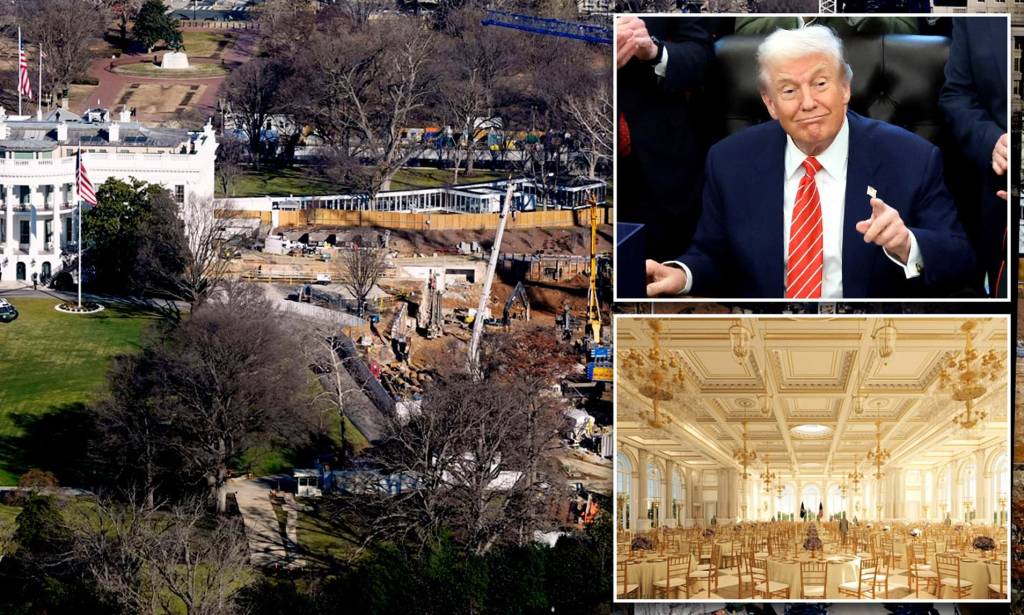
Donald Trumpunveiled a new version ofhis $300 million ‘Big, Beautiful Ballroom’in what he referred to as the ‘grand new East Wing’ of theWhite House.
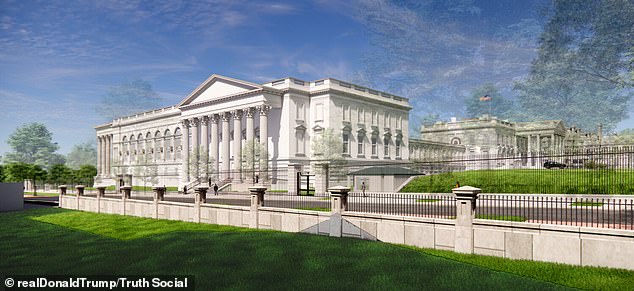
The leader displayed how the completed project will appear in a visual representation viewed from the Treasury Building across the street on his Truth Social platform.
He described the old East Wing as “very small, run-down, and rebuilt multiple times” and aimed to replace it with “a magnificent New East Wing, featuring a splendid Ballroom that Presidents have requested for more than 150 years.”
The specifics of the depiction featured a wall designed to mimic the North Facade of the White House.
“This area will benefit our nation greatly for, we hope, many centuries to come,” Trump added.
The Trump administration have gradually disclosed additional information about the large-scale initiativeamid backlash from liberals regarding the demolition of the East Wing.
Hello Baranes, the architect leading the design forTrump‘ballroom project, unveiled new information in early January.
The proposals for the upcoming structure were set to be submitted to the National Capital Planning Commission and the Commission of Fine Arts this month.
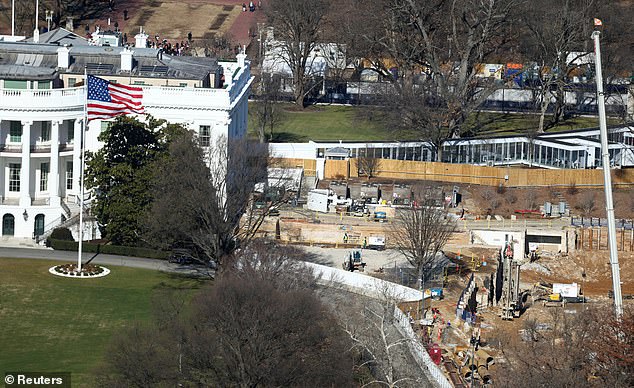
The existing proposals suggest reconstructing the White House’s East Colonnade—demolished together with the East Wing—as a two-level building rather than the original one-story design.
The new design would enable visitors to access the ballroom via the historic East Room located within the Executive Mansion, the primary structure of the White House.
However, the two-story colonnade would cause the White House to appear unbalanced, so Baranes revealed that the White House might include a one-story addition to the West Wing to achieve ‘symmetry’ after the East Wing renovation.
The existing single-story West Colonnade—which Trump exited in August and hinted he was constructing “something magnificent”—currently contains the White House press briefing room and journalists’ offices.
An outdoor area of the building currently features Trump’s “Presidential Walk of Fame” – where the president created plaques that criticize some of his Democratic predecessors.
“Here you can see the upper level of the East Colonnade and the possibility of a future expansion, a single-story addition to the West Wing, which would be placed right here,” the architect explained, holding up large cardboard models of the designs.
“And you understand, the reason to consider this is so that we can restore the symmetry around the central pavilion of the White House,” Baranes explained.
Later during the presentation, when Baranes was asked about a potential expansion of The West Wing, he explained, “It would only extend to the colonnade” — meaning there would be no two-story Oval Office.
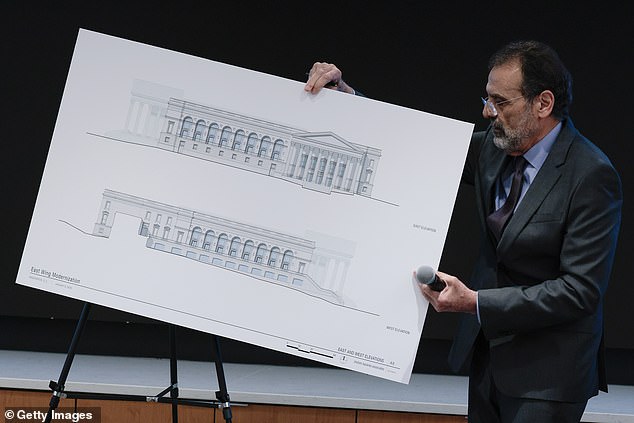
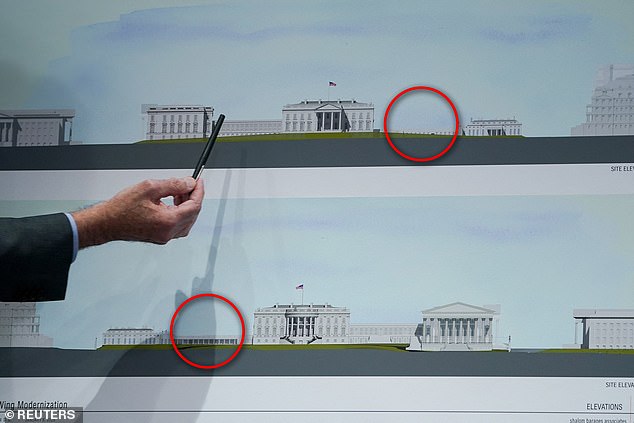
The project has faced criticism because the White House was not initially open about its plans to tear down the East Wing — which originally dates back to 1902 but was rebuilt in 1942 during President Franklin D. Roosevelt’s administration, partly to conceal a White House bunker.
The ballroom has also drawn attention because it was entirely financed by contributors – including corporations that have matters before the U.S. government.
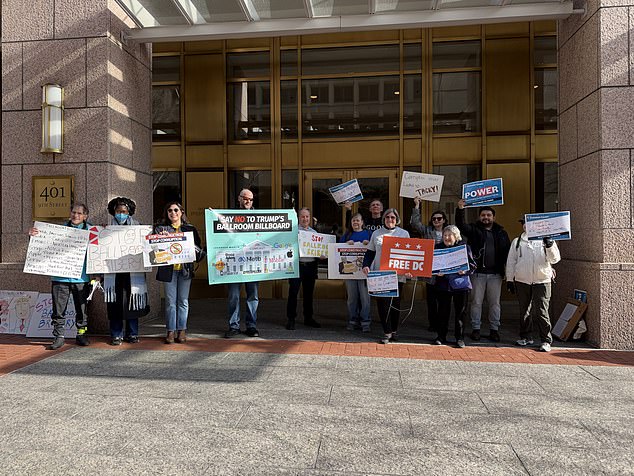
Before Thursday’s meeting, a group of approximately a dozen demonstrators, some affiliated with the watchdog organization Common Cause, assembled outside the NCPC’s office, displaying signs that read “corruption never looked so tacky.”
Within the meeting, NCPC Chairman Will Scharf—Trump’s chosen leader who also holds the position of White House Staff Secretary—told the small number of members of the public present to maintain calm.
Scharf admitted there was an agenda item, ‘the ballroom,’ which has generated ‘strong opinions from both sides.’
‘Although there will be chances for the public to provide feedback on the ballroom project later, we kindly request that you do not interfere with the commission meeting today. If you choose to make an unauthorized interruption, we will, regretfully, have to ask you to exit the room,’ Scharf stated.
Scharf also expressed prior apology in case he became irritable.
“To those of you who have set New Year’s resolutions, I stopped using nicotine eight days ago, so if I seem irritable or less lively or energetic, that’s the cause,” the chairman said, prompting laughter.

He stated again at the meeting that he felt the NCPC did not supervise the demolitions, which enabled the East Wing to be destroyed in October without any governmental supervision.
No interruptions affected the meeting, with the sole opposition to the ballroom plans originating from committee members representing the city.
Baranes, who assumed the project from architect James McCrery in November, stated at the end of the month that a choice was made “not to pursue further options for expanding the project’s scale.”
There were whispers that Trump aimed to make the ballroom larger – as the project’s cost has now risen to approximately $400 million.
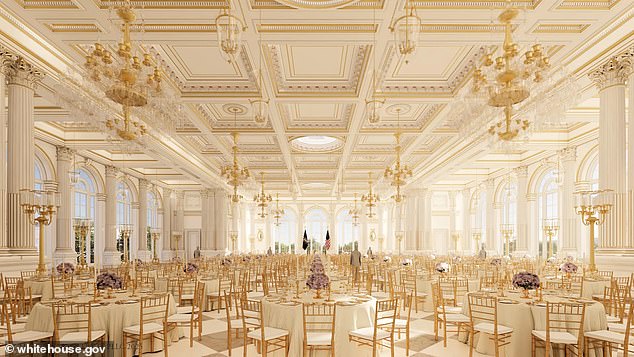
The existing designs for the ballroom are derived from one of the initial plans created by McCrery, featuring a 22,000 square foot ballroom capable of accommodating 1,000 guests seated for a meal.
The new overall design, incorporating the East Wing offices previously used by the first lady’s team, will be part of the total 89,000 square foot two-story structure.
Phil Mendelson, a member of the NCPC committee and head of the D.C. City Council, expressed his desire for the project to be reduced in scale, worried that the new structure might overshadow the primary White House building.
“I’m worried about the major impact on the original historic structure,” he said to the committee, Mendelson stated.
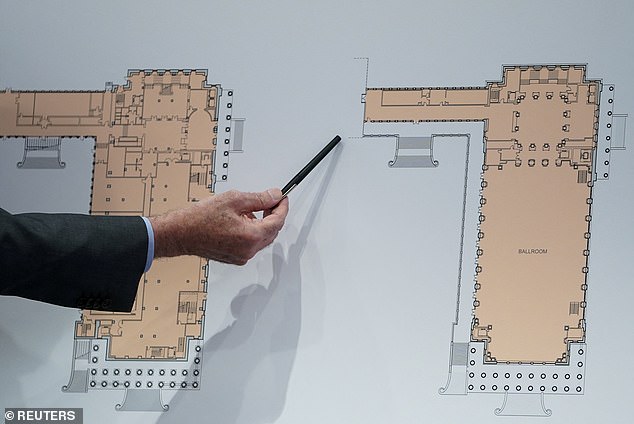
He also voiced worry that the board was focusing solely on one part of the White House project at a time.
“Another point I noticed is that it concerns me that we are considering an addition to this historic building, yet we are examining what seems to be a comprehensive plan in a highly fragmented manner,” he stated.
“So, there will be some modifications to the visitor center, some adjustments to Lafayette Park, and some changes to the West Wing,” he mentioned, indicating his preference for looking at the project as a unified entity.
Linda Argo, a member of the NCPC commission appointed by Washington, D.C.’s Democratic Mayor Muriel Bowser, also expressed that she had ‘some concerns regarding the size and scope in various aspects.’
The National Trust for Historic Preservation has taken legal action regarding the ballroom project, with a federal judge informing attorneys from the Department of Justice in December—representing the White House’s stance—that the ballroom plans must be submitted to the NCPC and the Commission of Fine Arts by the end of 2025.
Scharf stated to the Daily Mail following the court session that he believed today’s presentation was probably sufficient to meet the judge’s requirement—regardless of more structured plans expected from the White House at a later time.
The chairman made no secret of his support for the project moving forward, citing an upcoming visit by King Charles later this year. ‘It’s highly probable he’ll be accommodated in a tent on the South Lawn along with portable toilets,’ Scharf remarked.
“That, in my opinion, does not reflect well on the United States of America,” he stated.
The White House aims to accelerate the project to finish it by 2028, the final full year of Trump’s presidency.



 jasdooit
Leave a comment