
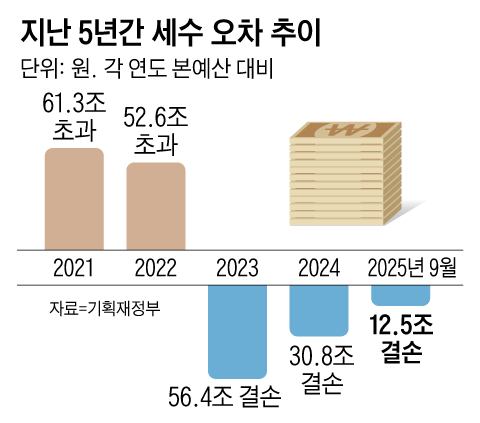
Last year, national taxes including income and corporate taxes were 8.5 trillion South Korean won below the original target, representing the third straight year of underperformance in tax collections. Nevertheless, the shortfall decreased considerably thanks to improved corporate tax revenues, higher wage-related income taxes, and profits from Seohak ants, which refer to Korean retail investors purchasing foreign stocks.
As per the Ministry of Economy and Finance’s statement on the 10th about the “2025 National Tax Revenue Performance,” the national tax revenue for last year totaled 373.9 trillion South Korean won. This was 8.5 trillion South Korean won below the government’s projected tax revenue of 382.4 trillion South Korean won outlined in last year’s budget plan. After experiencing a shortfall of 56.4 trillion South Korean won in 2023 due to a corporate tax shock and a deficit of 30.8 trillion South Korean won in 2024, this is the third consecutive year of underperformance in tax revenue compared to the budget. The total deficit over the three years amounted to 95.7 trillion South Korean won.
Nevertheless, tax revenue last year rose by 37.4 trillion South Korean won compared to the previous year (336.5 trillion South Korean won). It also surpassed the government’s revised estimate of 369.9 trillion South Korean won, which was announced in September of the previous year, by 4 trillion South Korean won. At that time, the government had predicted a shortfall of 12.5 trillion South Korean won compared to the initial budget. When compared to the adjusted tax revenue forecast of 372.1 trillion South Korean won, approved by the National Assembly during the supplementary budget in June of the previous year, the actual revenue was 1.8 trillion South Korean won higher. A representative from the Ministry of Economy and Finance stated, “Unlike 2023 and 2024, last year’s tax revenue was reduced through a supplementary budget revision, so it reflects normalized fiscal management rather than a ‘tax revenue shortfall.’”
The growth in last year’s tax revenue was mainly fueled by a rise of 22.1 trillion South Korean won in corporate taxes, attributed to better corporate performance. The operating profit (on an individual basis) for companies listed on the KOSPI increased by 67.5 trillion South Korean won (174.4%), rising from 38.7 trillion South Korean won in 2023 to 106.2 trillion South Korean won in 2024. As a result, corporate tax revenue last year amounted to 84.6 trillion South Korean won, marking a 35.3% increase compared to the previous year.
Wage income taxes also increased by 7.4 trillion South Korean won (12.1%) to reach 68.4 trillion South Korean won. This rise was due to a 283,000-person (1.7%) growth in regular employees—from 16,353,000 in the prior year to 16,636,000—and higher salaries. The average monthly salary for a regular employee went up by 310,000 South Korean won (7.4%) from 4,168,000 South Korean won in October 2024 to 4,478,000 South Korean won in October of the previous year.
Capital gains taxes, amounting to 19.9 trillion South Korean won, rose by 3.2 trillion South Korean won as a result of a surge in foreign stock investments, especially in the United States. The value of overseas stock transactions jumped by about 80%, increasing from 145.2 billion dollars (around 211 trillion South Korean won) in 2023 to 260.4 billion dollars (approximately 380 trillion South Korean won) in 2024, contributing to higher capital gains.
On the other hand, value-added taxes (79.2 trillion South Korean won) dropped by 3.1 trillion South Korean won because rising exports resulted in more transactions that were exempt from VAT and larger refund values.




 jasdooit
Leave a comment