
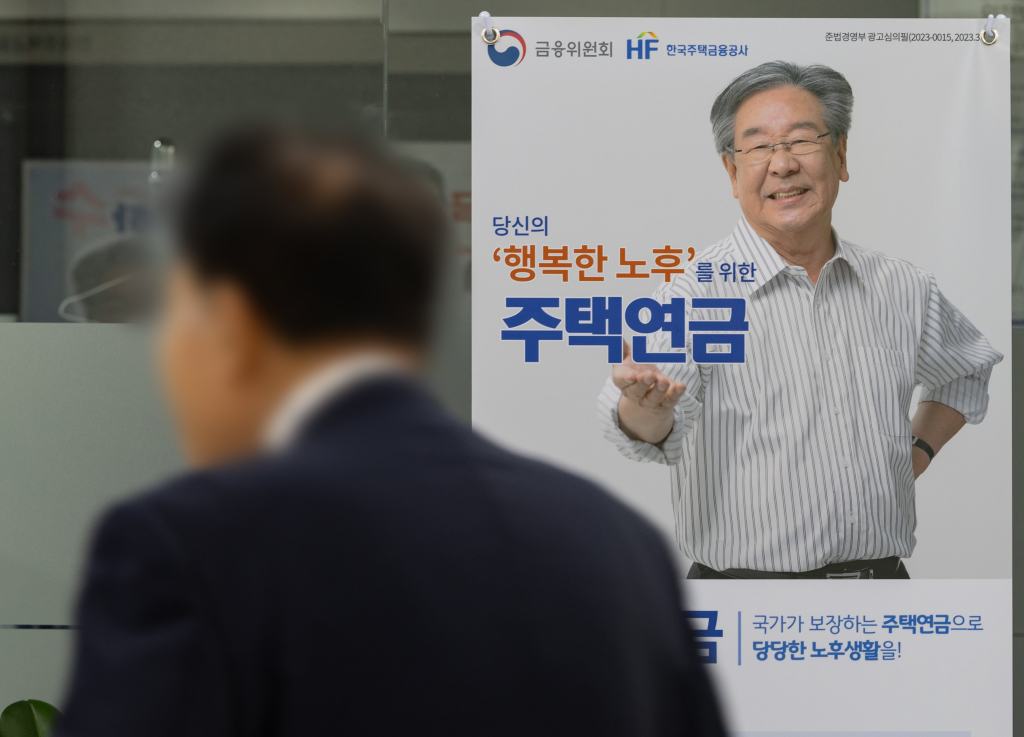
Last year, the count of new participants in Seoul’s housing pension scheme reached its lowest level in five years. This is due to a strong mental inclination to keep homes instead of leveraging them for pensions as house prices have sharply increased. Experts point out that the trend, where Seoul’s housing pension enrollments dropped during the Moon Jae-in era when property values climbed, is occurring once again.
As reported by the Korea Housing Finance Corporation on the 10th, the number of new housing pension registrations in Seoul last year reached 2,830, representing a significant drop of 20.5% compared to the previous year’s 3,561. This is the lowest number recorded in five years, surpassing the 2,641 registered in 2020. Meanwhile, the number of new enrollments in Gyeonggi Province last year also declined to 4,499, a reduction of 8.4% from the 4,914 recorded the prior year.
A housing pension is a financial product in which homeowners offer their homes, worth up to 1.2 billion South Korean won, as security to obtain regular monthly pensions, backed by the Housing Finance Corporation. The size of the pension and its length depend on the home’s value. Should the homeowner pass away before the pension period concludes, their heirs will only receive the leftover equity in the property after all pension payments have been made. The government strongly promotes the housing pension as it assists retirees in closing income gaps through the use of real estate assets.
Housing pension enrollments are significantly affected by changes in property values. As per the Korea Real Estate Board, the apartment price index in Seoul increased by 1.44% in June of last year compared to the same period in the previous year. This marked the highest rise in more than seven years, surpassing the 1.84% recorded in September 2018. A representative from the banking sector noted, “Housing pensions are typically chosen by individuals who value a secure retirement over maximizing profits from their homes,” and mentioned, “The attractiveness of housing pensions naturally decreases when property prices are on the rise.”
In 2018, under the Moon Jae-in government, when property prices increased significantly, new registrations for Seoul’s housing pension amounted to only 2,538. The previous two years, 2016 and 2017, had 2,903 and 2,899 enrollments respectively. Registrations in Gyeonggi Province also dropped from 3,412 in 2017 to 3,184 in 2018.
On the other hand, areas outside the capital experienced a rise in housing pension enrollments. Among the 17 provinces and cities across the country last year, Gyeongnam saw the biggest increase, going from 667 enrollments in 2023 to 757 in 2024, which is an increase of 90. Gyeongbuk had the highest growth rate, increasing by 17.1% from 292 to 342 enrollments. When split into the capital area and other regions, the capital area represented 58.8% of total enrollments, while non-capital areas accounted for 41.2%. This marked the first time that the capital area’s share dropped below 60%.
With the rise in enrollments outside the capital region, the properties being transformed into pensions were mainly affordable. The average cost of homes converted into pensions last year was 453 million South Korean won, a drop of 25 million from the prior year. In 2021 and 2022, the average price surpassed 500 million South Korean won. Moreover, 10,395 homes, which accounted for 74.6% of all cases, had prices under 600 million South Korean won last year.
Experts recommend that greatly increasing incentives is essential to rejuvenate the housing pension system. Professor Seo Jin-hyeong from Kwangwoon University noted, “Raising the maximum home value eligible for housing pensions and increasing the payment rate compared to the property’s value might prevent individuals from keeping real estate solely as an investment.”




 jasdooit
Leave a comment