
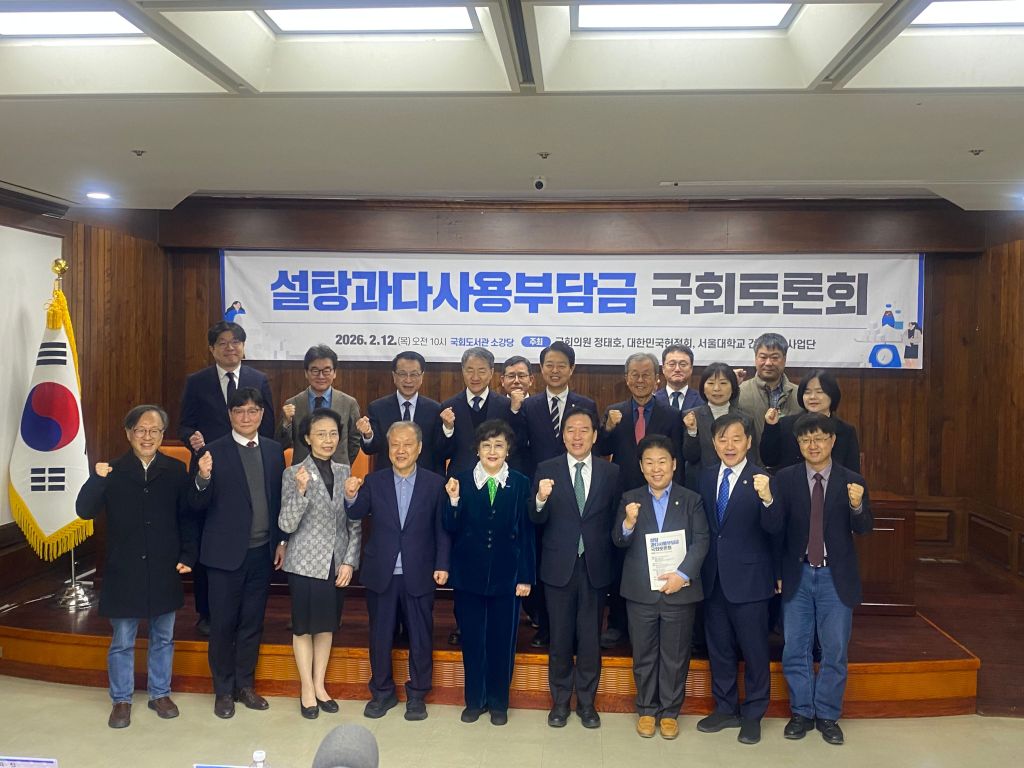
A discussion named “National Assembly Debate on the Sugar Overuse Tax” took place on the 12th at the National Assembly Library in Yeouido, Seoul, hosted by the Health Culture Business Unit of Seoul National University and Representative Jeong Tae-ho from the Democratic Party of Korea. This was the second such meeting after one that occurred in September last year. Last month, President Lee Jae Myung suggested allocating money obtained via the sugar tax to enhance public health services.
Professor Yun Young-ho from the College of Medicine at Seoul National University stated, “The sugar tax should be directed towards public benefits, such as enhancing the right to health and reducing health disparities, in accordance with its purpose as a tax. It should also be applied during national emergencies, such as regional healthcare challenges or when people face heavy medical costs.”
He stated, “A clear plan for how funds will be used is essential. Although existing legislative suggestions provide information on collecting the fee and its planned applications, factors affecting businesses and consumers should also influence how these funds are structured and included in the law.”
Disputes regarding varying perspectives influenced by income levels and political beliefs were also highlighted. Professor Yun stated, “There was discussion about whether views on the tax vary according to income or political orientation, but survey findings indicated no substantial variation in support or opposition. More than 70% of conservatives also back the sugar tax.”
Debates over terminology persisted. Professor Lee Jin-soo from the Graduate School of Public Administration at Seoul National University remarked, “The use of the term ‘sugar tax’ does not automatically imply it is a tax governed by national or local tax regulations. The main concern is ‘overuse,’ and legally, it should be categorized as a charge. The phrase ‘Sugar Overuse Charge’ is seen as suitable.”
Lee Sang-wook, leader of the Korea Food Industry Association, stated, “Although the intention behind the sugar tax is evident, the general public might view it as a tax. As it is expected to be regarded as a fiscal policy that directly impacts people’s lives—not merely an administrative charge—there needs to be societal agreement and examination before it can be put into effect.”
Worries regarding potential price hikes caused by the tax were also mentioned. Jeong Ji-yeon, secretary-general of the Korean Consumer Federation, stated, “From the consumer’s point of view, a more important issue than where the money is spent is whether the cost will be transferred to them. It needs to be made clear that the sugar tax is not intended to increase tax revenue, and ongoing observation of price fluctuations after its introduction is essential.”
Representative Jeong Tae-ho said, “As per the WHO, one out of five adults and one out of three teenagers in South Korea exceed the recommended sugar intake, which has led to the nation being referred to as the ‘Republic of Sugar.’ In this situation, not addressing the sugar tax would imply the government is shirking its duties.”
A recent poll, carried out by Hankook Research and funded by the Health Culture Business Unit at Seoul National University, revealed that 80.1% of 1,030 participants favored implementing a ‘sugar overuse tax’ on businesses that use large amounts of added sugars.
On the 28th of the previous month, President Lee Jae Myung referenced these survey findings on his X (formerly Twitter), posing the question, “What are your views on limiting sugar consumption via a sugar tax and using the revenue to enhance local and public healthcare?”


 jasdooit
Leave a comment