
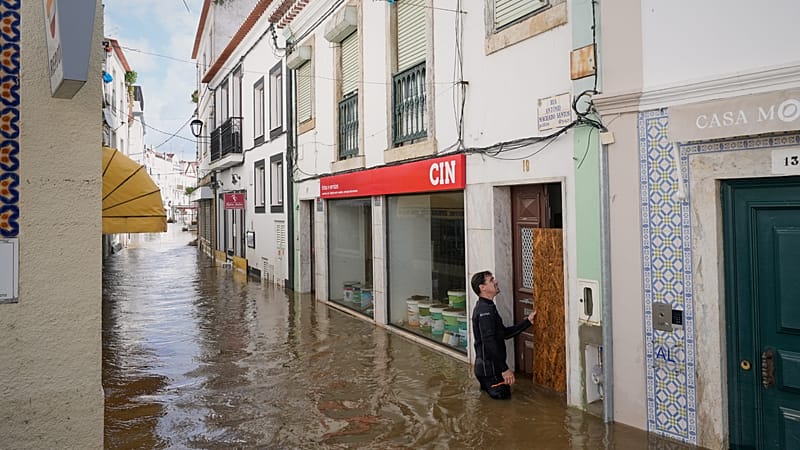
Homes demolished, trees uprooted, entire streets transformed into waterways: Portugal’s latest severe storms have resulted in massive destruction and forced thousands to leave their homes. Specialists believe some of this could have been prevented.
“Planning failed,” states Maria Rosário Partidário, a Professor of Planning, Urbanism, and Environment at the Instituto Superior Técnico of the University of Lisbon, in an interview with Euronews.
“This situation has persisted for years. It’s only in recent times that genuine worry has emerged,” she states. For numerous individuals, it’s already too late.
There is no space for water
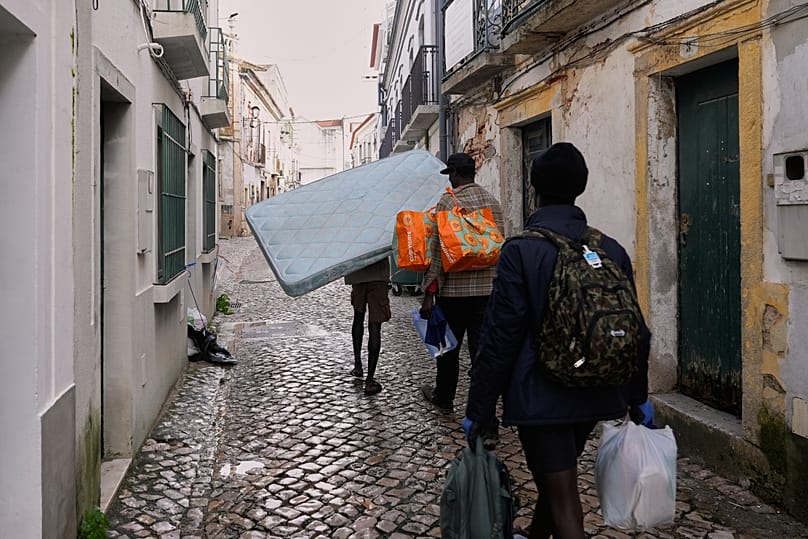
Portugal has experienced a series of named storms that have led to severe flooding, along with power outages, water shortages, and disruptions in communication. Over a dozen fatalities have been connected, either directly or indirectly, to the intense rainfall and powerful winds.
Cities must evolve,” states Partidário, who also works as a consultant in Strategic Environmental Assessment. The storms affected numerous areas and revealed flaws in land-use planning. “There is a total lack of consideration for the land’s ability to absorb water,” she explains. In short: “There is nowhere for the water to go.
“It’s similar to opening a faucet: it’s the contrast between water flowing into a sieve or into a cup. In the sieve, it leaks through; in the cup, it reaches a stage where it fills and spills over,” she says to Euronews.
Although Partidário recognizes that the storms were a natural occurrence, she argues that certain preventive actions could have been implemented to minimize the harm they resulted in.
“Building many parking lots, roundabouts, and shopping centers… this collection of structures only leads to soil sealing,” she states.
Overbuilding without allowing the soil to recover, constructing in vulnerable areas, and the lack of retention basins or drainage systems are some of the errors in land and urban planning that have failed to control the water and have made the disaster worse, as stated by Partidário.
“I’ve witnessed road failures where, upon examining what occurred, it’s evident that there was no adequate evaluation of the planning,” she states.
Urban development needs to consider the impacts of climate change.
The instructor has consistently maintained that we should return to fundamentals, meaning “integrate nature into urban areas. Increasing the number of trees planted and”green spacesis of utmost importance,” she states.
In addition to enhancing air quality and providing a cooling effect, trees also aid the soil and their roots in absorbing water.
It’s not only the excessive building that poses a problem, but also the nature of the construction and the substances employed.
Unstable building practices are becoming more common across the cities,” states Partidário, who criticizes an expensive real estate market that results in construction lacking in quality and foresight, featuring rapid and weak solutions like “self-building.
She remembers, of course, that we’ve witnessed many industrial areas with zinc roofs that haven’t lasted.
The inability to properly maintain and oversee infrastructure capacity is another contributing factor. The professor provides the example of REN’s power lines, which were designed to withstand winds of up to 150 km/h, yet storm Kristin produced gusts exceeding 180 km/h, causing 774 kilometers of high-voltage lines to fail and toppling 61 pylons. “It’s possible we also overlooked the risks in the context of climate change,” she remarks.
The upkeep of aging facilities is inadequate
By the end of the day on Wednesday, February 11, a dike along the River Mondego, already at its maximum capacity, broke in Coimbra as heavy rain was falling.
Several people expressed concerns regarding the insufficient upkeep of the hydraulic system, once more highlighting a disregard for preventive measures.
Jorge Avelar Froes, an agricultural engineer who was a member of the Mondego dyke project team, statedPúblicothat the framework remains strong, yet prolonged periods of “neglect and lack of attention” could have resulted in harm.
The levee network was established to stop the Mondego River from overflowing into the farmlands along its banks, a problem that occurred often in the past. In 2019, a levee failure took place in Montemor-o-Velho, which resulted in necessary repairs, and then another failure occurred in 2020.
A structural evaluation is now required for Avelar Froes to confirm that the system, constructed from the late 1970s to the mid-1980s, remains suitable for its intended use.
A lack of monitoring
In 2007, Portugal implemented a directive from the European Parliament that led to the introduction of the Strategic Environmental Assessment (SEA), a tool designed to evaluate the potential environmental impacts of any public plan or program, such as urban and rural planning or land use.
Supporter, an SEA consultant specializing in planning and land use in municipalities including Cascais, Montijo, Alcochete, Palmela, and Lourinhã, mentions that numerous studies have been conducted in this region. “Ten or 15 years ago, there were several initiatives. Plans and actions were implemented in cities to adapt them to heat waves or heavy rainfall.”
The issue, she explains, is that numerous projects “fail to move beyond the initial concept” or, if they do, “there is no follow-up” on what has been accomplished.
Climate risks are taken into account during urban planning, but Partidário argues that “they remain secondary” for many local governments, which occasionally attempt to bypass or violate regulations. “Take a look at the large-scale construction happening above the water level,” she points out.
The General Drainage Plan of Lisbon, initiated in 2016, serves as an example of an initiative designed to address climate change, specifically the intense rainfall experienced in recent years that has led to flooding in the city. However, “it’s not a preventive action, as it was implemented following numerous floods in Lisbon,” according to the expert.
The initiative, worth €250 million, involves multiple retention basins and two tunnels that will link Monsanto with Santa Apolónia and Chelas with Beato. These significant structures will gather water from two elevated areas in the city.
The significant need for financial support for this kind of project is one of the reasons why they are not being carried out more frequently, according to Partidário. “A retention basin is costly and the effects of these actions are not immediate; we will only notice them after many years,” she clarifies.
But I hope that someday someone will calculate the damage, the losses of recent years, and what needs to be rebuilt, in comparison to the funds that would be spent on these preventive actions.
The retention basin in Setúbal: A tale of successful disaster preparedness
Created in 2018, the Várzea Urban Park Retention Basin faced its first real challenge this year and served as a model for protecting the city of Setúbal.
“The measures taken to clear clogged drains were significant, but due to the storms we have experienced and the heavy rainfall, it was primarily the Várzea water storage area that safeguarded the city center and avoided flooding,” said Paulo Maia, the official in charge of Municipal Civil Protection at Setúbal City Council, in a statement released by the municipality.
The initiative was created in a region that once housed leisure farms, which are now no longer in use, where storage ponds, comparable to lakes, were constructed to minimize the effects of flooding.
For Partidário, this is one of the approaches that cities require. “It’s an organic solution at street level,” she mentions.
Through different European Union financial initiatives, including the Operational Programme for Sustainability and Efficient Resource Use (POSEUR), PORTUGAL 2020, and the European Regional Development Fund (ERDF), two geodesic boreholes were established to ensure the water supply for the whole park, along with approximately 1,290 trees being planted to assist in preventing soil erosion.
The walkways were constructed using permeable concrete, a type that enables rapid water absorption and air movement.
A week prior, following the intense rainfall from Storm Leonardo, the basin had only filled 20 percent of its capacity. “The Ribeira do Livramento retention basin, along with other similar smaller structures, which together provide a total capacity of approximately 300,000 cubic meters of water, continues to perform the task of preventing flooding in the city,” states a statement from Setúbal City Council.
The Várzea Urban Park demonstrates that implementing environmental strategies can help safeguard cities and their residents against severe weather conditions.
Partidário highlights that the participation of communities is crucial, enabling them to comprehend, make decisions, and feel empowered regarding their own land.
In the future, it will be crucial to reevaluate urban design, placing ecological conservation and citizens’ health at the core of every choice.



 jasdooit
Leave a comment