
A fundamental principle within the EU’s guidelines for welcoming new members, which officials frequently emphasize, is that membership is “based on merit,” indicating that no prospective country can become a member until it fully complies with EU laws and democratic principles.
But Ukraine could be an exception.
President Volodymyr Zelenskyy is pushing for a set timeline for Kyiv’s entry into the EU during US-mediated peace negotiations with Russia – prompting significant efforts within the EU administration to reconsider its long-standing expansion strategy.
In a WhatsApp conversation with journalists on Wednesday, Zelenskyy stated that Ukraine will “do everything to be technically prepared for EU membership by 2027,” and mentioned that he is “confident” that without a specific date being part of a peace agreement, Russia will “do everything to prevent” Ukraine’s entry into the EU.
EU leaders admit that the deadline is unachievable according to the existing regulations. German Chancellor Friedrich Merz has called it “not feasible.”
Some diplomats argue that setting a deadline is not practical. However, they also acknowledge that refusing a date included in a potential US-mediated trade agreement is politically difficult.
In an effort to achieve the impossible, the EU administration is currently developing suggestions to reform the expansion procedure and enable Ukraine’s rapid joining, according to EU officials and diplomats who have direct awareness of the issue, as reported to Euronews.
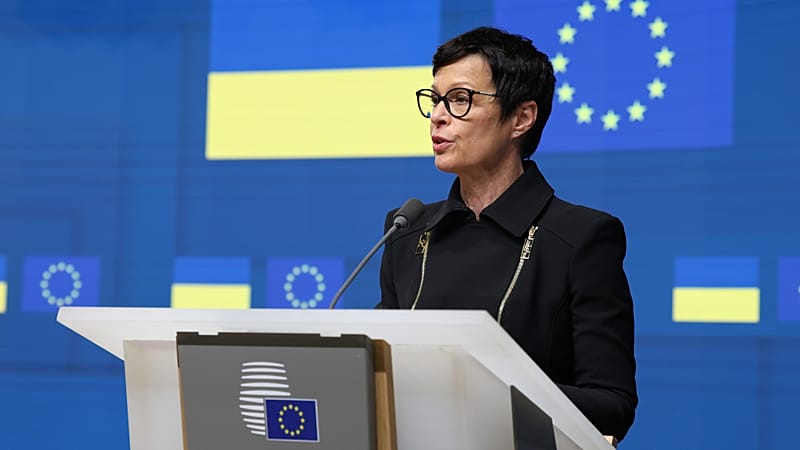
Marta Kos, the EU’s enlargement commissioner, highlighted the urgent issue confronting her team during a statement from Tallinn on Friday morning.
“We are experiencing a rising conflict between the time required to implement a genuine, merit-driven approach and the increasing pressure from external entities on our candidates—pressure designed to elevate the political cost of progressing along their EU journey,” Kos stated, noting that the existing enlargement model is “becoming increasingly unsuitable” for the current geopolitical landscape.
In a nutshell, our expansion model demands time, stability, and progressive changes. However, the current geopolitical situation is unstable and frequently forceful,” she mentioned, later warning that the new “models” being examined must always start from the same “foundation”: that “full membership is granted only following complete reforms.
Accession ‘in reverse’
Among the proposals being considered, officials mention, is changing the whole process by granting Ukraine immediate EU membership or associate status, but withholding full access to the EU budget or single market until it implements the required economic, legal, and social changes.
An EU representative involved in the talks mentioned that, according to this proposal, up to seven additional candidate nations might attain membership alongside Ukraine — recognizing that this action could significantly alter the EU’s operations.
Countries seeking membership are at various points along the way to meeting EU standards, withMontenegroand Albania is seen as the most advanced. The plan might lead to a multi-tier European Union that is vastly different from the existing system.
It is still uncertain what legal solutions the EU administration might consider to facilitate the swift integration. For a nation to be recognized as an EU member, a specific accession agreement containing detailed terms of membership must be approved by all 27 EU national parliaments.
Securing support from all 27 member states is a complex political challenge, especially due to Hungary’s long-standing resistance to Ukraine joining the union. Every stage of the accession process currently needs the agreement of every country, which means Budapest is currently preventing Ukraine’s advancement on its own.
Prime Minister Viktor Orbán, who haspreviously citedcorruption and the rights of the Hungarian minority in Ukraine were cited by him on Thursday as reasons for his opposition, stating that Ukraine’s entry in 2027 is “not up for discussion,” emphasizing that Hungary will not “finance, supply weapons to, or give legitimacy to a threat against its own security.”
The discussion is taking place alongside a larger reassessment of how the EU functions, with leaders agreeing on Thursday during economic talks that the union might have to give up its long-standing practice of acting as a single entity of 27 members to form smaller groups of nations committed to more significant changes.
It’s what Belgian Prime Minister Bart de Wever recently called the “European Onion” – a group made up of a central core and multiple outer layers, where countries that support deeper integration gain the most from being part of it.
Speeding up changes, confronting ‘Trojan horses’
Authorities are also holding fast to the idea that complete membership can only be achieved when applicants are completely in line with the EU’s democratic principles and economic criteria.
A successful democracy, a free court system, and anti-corruption efforts are frequently mentioned as essential requirements for candidates seeking to gain access to EU membership.
The Committee has prepared a10-point planTo speed up Kyiv’s reforms, even though the process is officially on hold due to Hungary’s veto in the discussions. This implies that Ukraine is unofficially moving forward with the reforms it is supposed to carry out with assistance from the Commission, enabling technical talks to continue despite Budapest’s strong resistance.
The procedure is known as “frontloading,” with the expectation that once Budapest removes its objection, Ukraine will have already met numerous targets, allowing its integration to be completed quickly.
The strategy focuses on the battle against corruption, which has become a top concern following the Ukrainian administration’s submission, and subsequently withdrawal, of a new bill that threatened the autonomy of two anti-corruption bodies, NABU and SAPO, during the summer, leading to a reactionsharp rebuke from the EU executive.
The idea of revising the EU’s expansion policies to include Ukraine also presents an opportunity for the union to establish fresh guidelines to prevent new countries from straying from EU principles and regulations after they join.
“I request that future Accession Treaties include more robust protections against regressing on promises made during the accession talks,” said EU enlargement official Marta Kos on Friday, noting that Montenegro’s treaty should be the first to incorporate these new safeguards.
Experts claim that although Croatia’s 2013 accession agreement contained some protective clauses to support its economic shift, future agreements should incorporate clear actions to avoid issues related to the rule of law and governance.
If new members abide by the rules, they won’t even realize those protections are there,” Kos remarked, calling it an “insurance policy.
The European Union currently has the ability to suspend specific rights of member states, such as voting privileges, in reaction to a decline in the rule of law and democratic principles. However, the procedure, initiated under Article 7 of the EU Treaty, is time-consuming and seen as politically delicate.

 jasdooit
Leave a comment