
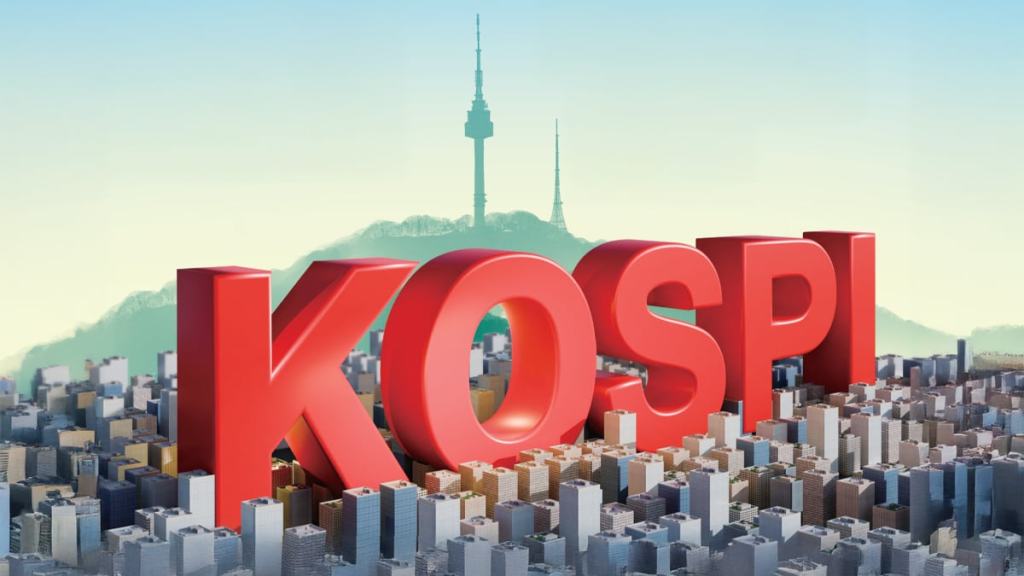
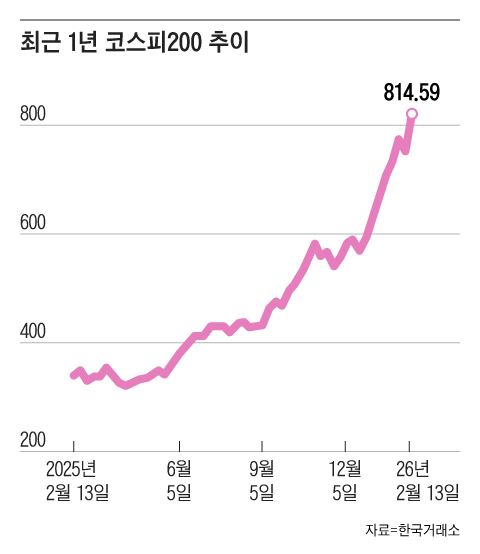
Last year, it increased by 95%, achieving record returns, and so far this year, it has risen by 34%. As this isn’t a single stock but a benchmark index, doesn’t this make it the ‘money-printing ETF’?
It is genuinely rare for a product not involving leverage or focused on a specific theme to experience such a significant increase. From last year up until now, there have been nearly no fund managers who surpassed the performance of the Kospi 200 index.
These kinds of statements are commonly heard from individual investors nowadays. Investors who carefully chose stocks around the clock have experienced significantly lower profits than those who merely purchased an index and remained patient.

The focus of investors has shifted to the Kospi 200, South Korea’s leading stock index. Major international media sources, such as Bloomberg and Nikkei, have also recently pointed out the Kospi 200’s impressive returns and the robust performance of the South Korean stock market.
The Kospi 200 is an index formed by meticulously choosing 200 top-tier stocks that reflect the securities market, such as Samsung Electronics and SK Hynix. It is considered the ‘all-star’ group of the South Korean stock market, consisting solely of the leading companies that hold significant market share and trading volume among the roughly 840 firms listed on the Kospi.
Specifically, the upward trend of the Kospi 200 has been supported by foreign investments flowing into big-cap stocks, fueled by hopes for a rebound in the semiconductor sector. As per Bloomberg, the two leading semiconductor companies contributed to 52% of the Kospi’s gains over the last year. Some retail investors have expressed, “I had difficulty selecting stocks, but I should have simply invested in the index.”
✅ Concentrate on Kospi 200 ETFs, even if owned by the president
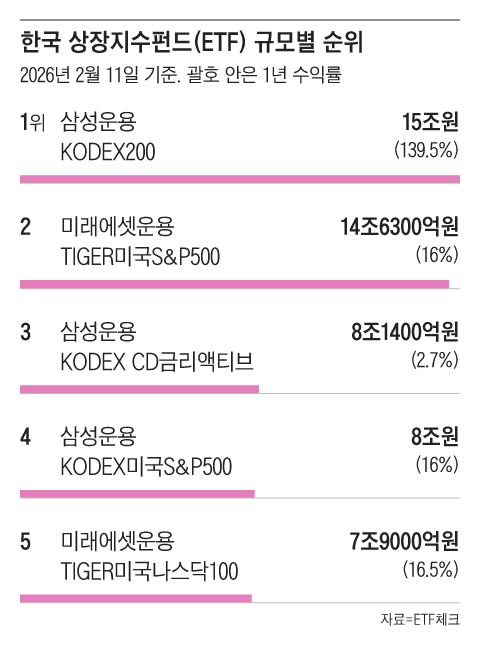
ETFs linked to the Kospi 200 are available from most local asset management firms. Their names contain the number ‘200.’ Specifically, Samsung Asset Management’s KODEX200 ETF and Mirae Asset Global Investments’ TIGER200 ETF, which follow the Kospi 200, are known as ‘president ETFs’ and are experiencing a significant increase in subscriptions.
During his presidential campaign last May, President Lee Jae Myung introduced a strategy to boost the domestic stock market and aim for a Kospi index of 5,000. He stated that he would make a one-time investment of 20 million Korean won in Samsung Asset Management’s KODEX200 ETF, and an additional 1 million Korean won per month for five years, amounting to 60 million Korean won in total, through a savings plan in Mirae Asset Global Investments’ TIGER200 ETF. At that time, President Lee mentioned on a television program, “By the time I leave office, the returns are expected to be quite significant.”
In fact, the KODEX200 ETF, in which President Lee Jae Myung made a one-time investment of 20 million South Korean won, is projected to have increased by more than 132% since the purchase, resulting in an estimated capital gain exceeding 26 million South Korean won (not including dividends). The earnings have exceeded the initial investment.
When President Lee Jae Myung revealed his investment in the KODEX200 ETF last year, the fund’s net assets stood at approximately 6 trillion South Korean won. Despite being the first ETF introduced in South Korea in 2002, its size was relatively modest for its age. This was likely due to the domestic stock market’s extended period of stagnation, which led to it being referred to as a ‘box range.’
Nevertheless, an unexpected shift occurred. The KODEX200 ETF’s assets have grown to 16 trillion South Korean won, positioning it as the biggest publicly traded ETF in the country. Its primary investments consist of Samsung Electronics (30.5%), SK Hynix (18.2%), Hyundai Motor (2.5%), KB Financial (2.0%), and SK Square (1.9%). Although it offers ease of trading because of its strong liquidity, its real expense ratio of 0.19% is somewhat higher than that of its rivals.
✅ Low-cost exchange-traded funds offer greater benefits for long-term investing
ETFs that track the Kospi 200 are managed automatically to mirror the index. As a result, the holdings and performance of different products are comparable. However, the actual expenses faced by investors vary between 0.19% and 0.04%. For an investment of 100 million Korean won, annual fees could differ by about 150,000 Korean won, falling between 40,000 and 190,000 Korean won.
Typically, products introduced by newer asset management firms usually come with reduced fees. Hana Asset Management’s 1Q 200 Active ETF has recently lowered the expenses that investors face to 0.04%, making it the cheapest among locally listed Kospi 200-based ETFs.
As per Hana Asset Management, if an investment of 100 million Korean won in an ETF that follows the Kospi 200 index yields an annual return of 20%, a cost difference of 0.15 percentage points could result in an asset disparity of as much as 1.2 billion Korean won after 30 years. This occurs because cost variations are amplified by compounding over extended periods.
Keep in mind that ETFs tracking the Kospi 200 that include ‘TR (Total Return)’ automatically reinvest dividends. As a result, dividends (ranging from 1 to 1.5%) are reinvested instead of being paid out, leading to slightly better long-term performance compared to standard Kospi 200 ETFs. At present, nine asset management firms provide these types of products, with Samsung Asset Management’s KODEX200TR ETF (approximately 5.472 trillion Korean won in assets) being the biggest. It has achieved a one-year return of roughly 145%.
✅Kospi 200 surge… the celebration is far from ending
Investing in the Kospi 200 is a common approach to bypass the challenge of picking individual stocks and benefit from the expansion of the South Korean economy. Nevertheless, some people question, “Hasn’t it already gone up too much?” Will the market keep supporting index investors?
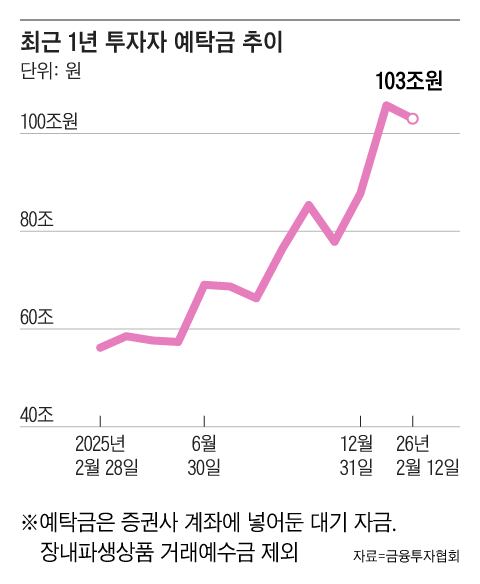
Park Jin-hwan, the head of V Asset Management, stated, “The South Korean stock market is now in a period of structural growth driven by the semiconductor industry. There are predictions within the investment sector that the total operating profit of Samsung Electronics and SK Hynix may reach around 200 trillion Korean won this year.” He further noted, “It is evident that the earning potential of the local stock market is greater than it has ever been.”
Kang Dae-kwon, the chief executive of Life Asset Management, said, “Last year, a mechanical investment approach focused on major indices such as the Kospi 200 proved successful. However, from this year onward, differences among asset categories, countries, sectors, and individual stocks are expected to grow, highlighting the importance of stock-picking skills.” Kang noted that he is looking for chances in stocks related to governance that are currently experiencing a re-rating.
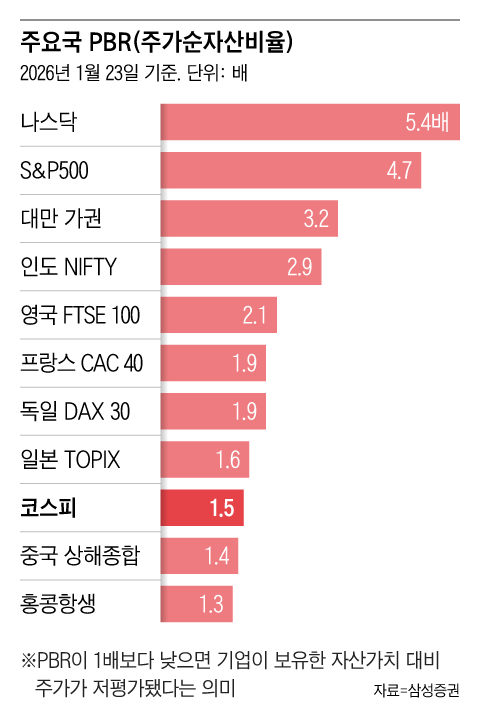
Some guidance suggests, “Don’t get off a running horse too soon.” Until the first half of the year, it’s important to keep an eye on the trend. However, when signs of a ‘peak-out’—when company earnings hit their highest point—start to appear, specialists indicate that investment approaches should be reconsidered.
Kim Joon-young, a researcher from iM Securities, stated in a recent report titled “Do Buy Kospi,” “During the semiconductor boom between 2016 and 2017, forecasts for Kospi earnings were quickly increased, yet the market moved into a flat period as growth decreased. Should indications of declining investor confidence in earnings projections emerge in the second half of the year, it may indicate a change in the market’s trend.”




 jasdooit
Leave a comment