
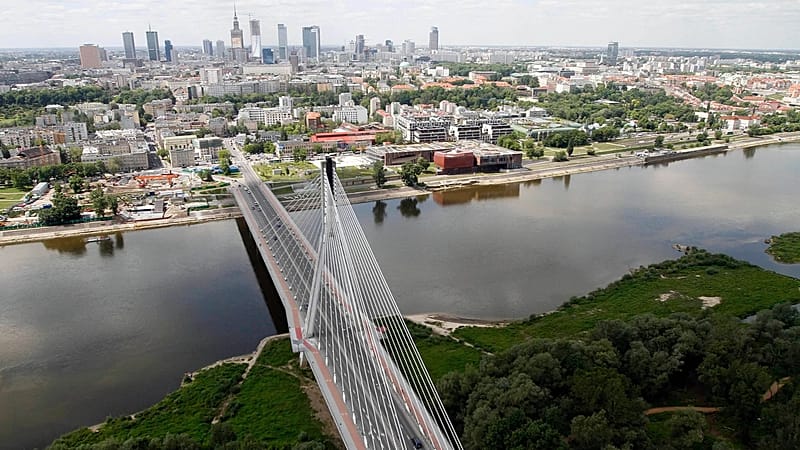
The outcome involves reputation, hundreds of jobs, and control over how the European Union safeguards its economic boundaries for many years ahead. The new position is anticipated to start functioning this year and will be fully operational within two years.
Who will Warsaw face?
The list of potential candidates is extensive. Alongside Warsaw, the following cities are also in consideration: Liège (Belgium), Malaga (Spain), Lille (France), Zagreb (Croatia), Rome (Italy), The Hague (Netherlands), Porto (Portugal, and Bucharest (Romania).
Every city has its own strategy. The Hague is pushing for stronger connections with Europol. Belgium and France are focusing on logistics.
Poland is presenting geopolitical and operational reasons: Warsaw already hosts the EU border agency Frontex, and the Polish government claims that in the era of hybrid warfare, security and cooperation among these organizations are essential.
The case is straightforward: as customs officers and guards are confronting similar dangers, they ought to collaborate closely.
What makes it worthwhile?
“From one perspective, having the EUCA headquarters provides greater chances to be actively involved in the reform of the customs union. From another angle, it presents an economic development opportunity for the host city,” said Małgorzata Krok, the Plenipotentiary of the Minister of Finance and Economy for the bid to establish the EU Customs Authority (EUCA) headquarters, in an interview with Euronews.
“The establishment of the new agency is anticipated to bring more commercial and tourist activity, along with the arrival of EUCA staff accompanied by their families. The EUCA is projected to eventually hire 250 individuals, although this figure could rise in the coming years,” she stated.
Warsaw provides direct flights to every EU country, along with destinations in candidate and partner nations. The collaboration with Frontex, being close to various border points, and the expertise of our administration in customs issues, as well as the development of extensive tax and customs IT systems, offer ideal conditions for the growth of the EUCA,” Krok mentioned.
Polish diplomats, in private discussions, highlight the vulnerabilities of their competitors, pointing out that serving as a logistical center for online shopping, similar to Belgium or the Netherlands, can become a challenge in an age dominated by inexpensive packages from Asia.
Poland’s main competitor, nevertheless, is considered to be France, which has been seeking the agency’s favor for a considerable period.

Not just taxes, but also safety and innovation
The function of the tax collector has transformed into that of a protector of the single market, the economy’s competitiveness, and the safety of citizens. It is not only about smuggling or terrorism, but also about product compliance,” said Magdalena Rzeczkowska, former Minister of Finance, in an interview with Euronews. Rzeczkowska previously led the National Tax Administration and witnessed the development of customs from paper forms to the digital era.
The ex-minister highlights our asset, specifically the Frontex position. The discussion on institutional synergy is seen as vital, particularly regarding the security of the eastern border: “We are referring to integrated border management, and this synergy is a key component. It is at the intersection of these institutions’ work where security can truly be established.”
Additionally, the former minister highlights that EUCA will also serve as a technological center. “It should certainly not consist of officials in suits, because the primary responsibility will be not only to establish but also to manage the EU Customs Data Hub,” she emphasizes.
Rzeczkowska is supported by Minister Krok: “The core of the current customs reform will specifically be the data hub. The agency, meanwhile, will serve as the brain, analyzing customs matters and risks at the EU level. Through this, the agency has the potential to evolve into a research and development center in the customs field.”
What is the Customs Data Repository?
The battle over localization is just one aspect of the issue. The true difficulty lies in what the EUCA is expected to handle: the EU Customs Data Hub.
Scholars refer to this system as the ‘nervous system’ of the new customs union. Rather than having 27 distinct national systems, the Union aims to establish a single, integrated database. This is intended to allow for real-time monitoring of goods and the identification of hazardous products through the use of artificial intelligence.
The transformation is being fueled by the crisis. As per European Commission projections, 5.6 billion packages, mostly originating from China, were anticipated to enter the Union in 2025. The existing framework is ineffective, and customs officers are unable to physically inspect such a large volume. The outcome? Europeans lose billions of euros in unpaid tariffs and taxes. This is the system that the new authority seeks to address.
Nevertheless, businesses caution: without collaboration with the private sector (such as courier firms and e-commerce sites), the development of the ‘Data Hub’ might hinder trade. The logistics sector has indicated that the timelines for enacting these changes are extremely tight, and the technical requirements are still not well-defined.
The industry further states that, without involving professionals, the ambitious digital transformation might result in obstacles that will affect European customers. Meanwhile, the Polish proposal specifically argues that only a ‘digital stronghold’ with expertise in managing crises will be able to handle the responsibility.
This is why Warsaw, in its effort to secure the EUCA, is not only aiming to accommodate officials, but also to become the main operational hub that will handle the most significant customs reform in the history of the European Union.
EUCA. The behind-the-scenes of the competition
And how is the situation behind the scenes right now? Here, Minister Rzeczkowska has no mistaken beliefs regarding the selection of the seat: “In the end, it will be a political decision, although it shouldn’t quite be. We should consider it from the perspective of the institution’s independence.”
“We deliberately chose to run for this position because we feel it will thrive most in Warsaw. We are currently working hard to convince the decision-makers to support this choice,” says Krok, noting that the final decision will be taken by the EU Council and the European Parliament.
The ultimate decision is expected in March 2026. It will then be evident if Brussels chooses to rely on established trade routes in the west or a digital defense on the eastern side – and whether the focus is ultimately moving towards the east in Europe’s emerging structure.


 jasdooit
Leave a comment