
Four decades following the Chernobylnuclear powerindustrial catastrophe, the offspring of the employees continue to face the consequences.
Up until this point, researchers have remained uncertain about whether the offspring of individuals exposed to radiation would inherit their parents’ genetic harm.
However, scientists from the University of Bonn have recently discovered that children of workers involved in the power plant’s cleanup process exhibit a higher count of genetic mutations in their DNA.
Rather than searching for entirely new DNA mutations, the scientists focused on a phenomenon known as ‘clustered de novo mutations’ (cDNMs).
These are instances where two or more mutations, absent in the parent’s DNA, are grouped together, indicating that the DNA strand has been fractured and improperly repaired.
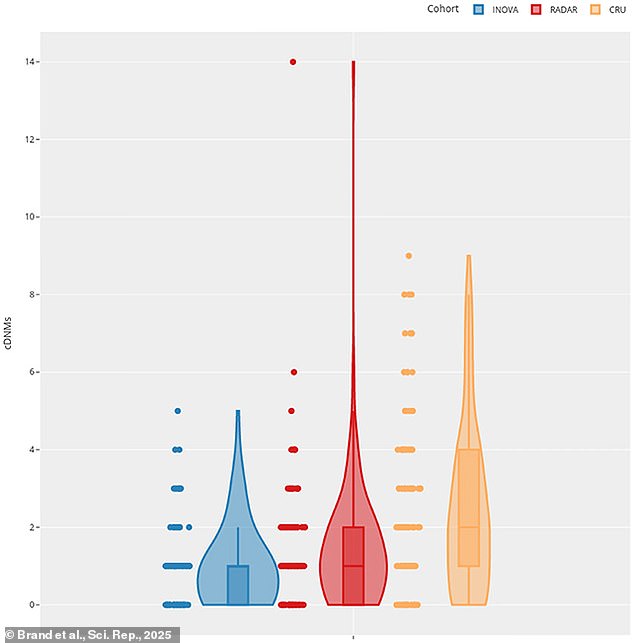
The scientists analyzed the DNA of 130 children ofChernobylemployees, 110 children of German military radar operators who were exposed to unintended radiation, and 1,275 ordinary individuals.
On average, kids whose parents participated in cleaning up Chernobyl had 2.65 cDNMs, whereas children of radar operators had 1.48.
As a point of comparison, children whose parents had not been exposed showed 0.88 cDNMs per individual.

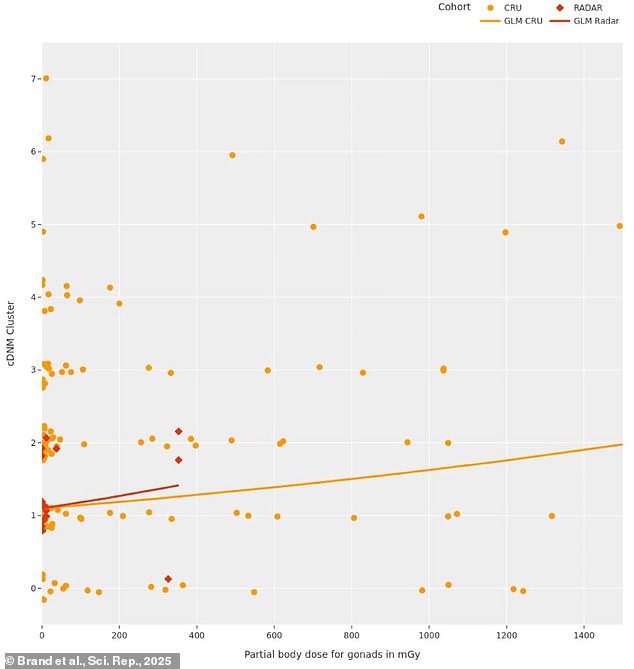
Notably, the research also found a clear link between the level of radiation exposure experienced by parents and the quantity of mutations present in their offspring.
The scientists warn that these numbers might be somewhat higher than accurate because of random variation and a limited number of participants, yet the difference remained meaningful once these elements were considered.
In their research article, released in the journalScientific Reports, the researchers state: ‘We observed a notable rise in the cDNM count in the offspring of irradiated parents, along with a possible link between the dose estimates and the number of cDNMs in the corresponding offspring.’
The current research is the initial one to offer proof of a transgenerational impact of extended paternal exposure to low-dose [ionising radiation] IR on the human genome.
The parents were either residents of the town of Pripyat when the incident occurred or had worked as liquidators responsible for securing or cleaning the accident location.
As their bodies were exposed to ionizing radiation from the nuclear reactor, scientists think that particles known as reactive oxygen species were formed.
These are highly reactive, unstable molecules containing oxygen, capable of breaking apart DNA strands.
These harmful oxygen compounds harmed the DNA within growing sperm cells, resulting in groups of genetic changes.

When these individuals eventually had children, those genetic changes were inherited and integrated into the DNA of their descendants.
Fortunately, the scientists discovered that the likelihood of illness resulting from these mutations was very minimal.
The cDNMs identified in the children were present in ‘non-coding’ regions of their DNA, in contrast to the ‘coding’ sections that play a role in generating specific proteins.
This indicates that they do not result in any adverse impacts, and the offspring of Chernobyl workers did not face a higher likelihood of illness compared to the broader population.
For reference, research has also indicated that older fathers tend to transmit a higher quantity of mutations to their offspring.
The scientists discovered that the father’s age during conception posed a greater likelihood of illness in offspring compared to radiation exposure.
This could be partially due to the fact that the parents of children involved in this research were exposed to only modest amounts of ionizing radiation.
For comparison, their estimated exposure to ionizing radiation was approximately 365 milligrays, while NASArestricts the overall lifetime exposure of astronauts to 600 milligrays.




 jasdooit
Leave a comment