
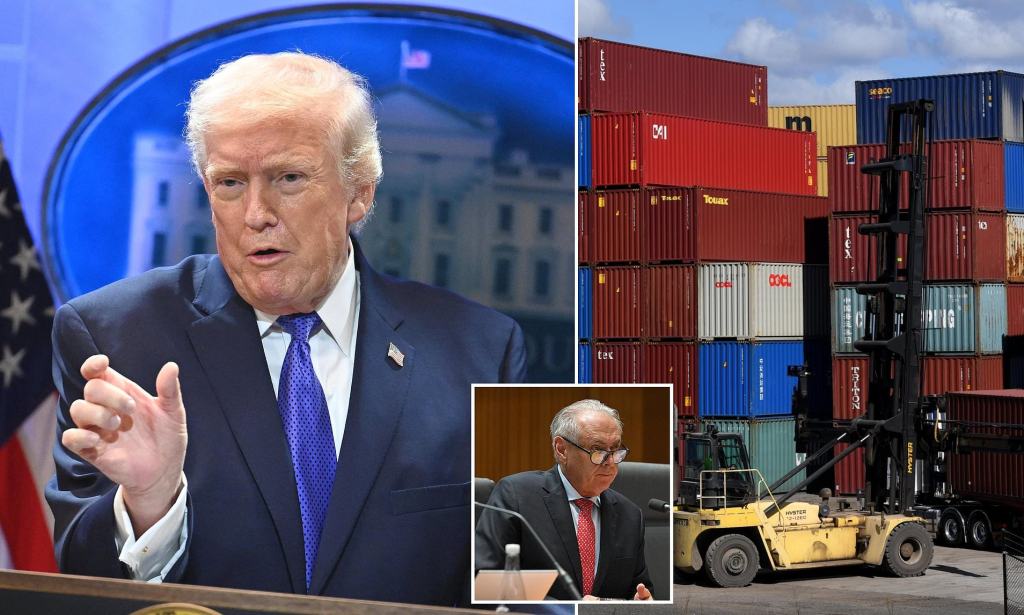
- Trump plans to introduce extensive tax barriers
- The Australian government will ‘review all possibilities’
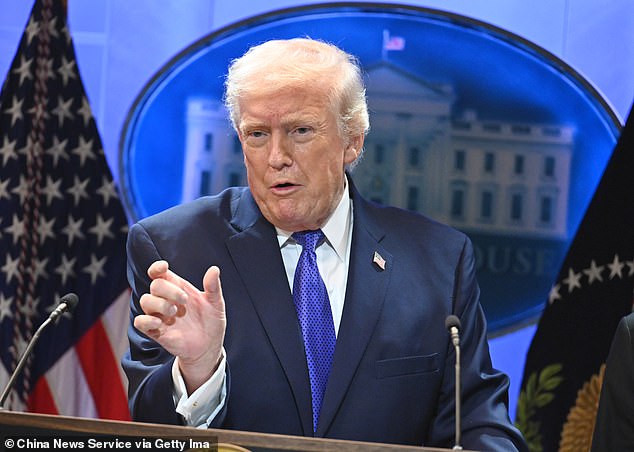
The Australian government has pledged to take appropriate action following the US PresidentDonald Trumputilized a rarely used commercial regulation to reestablish his extensive policiestariffs, scheduled to come into effect in a few days.
The US Supreme Courtdeclared Trump’s trade policies unconstitutional on Friday in a historic 6-3 decision.
He then became the first president to use Section 122 of the Trade Act of 1974, which enables Congress to allow Trump to impose tariffs as high as 15 percent for a period of up to 150 days to address ‘fundamental international payments issues’.
“It is a great privilege for me to have just finalized, from the Oval Office, a worldwide 10 percent tax on all nations, which will take effect very soon. Thank you for your focus on this issue,” Trump posted on Truth Social.
Tariffs are allowed to remain in effect for a maximum of 150 days.without congressional approval.
The White Housementioned that the temporary import tax will come into force on February 24.
Ten months have passed since the US implemented a 10 percent ‘baseline’ reciprocal tax on most imports from Australia, a decision made by the Prime Minister.Anthony Albanesereferred to at the time as ‘not the action of a friend’.
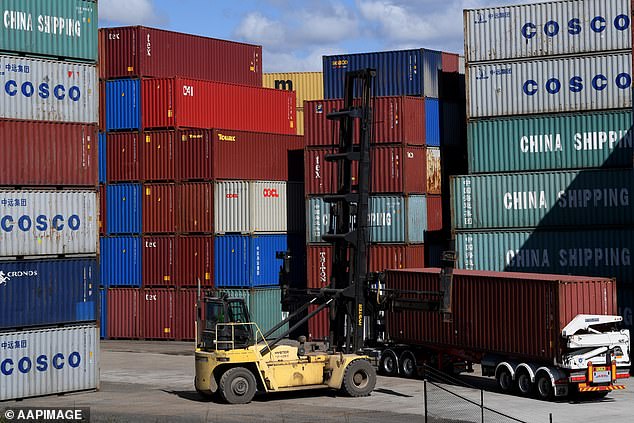
Some Australian exports are still subject to higher tariffs under other US regulations, such as steel, aluminum, vehicles, auto parts, and upholstered furniture.
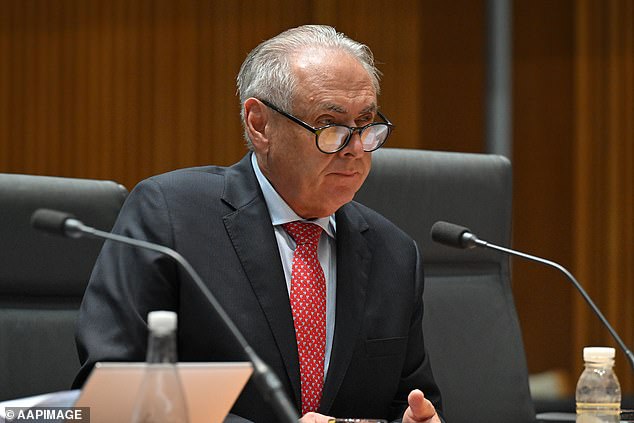
Australian Trade Minister Don Farrell pledged to keep pushing against tariffs following Trump’s recent action.
“He stated to the Daily Mail that Australia supports free and equitable trade,” he said in a statement on Saturday.
We have continuously opposed these unwarranted taxes.
We are collaborating closely with our Embassy in Washington to evaluate the consequences and review all possible courses of action.
A Monash University economist, Professor Robert Brooks, thinks that global tariffs are unlikely to significantly affect Australia beyond the current US trade policies.
However, he acknowledged that the continuous uncertainty is not favorable for global trade and the international economy.
“The 10 percent rate aligns with the base rate in several countries and those with trade agreements,” Professor Brooks stated.
Another concern is that these tariffs are only temporary (150 days) unless Congress takes action.
‘Such action by Congressis complicated in today’s political environment in the United States. The biggest effect is the continuous uncertainty regarding the direction of US trade policy.
Typically, uncertainty is not favorable for either consumer confidence or business investment.
A professor from Michigan, Justin Wolters, currently a visiting academic at the University of NSW, thinks that future trade policies will focus on product-based tariffs instead of country-specific ones.
An EY partner and head of global trade in Oceania, Luke Branson, stated that although tariffs might not affect every Australian business directly, the uncertainty will have an impact.
“That’s why I’ve been dedicating so much time to following and observing these changes—since business executives are already dealing with the weight of uncertainty, keeping informed is essential for making secure choices in a more unpredictable global economy,” he said to the Australian Financial Review.
Australian companies might receive a refund following the determination that Trump’s tariffs were unlawful.
EY Australia’s analysis indicates that Australian exporters would be entitled to over $1.4 billion in refunds combined if the tariffs were removed.
Nevertheless, the responsibility would fall to Australian exporters to request reimbursements.
“Legal experts are skeptical about the powers outlined in this specific law granting the president the ability to levy tariffs,” Mr. Branson said to the ABC.
This specific law enables the president to control imports… however, it does not clearly state that the president has the authority to levy tariffs.
He also cautioned that the Trump administration is expected to try to evade repaying exporters.
“There is much discussion among legal experts in the US that the president could implement additional actions… through other legal channels, lawful methods he has utilized before, to retroactively apply tariffs so that he isn’t required to issue refunds,” Mr. Branson stated.
 jasdooit
Leave a comment