
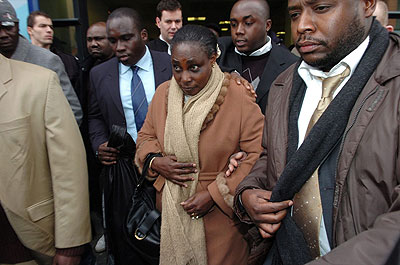
In the early hours of April 9, 1994, Paris deployed troops to Rwanda as part of Operation Amaryllis, aimed at evacuating French and other foreign nationals. According to the Muse Report, a four-year investigation initiated in 2017 by the U.S. law firm Levy Firestone Muse, which examined the involvement of the French government in the 1994 Genocide against the Tutsi, the first aircraft to evacuate French citizens from Kigali also carried, at President François Mitterrand’s instruction, Juvénal Habyarimana’s family, including his wife Agathe Kanziga-Habyarimana, who was a leader of the Akazu. Mitterrand reportedly later remarked, “She is possessed by the devil, if she could, she would continue to call out for massacres from French radios.” ALSO READ: Agathe Habyarimana: France’s useful “victim” of Genocide? The term Akazu, derived from Kinyarwanda meaning “small hut,” refers to an informal but highly influential group composed mainly of family members, close friends, and loyalists around Habyarimana and his wife. Operating like a ‘mafia,’ Akazu members wielded significant power over government, military, and administration without holding formal positions. ALSO READ: There is still hope that Akazu members will face justice In an exclusive interview on January 21, a day before returning to France to attend the appeal trial of another genocide suspect, Claude Muhayimana, Alain Gauthier, president of Collectif des Parties Civiles pour le Rwanda (CPCR), stated that Kanziga’s case is “more than symbolic.” For over two decades, Gauthier and his wife Dafroza have worked to bring genocide suspects residing in France to justice. Reflecting outcomes in several similar genocide trials, French judges dismissed Kanziga’s case last August, citing insufficient evidence. They also labeled her a ‘victim’ rather than a suspect in the 1994 genocide. I asked Gauthier what this means and how such a judicial framing affects genocide memory, especially for survivors who associate Habyarimana’s wife with mobilization and power, not victimhood. “It’s terrible!” he responded, adding: “Indeed, their conclusion, after presenting their arguments, is to say that Agathe Kanziga is a victim. And we can’t accept that. How could she, considering what she is accused of, be a victim?” What exactly is Kanziga accused of? In February 2007, CPCR filed a case against Kanziga before a senior investigating judge at the Tribunal de Grande Instance (TGI) in Évry-Courcouronnes, located in the Essonne department of Île-de-France, approximately 25 to 30 kilometers south of central Paris, who initially handled the case. Later, the investigation was transferred to judges in Paris, where it continued under magistrates specializing in genocide and crimes against humanity. ALSO READ: Habyarimana’s role in planning, implementing 1994 Genocide against the Tutsi The rights group accused Kanziga of participating in the planning, organization, and direction of the 1994 genocide against the Tutsi, particularly by taking part in the 1991 preparatory meetings for the Bagogwe massacres, considered by the rights group as one of the preludes to the 1994 killings. They also accuse her of playing a key role within Akazu, a powerful network of anti-Tutsi extremists, having allegedly financed Radio Télévision des Mille Collines (RTLM), Interahamwe militia, and the “death squads,” having conducted economic operations described as mafia-like, having promoted Hutu extremism, and having had opponents eliminated. Additional CPCR charges include: allegedly participating in the financing and subsequent control of the extremist magazine Kangura, providing substantial funds for the creation of RTLM—a tool for spreading anti-Tutsi and anti-moderate Hutu ethnic hatred—and expressing support for that media outlet; participating in decisions by the authorities of the prefectures of Kigali-Ville and Gisenyi to plan attacks against the Tutsi, and around February 11, 1994, compiling a list of influential members of the Tutsi ethnic group and moderate Hutu to be executed. ALSO READ: Kangura’s 8th Hutu commandment re-examined In the first hours following the death of her husband, on April 6, 1994, she is also accused of participating in extremist political discussions and giving her approval to acts of terror carried out in particular by the presidential guard, notably the assassination of then Prime Minister Agathe Uwilingiyamana. Kanziga is also accused of ordering the massacre of seven employees of the Sainte-Agathe orphanage—located in Masaka, on the outskirts of Kigali—and, after her evacuation to Paris on April 9, continuing to intervene in Rwanda’s internal affairs through ongoing contact with members of the interim government implicated in the genocide. ALSO READ: Will France ever bring Kanziga to book? Kigali’s request for her extradition was rejected by Paris in 2011. Ten years later, Gauthier acknowledged that when they first filed a complaint against Kanziga on February 14, 2007, “we were well aware that we were facing insurmountable difficulties.” From the beginning, they understood how politically improbable it seemed that France—which had welcomed her with a bouquet of flowers and provided security protection—would ever agree to put her on trial. Although French authorities denied her a residence permit, Kanziga continues to reside—without restrictions—in Paris, surrounded by members of her family. At the end of last month, she appeared on a podcast—raising inevitable questions about the timing. Was it an attempt to shape public perception ahead of potential judicial developments, to reframe a long-contested narrative, or simply to reassert visibility at a moment of renewed attention? Today, France is home to more than 40 indicted genocide suspects and hundreds of genocide deniers and revisionists. Why is Kanziga’s trial important? According to Gauthier, the judgment in Paris concerning Kanziga comes within the framework of “all the other complaints that we have filed,” in France. Gauthier said: “Kanziga case is more than symbolic. She is still the wife of President Habyarimana who benefited, in France, from a very favorable reception from François Mitterrand. “For us, the Kanziga case is important, and it is important for everyone, precisely because she is at the center. She is at the center of this network—the Akazu—including her family, her brothers, and other relatives.” ALSO READ: Lessons from Protais Zigiranyirazo’s enduring infamy When it comes to Kanziga’s relatives in Akazu, Gauthier was “especially thinking of Protais Zigiranyirazo,” her elder brother and Akazu power-broker who died last year in Niamey, Niger, where he was living under UN supervision, and of Séraphin Rwabukumba, his other brother, who lives in Belgium. Before and during the genocide, “Mr. Z” or “Mr. Zed”, as Zigiranyirazo was widely known, wielded influence far beyond his official titles. Gauthier added: “All of these are around, all her relatives, all her friends who were part of Akazu. It is true that if we could, and everyone hopes so, if justice could be reversed in these case dismissals, we would be immensely satisfied. But it’s far from certain.” “But we strongly hope that the judicial investigation will be reopened. But, you know, Mrs. Habyarimana isn’t young; she’s 82 or 83. And she could pass away at any moment. If that happens, the case would automatically be closed, because a person cannot be prosecuted after death.” Kanziga turned 83 on November 1, last year.
Provided by SyndiGate Media Inc.Syndigate.info).




 jasdooit
Leave a comment