
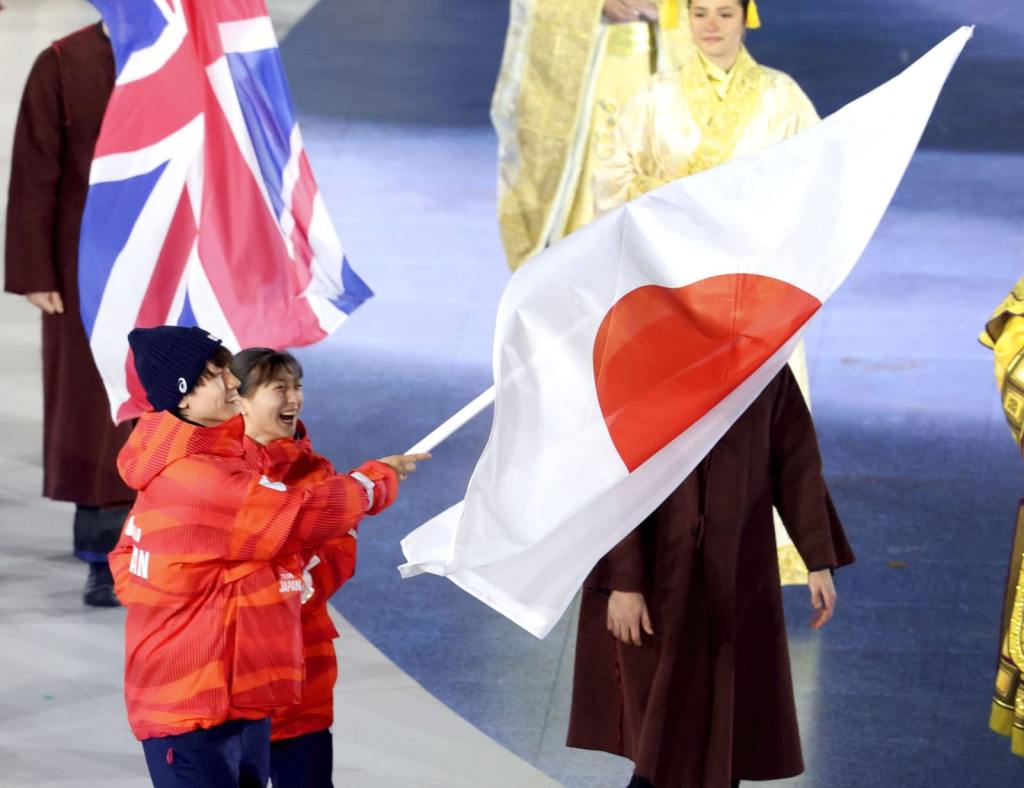
VERONA, Italy – The Milan Cortina Winter Olympics concluded on Sunday with the closing ceremony held at the historic Arena di Verona, bringing an end to the significant games that included 116 medal events, organized for the first time across four different areas in northern Italy.
Figure skater Kaori Sakamoto and speed skater Wataru Morishige carried the flags for the Japanese delegation, who raised both Japanese and Italian banners, as they had done during the opening ceremony. This came after the team secured its highest number of medals at the Winter Games, totaling 24, which included a record-equalling five golds, seven silvers, and 12 bronzes.
The fires in the two identical Olympic torches, which were lit at the same time on February 6, were extinguished together to signify the end of the games. These torches were positioned approximately 250 kilometers apart, at the Arco della Pace in Milan and the Piazza Angelo Dibona in Cortina d’Ampezzo.
You have been amazing — every single one of you. Courageous. Bold. Full of soul and enthusiasm. You gave everything on the snow and ice,” said International Olympic Committee President Kirsty Coventry. “The Olympic Games will remain a place where athletes can motivate the world through sports: freely, safely, and with pride.
The organizers mentioned that approximately 1.3 million tickets were sold, making up 88 percent of the available tickets. The newly introduced ski mountaineering event sold out quickly, while speed skating and figure skating drew significant interest.
Norway led the medal standings significantly, securing 18 gold medals and a total of 41, with its male cross-country skiing star Johannes Hoesflot Klaebo achieving an impressive six-gold haul and Jens Luraas Oftebro claiming three golds in the Nordic combined events.
The United States ranked second in both categories with 12 gold medals and a total of 33 medals, while Italy and the Netherlands each earned 10 golds. The host country surpassed its previous best of 20 medals by securing 30, as short track speed skater Arianna Fontana accumulated 14 Olympic medals throughout her career, just one shy of the Winter Games record.
It marked a significant achievement for Japan, securing five gold medals, which was the highest number the nation had ever earned at a Winter Olympics held outside of Japan, matching its prior record when it hosted the event in 1998 in Nagano. With a total of 24 medals, this surpassed the 18 it won in Beijing during the 2022 games and ranked fifth overall among countries competing at the Milan Cortina event.
Snowboarding provided the highest number of medals, including four golds and a total of nine. Kira Kimura claimed the men’s big air title, kicking off the success, followed by Kokomo Murase winning the women’s competition. Yuto Totsuka took the men’s halfpipe, while Mari Fukada secured the women’s slopestyle in Livigno.
Figure skating contributed six medals in total, including Japan’s first pairs gold won by Riku Miura and Ryuichi Kihara in Milan, while ski jumping offered the second-highest number of medals, with four achieved at Val di Fiemme.
Japan also achieved a total of 100 Winter Olympic medals, starting with Chiharu Igaya’s silver in the men’s slalom at the 1956 Cortina Games.
Sakamoto, who announced her retirement at the conclusion of the season, secured two silver medals, while speed skater Miho Takagi earned three bronze medals, bringing her total career medals to 10—setting a record for the highest number of medals won by a Japanese Winter Olympian and the most by a Japanese woman in either the Summer or Winter Games.
On the second-to-last day of the competitions, Satoshi Furuno almost secured Japan’s 101st medal in the four-man freestyle skiing ski cross final.
In earlier events, 42-year-old snowboarder Tomoka Takeuchi participated in her seventh straight and last Olympic Games, the silver medalist from the 2014 women’s giant parallel slalom retiring after being eliminated in the qualification round.
Nordic combined athlete Akito Watabe, 37, is set to retire at the conclusion of the season, unable to maintain his streak of securing a medal in three consecutive Olympics following participation in three events.
President of the Japanese Olympic Committee, Seiko Hashimoto, feels that the games “acted as a trigger for young individuals to develop an interest in sports,” with the athletes scheduled to participate in a parade in Tokyo on April 25. She proposed that Japan might consider a multi-city proposal in the future, inspired by the achievements of the games in Italy.
The JOC mentioned that its initial 24-hour surveillance of online harassment on social media platforms, which included personnel located in both Milan and Tokyo, led to the removal of 317 posts out of 1,919 requests prior to the commencement of the games.
The Winter Paralympics in Milan Cortina are scheduled for March 6 to 15, while the IOC is exploring the option of moving the 2030 French Alps Winter Olympics ahead by a month due to climate change concerns, potentially incorporating some events from the Summer Olympic schedule.



 jasdooit
Leave a comment