
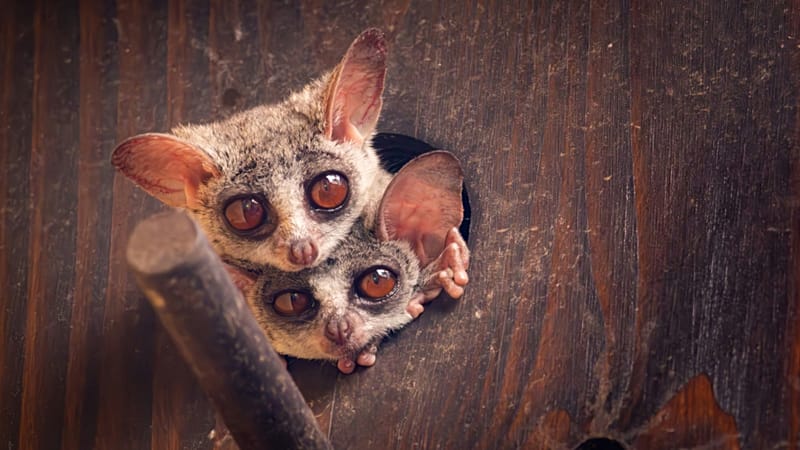
Researchers are promoting the construction of “canopy bridges” to aid in the recovery of bushbaby numbers affected by deforestation.
Famous for their large round eyes and sharp ears, bushbabies were once common inSouth Africa, acquiring a bad reputation for entering towns to steal pet food from dishes and pleading with tourists on safari for leftovers.
Nevertheless, researchers Frank Cuozzo and Michelle Sauther, who initially went to South Africa in 2012 to look for the ‘unusual’ primate, have begun to observe a worrying pattern. They continued to find dead bushbabies that had either been hit by vehicles or attacked by dogs.
Why are galagos classified as ‘near threatened’?
In January 2026, the Endangered Wildlife Trust (EWT) changed the status of thick-tailed bushbabies from ‘least concern’ to ‘near threatened’. Although this classification is not as critical as ‘endangered’, experts believe it suggests that their numbers are probably declining at a worrying pace.
“Human threats are present everywhere, affecting all species,” states Cuozzo, a researcher at the Lajuma Research Center in South Africa.
But we have managed to record that the human-related dangers affecting bushbabies, such as deforestation and loss of habitat, are on the rise.
Thick-tailed bushbabies spend the majority of their time in trees, feeding on acacia gum. However, as humans clear large areas of forest foragricultureand suburban housing, bushbabies are being compelled to move into residential zones to find sustenance.
By analyzing satellite imagery, scientists determined that the environments where primates reside are decreasing by approximately 3.6 percent each decade, a rate quicker than the typical decline observed in natural areas within the region.
In one instance, approximately 200 kilometers north of Pretoria in South Africa, bushbabies have apparently disappeared after an upstream dam was built, which caused the forest that the primates favored to dry out.
Earlier research has also indicated that the illegal pet trade, vehicle collisions, and attacks by dogs could be causing significantly more harm to bushbabies in South Africa than initially estimated by specialists.
Might canopy bridges assist bushbabies in their recovery?
Cuozzo and Sauther are now urging residents to avoid feeding monkeys or leaving pet food outside at night, in an effort to keep bushbabies from entering human areas where they face greater risks.
To address the problem of roadkill, scientists are now promoting the use of “canopy bridges.” These rope structures will enable bushbabies to traverse roads safely, avoiding the danger of being struck by vehicles.
Canopy bridges have been installed globally, including in the heart of the Amazon, to safeguard wildlife and reduce their contact with human-made structures like roads.
The WWF states that canopy bridges serve as a “critical solution” for animals like porcupines, sloths, and monkeys, whose habitats have been “divided by linear development.”
The organization states, ‘A single road can separate an animal from shelter, food sources, and possible partners, affecting its daily activities and splitting species into separate groups, which may reduce genetic variation.’
However, experts note that there is “so little funding” available forconservation, that even building a basic canopy bridge can be time-consuming.
They add, ‘The more we understand about an animal, the more efficiently we can allocate that funding.’
In the absence of a halt to deforestation, the thick-tailed bushbaby faces a greater chance of moving closer to extinction.




 jasdooit
Leave a comment