
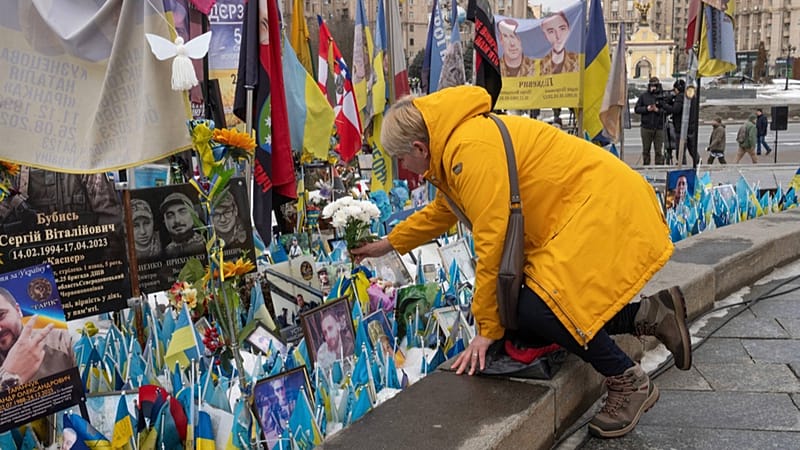
European countries have reconfirmed their backing for Ukraine and their unity with its population on Tuesday, as the nation commemorates the fourth year since Russia’s large-scale invasion.
Officials from various parts of the continent have highlighted that assistance to Kyiv will remain ongoing as required until the conflict with Russia concludes.
On Tuesday, Ursula von der Leyen, the head of the European Commission, along with leaders from several EU countries such as Denmark, Estonia, and Norway, traveled to the Ukrainian capital to commemorate the event.
The officials met with Ukrainian President Volodymyr Zelenskyy to demonstrate their backing for the military campaign and honor the nation’s deceased troops.
In a message on X, von der Leyen stated that her trip is intended to “reaffirm that Europe remains firmly behind Ukraine, financially, militarily, and throughout this difficult winter”.
French President Emmanuel Macron conveyed his condolences to the approximately 15,000 Ukrainian civilians who have lost their lives in the ongoing conflict.
“Four years of broken lives — involving violence, sexual assault, suffering, war crimes, and fear. Four years, with thousands of Ukrainian children separated from their homeland and their families,” he wrote on X.
Macron promised France’s ongoing assistance to Ukraine, both on an individual basis and via European organizations.
With the conflict approaching its fifth year, what is the current state of public opinion across Europe?
France
A new poll carried out for La Tribune du Dimanche revealed that the majority of the French population continues to back their nation’s support for Ukraine, even though the level of excitement seems to have decreased from levels seen four years ago.
As per the survey, 47% of participants backed Paris in maintaining arms supplies to Kyiv, whereas 39% were against it. In comparison, a study conducted in March 2022 revealed strong backing for military aid, with 65% expressing approval at that time.
Views regarding sending soldiers to Ukraine for peacekeeping purposes in case of a truce were more split: 43% expressed disagreement, whereas 40% showed support.
In the meantime, 53% of French people supported Macron’s plan to restart direct talks with Russian President Vladimir Putin — a position that European leaders have mostly rejected during the last four years.
Spain
Official statistics from the Real Instituto Elcano, gathered in May 2025, indicate that Spanish public sentiment seems to be skeptical regarding the future of Russia’s conflict in Ukraine.
The study revealed that most Spaniards think Ukraine will not be able to regain any of the land currently controlled by Russia if a peace agreement is reached.
It is believed that Russia has taken control of approximately 20% of Ukrainian territory, with the majority of this land located in the eastern Donbas region.
Just 39% of participants felt the conflict would conclude this year. Several others also questioned whether the war would remain confined to Ukraine, and expressed worries about the risk of it extending into other Eastern European nations.
Although there is this negative outlook, approximately 75% of Spaniards felt that Europe should keep offering military assistance to Ukraine, while slightly more than half backed sending Spanish soldiers to ensure safety in a Ukraine after the war.
Portugal
In the meantime, approximately half of the respondents in Portugal favored significant European Union financial support for Ukraine, with Lisbon playing an active role in these efforts.
Slightly more than a third (35%) supported further financial assistance between states for Kyiv, but on a reduced level, indicating the nation’s smaller economic capacity.
Just 11% were against Lisbon’s participation in EU support for Ukraine.
Portuguese participants also showed significant approval for military involvement: 61% supported the deployment of Portuguese forces if NATO got involved in a war or in peacekeeping missions after the conflict.
Regarding possible compromises, views were more varied. Only 15% of Portuguese individuals expressed support for an agreement that would require Ukraine to make territorial concessions, as previously suggested by US President Donald Trump.
A higher percentage, 43%, indicated that their stance would rely on the details of the agreement and the assurances provided. In contrast, 36% strongly opposed the notion of Ukraine giving up territory to Russia in any peace deal.
Germany
In Germany, a survey carried out in early February by Bild revealed that the majority of people back boosting assistance to Ukraine to aid its efforts against Russia.
More than half (52%) of those surveyed felt that the West should offer further military and financial support if Russia keeps disrupting peace initiatives and refuses to engage in substantial talks to conclude the conflict.
A majority of participants supported distributing aid evenly between weapons and financial aid, whereas 12% favored increasing financial aid solely, and an additional 12% backed enhancing military supplies exclusively.
Approximately one-third of individuals (35%) were against maintaining aid to Ukraine.
 jasdooit
Leave a comment