
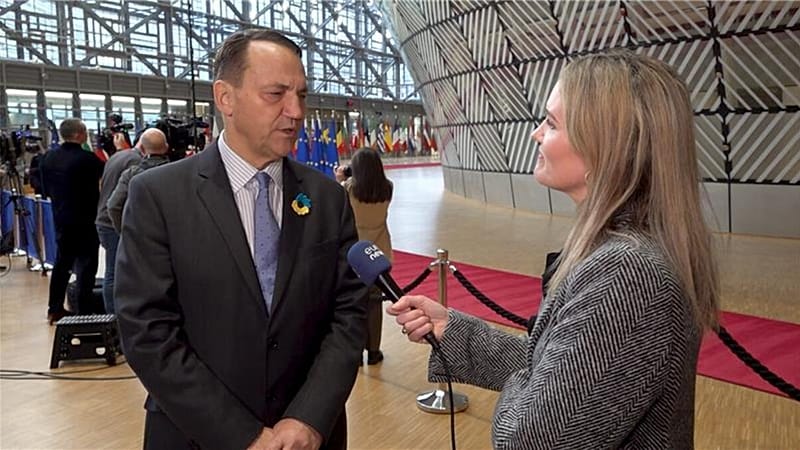
Poland’s Foreign Minister Radosław Sikorski has criticized Hungary for increasing its resistance to EU aid for Ukraine, calling Budapest’s recent attempt to prevent a €90 billion loan and additional penalties an “escalation” that benefits Moscow.
In an interview with Euronews’ main Europe Today morning show, Sikorski stated that Hungary has consistently opted for energy agreements that ultimately favor Moscow.
“Throughout the years, Hungary has had numerous chances to carry out what the rest of Europe has already accomplished,” he stated, alluding to long-term oil and gas agreements with suppliers not from Russia.
Rather, he contended, Budapest still purchases directly from Russia, “thereby fueling Putin’s war machine.”



A pattern of vetoes
Sikorski highlighted earlier Hungarian restrictions, such as the halt of approximately €7 billion from the European Peace Facility funds meant to compensate member states that provided military equipment to Ukraine. Poland was one of the recipients waiting for reimbursement.
He also remembered that during Poland’s EU presidency, Warsaw focused on initiating the first accession negotiation cluster with Ukraine, addressing democracy and the rule of law. Hungary blocked the initiative, claiming Ukraine was mistreating ethnic minorities.
Kyiv has consistently rejected these allegations as baseless.
“This represents an intensification of existing procedures that benefit Russian President Vladimir Putin,” Sikorski stated.
Budapest has maintained its position, stating it is essential to safeguard national interests, especially regarding energy security, and has indicated it will keep using its veto if its issues remain unresolved.
Europe’s ‘strong cards’
When asked if the EU should contemplate activating Article 7, the union’s procedure for dealing with violations of fundamental principles, Sikorski supported the implementation of targeted penalties.
He challenged assertions that Ukraine was behind the energy transit interruptions, pointing to reports suggesting the damage to the Druzhba pipeline could have resulted from Russian actions.
“If that’s the case, then it’s somewhat unjust to hold blame and direct anger towards the Ukrainians, who are the victims of aggression,” he stated.
Sikorski also mentioned that Hungary’s stance should be understood within the framework of upcoming national elections, implying that a new administration might reconsider the policy.
As U.S. backing for Kyiv becomes more uncertain, Sikorski contended that Europe’s influence should not be overlooked.
We have provided more support to Ukraine than the United States,” he stated, noting that Europe has become the main provider of financial and military assistance to the Ukrainian government and its military, and that its “cards are quite strong.
The senior Polish representative also foretold that both Washington and Moscow would ultimately have to acknowledge that European security concerns cannot be ignored.
Ukraine will take its own decisions depending on the backing it receives from Europe,” he stated. “Therefore, Europe’s perspective cannot be overlooked.
With another crucial year of the war drawing near, Sikorski emphasized that the EU needs to resolve internal disagreements and stay united, cautioning that ongoing vetoes could undermine Europe during a key time for its own security.

 jasdooit
Leave a comment