
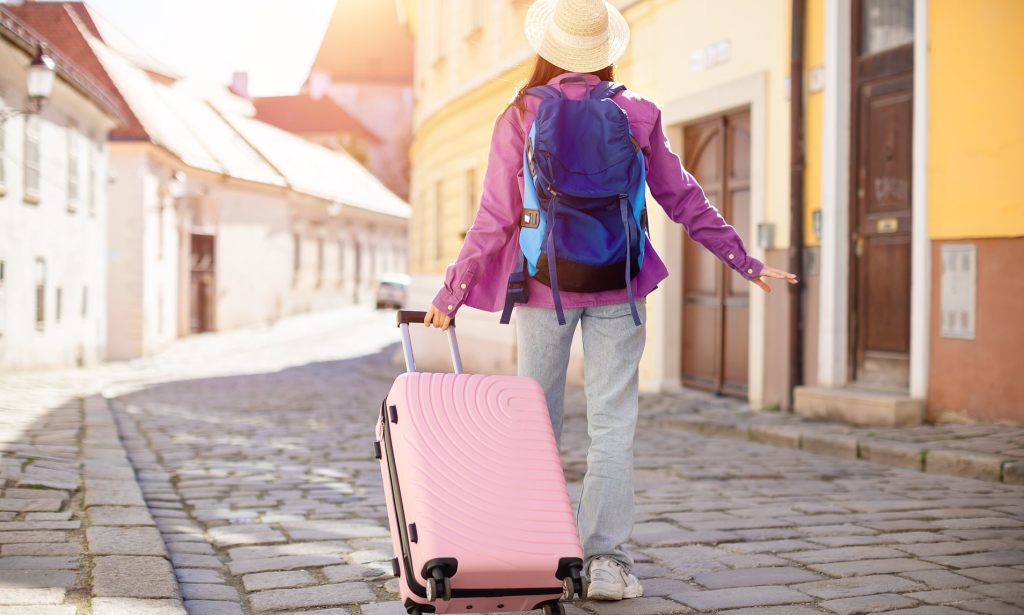
A travel specialist has cautioned that a typical vacation practice might result in you receiving a penalty — before your journey has even begun.
Numerous British tourists reach Italian cities like Rome and Portofino carrying their bags, prepared to start exploring immediately after arriving at the airport or train station.
But many fail to realize that this could be against the law.
Italyhas implemented regulations regarding tourist behavior, including detailed guidelines on baggage.
In Rome, it is prohibited by the city’s regulations on public appearance to pull a wheeled suitcase along the Spanish Steps, with penalties beginning at €250 (£218) and increasing to €400 (£350) or higher if there is any damage.
In Portofino, a local rule strictly prohibits visitors from staying in busy zones with luggage, carrying penalties as high as €500 (£437).
Jacob Wedderburn-Day, a travel specialist and CEO of the luggage storage firm Stasher, states that these regulations are surprising British travelers while overseas.
Jacob said, “These guidelines direct individuals toward the actions that seem entirely natural when entering a new city: carrying their luggage and immediately heading towards famous attractions.”

The issue is that marble staircases, which have endured for centuries, are not capable of withstanding the constant friction from millions of suitcases being dragged over them annually.
Even the tremors from moving suitcases down stairs result in tiny injuries that build up over time.
Law enforcement officers in Rome regularly monitor high-traffic areas during the day and act swiftly when needed.
Jacob says: “Don’t consider your arrival day as a day for sightseeing if you still have your luggage with you.”
Proceed directly to your lodging or opt for a baggage storage facility first, as receiving a penalty from local authorities before your vacation begins is certainly not the kind of situation anyone wishes to encounter.
Numerous additional regulations could result in significant penalties as well.
At the Acropolis in Greece, wearing high heels is not permitted.
Jacob states: “Greece has prohibited the use of high-heeled shoes at historical locations, such as the Acropolis and the Epidaurus Theatre. The penalty for violating this rule can be as high as €900 (£786).”

On ancient surfaces that have existed for thousands of years, a single step can create tiny cracks. This represents one of the most costly hidden penalties in European tourism.
It is prohibited to drive in flip-flops in Spain, as Jacob cautioned: “The traffic authority in Spain has stated that officers have the power to impose fines of up to €200 (£175) if they believe that the footwear is impacting a driver’s ability to safely operate the vehicle. Guardia Civil officers can make immediate decisions.”
Bikinis are not allowed on public roads in Spain and Italy.
Jacob states: “Barcelona has enforced a swimwear restriction since 2011, imposing penalties as high as €300 (£262) for wearing bikinis or swim shorts outside of the beach area.”
In Majorca and the Balearic Islands, the penalty can reach €600 (£524), while Sorrento in Italy imposes fines of up to €500 (£437). These regulations apply to both men and women. Entering a restaurant without a shirt is also not allowed.
In Venice, it is prohibited to feed the pigeons.
Jacob states: “It has been against the law to feed pigeons anywhere in Venice since 2008, with penalties reaching up to €500 (£437). The droppings and pecking from pigeons result in significant harm to Venice’s delicate marble buildings, and the cost of cleaning up amounts to hundreds of euros per resident annually. This issue is taken quite seriously.”




 jasdooit
Leave a comment