
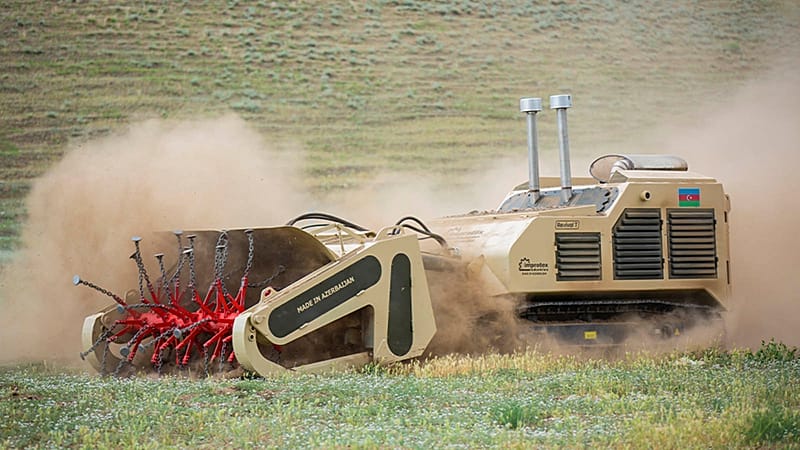
Nations affected by landmines following prolonged conflicts are utilizing remote-controlled demining machines to speed up the removal process, minimizing risks for personnel and enabling coverage of significantly larger zones compared to traditional techniques.
In Azerbaijan, unmanned systems are developed by the domestic engineering company ImProtex and managed by the Azerbaijan National Agency for Mine Action (ANAMA).
Designed for hazardous settings, the equipment is used in regions where manual removal is both time-consuming and perilous, aligning with International Mine Action Standards (IMAS).
The extent of pollution makes technological approaches a key focus for Baku.
“In the case of Azerbaijan, the landmine problem continues to pose a significant humanitarian and security challenge even after the conflict has ended,” said Gunel Alakbarova, Vice President of ImProtex, to the international TV channel AnewZ.
“Mines and unexploded ordnance left during the occupation continue to occupy large regions, endangering people’s lives and preventing the regular use of the land,” Alakbarova added.
One of the most recent models, the Revival T, is a robust armored vehicle engineered to eliminate both anti-personnel and anti-tank mines in challenging landscapes.
Manual demining is still the most accurate but also the slowest approach,” notes Emil Hasanov, vice-chair of ANAMA’s Public Council. “A single deminer usually clears between 20 and 50 square meters each day.
Mine detection dogs, valued for their quickness and effectiveness, can cover 200 to 400 square meters each day,” Hasanov said. “Mechanical demining machines offer the greatest output, varying between 500 to 2,000 square meters per day, based on the terrain and machinery used.
In the meantime, Alakbarova stated that automation plays a key role in minimizing injuries, as “mechanical devices decrease the requirement for human work, allowing quicker and more efficient removal of minefields.”
“Conventional landmine removal techniques pose a significant danger to human lives. Remote-operated systems fitted with modern sensors reduce this risk,” she stated.
The growing adoption of mechanical clearing is accelerating land availability, aiding rebuilding efforts and the return of displaced populations.
“This method not only demonstrates technological advancement but also emphasizes Azerbaijan’s humanitarian efforts and its regional technological capabilities,” Alakbarova added.
The machinery speeds up recovery after conflicts by facilitating secure land clearing and enabling farming and infrastructure to restart.
From home-based sorting to global display
Azerbaijan has also showcased its remotely operated mine-clearing technology at global defense and security expos, such as UMEX 2026 in Abu Dhabi.
Azerbaijan continues to face significant post-war challenges due to landmines and explosive remnants of war (ERW). According to ANAMA, since the conflict ended in 2020, over 240,000 hectares of affected land have been cleared, with more than 227,000 mines and ERW neutralized.
Although there have been improvements, pollution remains in various areas, still hindering growth and presenting dangers to residents.
To keep the progress going, the Azerbaijani government has set aside 74.9 million Azerbaijani manat (€39 million) for mine clearance activities in 2026 and has entered into agreements with several specialized firms to increase the capacity for removal operations.
The European Union and the embassies of its member countries are also enhancing their collaboration with Baku in humanitarian demining, committing approximately €23 million in support.
The financial support facilitates demining activities, awareness initiatives, and aid for victims, positioning mine action as one of the most significant continuous efforts in the nation.
Azerbaijan has expanded its capabilities on a global scale, including in Ukraine, where it has delivered unmanned demining vehicles and offered training to professionals, along with generators to support heating for the civilian population.
Vast regions of Ukrainian farmland, buildings, and infrastructure continue to be impacted by mines and unexploded ordnance after Russia’s large-scale invasion in early 2022, with the removal of these hazards considered essential for ensuring public safety and supporting economic revival.
A global challenge
As reported by UN agencies and global monitoring organizations, over 6,000 individuals were killed or injured by landmines and explosive remnants of war across the world in 2024, marking one of the highest totals seen in recent times.
Mines can stay active for many years, and in some cases, even a hundred years, posing risks to people long after the fighting has stopped.
” Countries like Egypt, Angola, Afghanistan, and Bosnia and Herzegovina are still dealing with the lasting effects of pollution,” Hasanov stated. “Landmines limit access to farmland, essential services, and secure relocation,” he added.
Hasanov mentioned that humanitarian groups, such as the UN’s Mine Action Service (UNMAS), the UNDP’s development program, UNHCR, the Mines Advisory Group (MAG), and Norwegian People’s Aid, have highlighted that landmines continue to be a significant barrier to recovery after conflicts and the safe return of refugees and those displaced within their country.
Alakbarova emphasized that although there has been advancement, the issue goes well beyond the borders of one nation.
“Although there have been achievements in global demining initiatives, operations around the world continue to encounter obstacles including limited resources, lack of political commitment, and technological issues,” she stated.
“Mines continue to pose a lingering danger in over 50 countries, highlighting that tackling this problem demands ongoing cooperation and consistent funding,” Alakbarova noted.
Professionals note that the increasing application of remote-controlled mine-clearing devices signifies a change in humanitarian demining efforts, minimizing people’s contact with dangers and enhancing effectiveness.
In Azerbaijan, homegrown systems are not only preserving lives within the country but also allowing it to take a more prominent part on the global stage, as the demand for mine action around the world is increasing.




 jasdooit
Leave a comment