
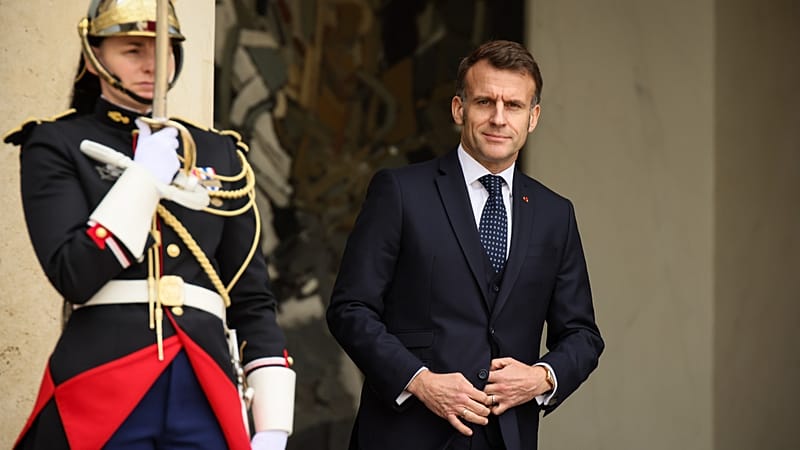
France’s proposal to extend its nuclear capability across Europe will not in any way rival the protection offered by the United States, Emmanuel Macron is set to state on Monday during a speech addressing the issue.
The speech by the French President will mark the first time the nation’s nuclear deterrent has been addressed since a 2020 statement in which he expressed willingness to “include” European nations interested in participating in drills. The address will take place at the Île Longue peninsula in north-western France, where the country’s four nuclear-powered ballistic missile submarines are located.
“This marks a crucial point in his time in office. There are sure to be notable changes and advancements,” the Elysée stated.
The 2020 proposal by Macron was largely overlooked, but the French president announced again this monthat the Munich Security Conferencethat he had participated in “strategic dialogue” with German Chancellor Friedrich Merz and other unidentified EU leaders regarding “how we can express our national doctrine” on nuclear deterrence.
‘Growing interest among partners’
This growing nuclear focus in European Union capitals arises from a significant change in the global political environment since Russia initiated its large-scale invasion of Ukraine and Donald Trump regained power in the United States.
The first event compelled Europeans to confront the weaknesses and reliance inherent in their own defense, whereas the second led many across the continent to question Washington’s dedication to Europe’s security.
The most recent episode, where Trump warned of military action against Denmark, a fellow NATO member, to take control of Greenland, further increased these concerns, even though European leaders and officials have publicly affirmed their belief in America’s long-term dedication to its NATO partners.
The United States has also indicated its intention to partially remove some of its forces and gear from Europe as it shifts focus toward the Indo-Pacific region. It remains uncertain what this partial withdrawal will entail and how it will be carried out.
However, sources affiliated with the president also emphasized their conviction that “we are experiencing a time that is inherently favorable to the spread of nuclear weapons,” citing Russia’s development of new hypersonic missiles, China’s rapid expansion of its own nuclear stockpile, and the uncertainty surrounding Iran’s future in the Middle East.
All of this is attracting increasing attention from partners,” the Elysée stated, while emphasizing that “this is not in any way competing with NATO.
How a different approach might be expressed, however, is still uncertain.
We are not participating in a weapons competition
NATO Secretary General Mark Rutte and the EU’s Defense Commissioner Andrius Kubilius have both indicated that it would be excessively expensive and time-intensive for European allies to attempt to replace the US nuclear umbrella.
France’s nuclear strategy is based on the concept of “strict sufficiency,” which means it maintains a number of warheads sufficient to cause severe harm to any adversary.
Therefore, it possesses approximately 300 nuclear warheads in its collection – a figure significantly lower than the over 3,500 that the US and Russia are each thought to have.
“One aspect of our nuclear policy that deserves to be emphasized is our refusal to consider nuclear warfare. Therefore, we are not involved in an arms race, in a way, with the major nuclear stockpiles. What matters is that our arsenal guarantees our capacity to cause devastating harm,” said the Elysée.
France and the United Kingdom have already enhanced their nuclear collaboration and coordination under the Northwood Declaration, which was finalized last summer. They now maintain a Nuclear Steering Group that offers political guidance for these efforts and takes part in each other’s nuclear drills.
 jasdooit
Leave a comment