
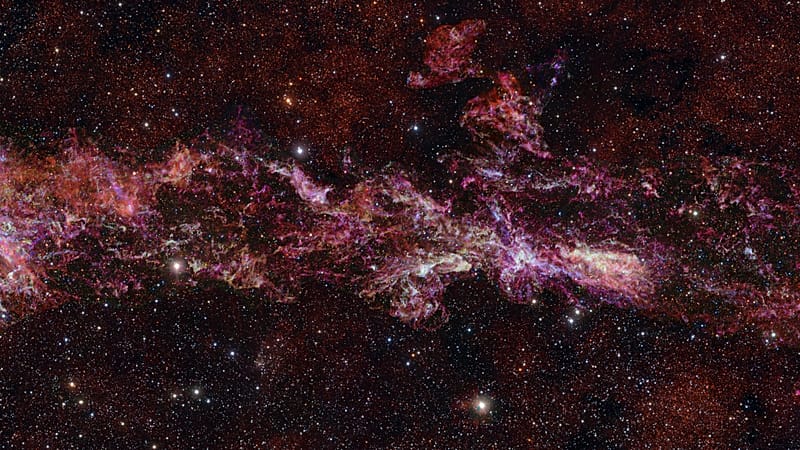
Although it appears as if purple and pink clouds are being swept by a flow, this image actually captures the gas involved in star formation at the center of our galaxy, the Milky Way.
The image was released on Wednesday (25 February) by the European Southern Observatory (ESO) and showcases new insights into these gases, especially within what is referred to as the central molecular zone (CMZ) of the Milky Way.
“This [image] offers insight into how stars and planets develop when they are closely situated and densely packed, which we believe is the typical way most stars in the universe were formed,” said Steve Longmore, Professor of Astrophysics at Liverpool John Moores University.
The image highlights an area spanning over 650 light-years, composed of cold interstellar gas, “which is invisible to the human eye under extreme conditions,” according to the European Southern Observatory. This is the biggest picture ever captured by the 66 ALMA antennas located in the Atacama Desert in Chile, which is operated jointly by the ESO, the United States, and Japan.




 jasdooit
Leave a comment