
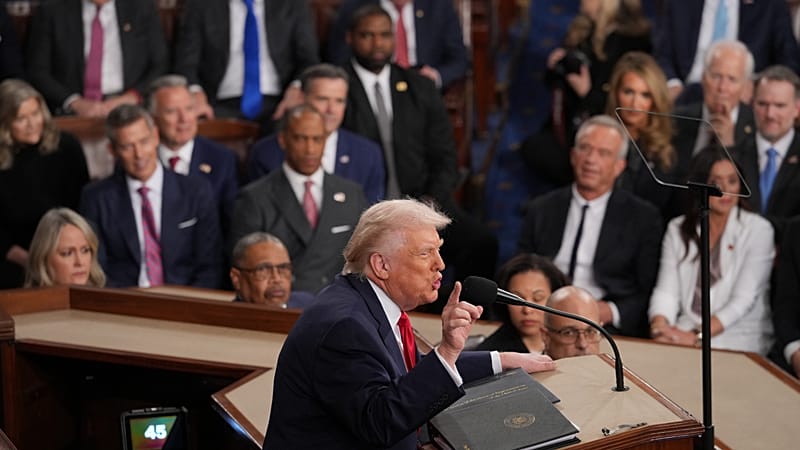
In his Tuesday State of the Union address, President Trump attributed the significant economic progress and successful foreign policy achievements to himself.
The yearly speech mainly centered around the economy and especially cost of living, which Republicans appreciated as “what he should be focusing on.”
Nevertheless, the favorable comments about the economy combined with a distinct concern for tackling the financial challenges faced by typical American families are contradictory.
Additionally, current surveys and financial statistics contradict President Trump’s exaggerated statements.
The latest official update on the US economy was released last Friday, on the same day the Supreme Court ruled to invalidate most of President Trump’s tariffs.
The Bureau of Economic Analysis (BEA) published its preliminary estimate for last year’s fourth quarter GDP, showing an annualized real growth rate of only 1.4%, significantly lower than predictions that were centered around 2.5% and a notable slowdown from the 4.4% recorded in the third quarter.
Real gross domestic product increased by 2.2% throughout the entire year of 2025, a decrease from the 2.8% growth recorded in 2024.
Nevertheless, the BEA quickly highlighted a significant limitation: the October–November 2025 federal government shutdown, the longest in US history, reduced fourth-quarter growth by approximately 1% by itself.
Approximately thirty-five minutes prior to the release of the BEA’s figures, President Trump also shared a post on Truth Social, indicating he was aware the economic data would not be favorable and asserting that the shutdown had twice the adverse impact as previously calculated.
“The Democratic government shutdown resulted in a loss of at least two points in the U.S. GDP. No more shutdowns!” said President Trump.
The GDPNow forecasting model from the Atlanta Federal Reserve estimated the first quarter of 2026 at 3.1%, indicating that the US economy could be recovering as disruptions caused by the shutdown diminish.
A sturdy year but not an exceptional one
As per information from the Bureau of Labor Statistics (BLS), the growth in the US job market during the previous year was significantly subdued. The economy averaged only 15,000 non-farm payroll positions added each month in 2025, a drop from 168,000 in the preceding year.
The BLS’s updated revision, along with the January 2026 employment report published this month, removed a total of 862,000 jobs that had been previously counted for the period ending in March 2025.
Nevertheless, this January saw a more positive figure: 130,000 jobs created, significantly higher than the 55,000 predicted and the highest monthly number since December 2024. In total, the unemployment rate slightly decreased to 4.3%.
On Truth Social, President Trump shared “EXCELLENT JOB FIGURES, SIGNIFICANTLY HIGHER THAN ANTICIPATED!” and according to the benchmarks of a year where the job market had largely stalled, January’s data was indeed a positive development.
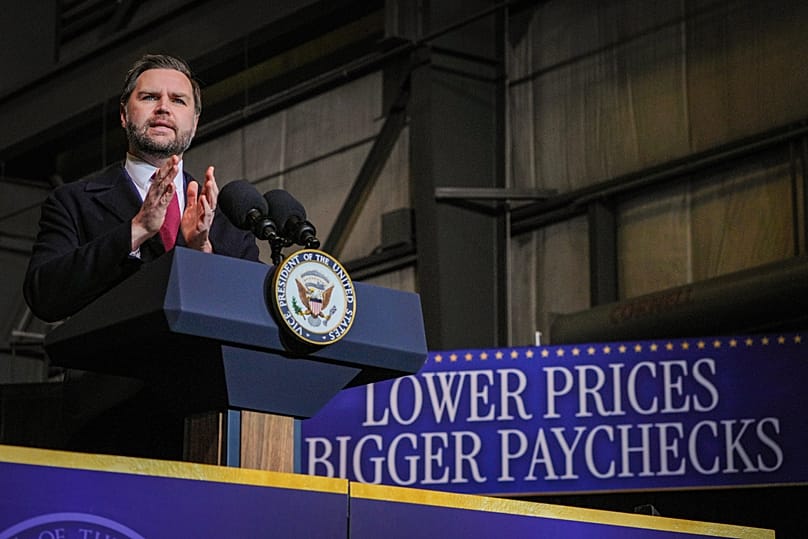
A component that President Trump brought up but didn’t focus much on during his State of the Union speech on Tuesday was the situation of the federal employees.
The BLS stated that after federal employment reached its highest point in October 2024, the government workforce has decreased by 327,000 jobs, which is a reduction of 10.9%.
In January 2026, 34,000 more federal employees were removed from payroll as individuals who had chosen to defer their resignations in 2025 officially exited government employment.
This stems from intentional actions taken by the present US administration to reduce federal employment.
President Trump has often claimed that he doesn’t feel bad because they are now securing private sector positions and earning sometimes double or even triple the amount of money,
However, the current job data does not back up the assertion.
The tariff earthquake
Although the economic narrative Trump presented in his State of the Union address, it was overshadowed by the Supreme Court’s 6-3 decision last Friday that opposed his tariffs.
The decision invalidated import duties that had produced approximately $129bn (€109bn) in revenue under the IEEPA by December 2025, as per the US government’s data.
Furthermore, it is still unclear if importers are entitled to reimbursements.
Treasury Secretary Scott Bessent mentioned over the weekend that refunds would necessitate court involvement, and that the Trump administration would not act on its own.
Shortly after the decision, President Trump activated Section 122 of the Trade Act of 1974, a seldom-used clause, to implement a 10% general tariff on imports from every nation. The next day, this rate was increased to the highest level of 15%.
However, the tariff will take effect this Tuesday at a rate of 10% and will continue for 150 days, ending on 24 July 2026, after which it will need approval from Congress to stay in force.
A comprehensive list of exceptions includes energy products, essential minerals, medicines, passenger vehicles, books, and agricultural items such as beef and tomatoes.
The Council on Foreign Relations, a U.S. policy institute, stated that without the IEEPA tariffs, consumers currently encounter an average effective tariff rate of 9.1%, the highest since 1946, not counting last year.
Legal professionals anticipate that the Section 122 process will encounter judicial disputes, as the law was created for temporary “balance-of-payments crises” and not as a general trade policy tool.
A survey conducted by the Associated Press this month, in partnership with NORC at the University of Chicago, revealed that only 39% of Americans support President Trump’s present management of the economy.
While 59% express disapproval, this marks a significant shift from the political edge he had on this matter before the 2024 election.


 jasdooit
Leave a comment