
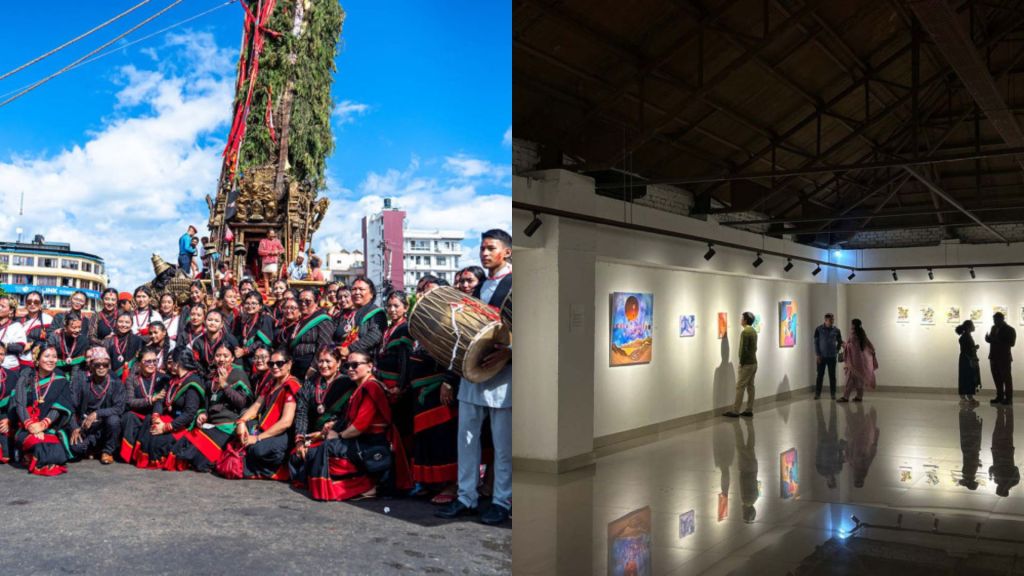
Kathmandu, February 27 — Nepal is at a critical juncture as leading political parties, in reaction to the recent Gen Z uprising, present their agendas before the upcoming election. However, a significant gap persists—the realm of art and culture in politics.
The ascent of Balen Shah, starting as a Hip-Hop artist and becoming the mayor of Kathmandu Metropolitan City, and now being recognized as a significant figure within the Rastriya Swatantra Party (RSP), indicates an increasing political influence among young people and artists.
Nevertheless, the irony is quite hard to ignore.
The involvement of an artist in the political mainstream appears to have generated significant energy for artistic and cultural development. Nevertheless, major political parties, including the RSP, fail to adequately address all aspects of Nepali art and culture. Viewed more as decorative elements rather than essential components of nation-building, conversations about this topic continue to be on the margins.
Political manifestos were released in various regions of Nepal, as leading political parties introduced ‘Commitment Documents’, ‘Electoral Promises’, and ‘Pledge Documents’. Although the demands from the uprisings mainly focus on governance and infrastructure development, the political conversation still overlooks cultural policy structures, the creative sector, preservation of heritage, and artistic liberty.
Among Nepal’s four primary political groups, two—Nepali Congress (NC) and Nepali Communist Party (NCP)—have recognized art, culture, and literature in their official papers. The remaining ones have not made any progress in this regard.
The Nepali Congress’s 200-page ‘Pledge Document’ includes a section titled ‘Our Civilisation, Our Culture’, which spans five pages (175 to 179).
This part suggests a structured examination of the current traditions and folktales within Nepali culture. Additionally, it seeks to integrate these results into an online repository and encourage the growth of cultural sectors.
NC pledges to set up multi-functional art centers featuring amphitheaters, art galleries, training facilities, and digital archives in each of the seven provinces. The manifesto also suggests comprehensive educational changes to support the ‘teacher-artist’ model. Divided into seven sections, the document outlines a vision for enhanced cultural development, seeking to restore Nepal’s spiritual legacy and civilization, emphasize the creative economy, safeguard heritage and culture, and encourage the scientific examination of traditions.
In its 52-page ‘Commitment Document’, the Nepali Communist Party portrays culture, art, and literature (pages 45 and 46) as a reflection of Nepali society and pledges to place them at the forefront. The four bullet points in the manifesto commit to safeguarding and advancing traditional artistic expressions and to encouraging original and creative inputs via acknowledgment and awards.
On the other hand, the ’25 Pillars of Prosperity’ by CPN-UML does not prominently feature art and culture as a separate policy focus. The 12th pillar (page 63) outlines a commitment to enhancing Nepal’s tourist attractions via cinema, social media, influencers, and travel bloggers.
Out of the 100 points outlined in the ‘Manifesto’ of the Rastriya Swatantra Party, the 50th point (page 26) highlights the multi-cultural richness of Nepal, with an intention to channel tourist visits to Pashupati Temple, Lumbini, and Janakpur.
Heritage and culture are scarcely referenced in both documents, typically serving as an addition to tourism and other forms of infrastructure development. Topics related to art are not included.
As per the leading political parties, progress seldom entails the structured promotion of innovation. Although survival is the main issue for artists, they feel discouraged by the government’s unpredictable focus.
A heritage conservationist named Alok Siddhi Tuladhar remembers how development has always been connected to building projects. “In a nation such as Nepal, the effects of federal policies haven’t been thoroughly examined. The relationship between cultural heritages and development must be carefully considered,” he mentioned. Tuladhar thinks that instead of aggressive construction initiatives, the main emphasis should be on protection and maintenance.
Over two decades of exploring and researching Nepal’s tangible and intangible heritage, he strongly maintains that the future depends on the knowledge of the past. Therefore, he thinks the government should focus on recording and spreading correct information about heritage and family histories.
Film regulations are greatly unclear due to the manifestos. As film culture continues to grow among Nepalis, the difficulties faced by independent filmmakers have become clearly apparent in areas such as censorship, financial support, and global acknowledgment. This leads to a discussion on the role of government control in art and cinema.
Music has historically served as a means of identity—a way to express feelings, culture, and artistic expression. Although political groups often employ music as their main tool to promote their political goals, it is still overlooked in policy development.
Kunti Moktan, a seasoned Nepali musician, shares that it is the general public, not the government, who provide support to artists. “Even though artists are often referred to as ‘deshko gahana,’ after spending a significant amount of time in the music industry, I have not witnessed the government’s involvement in supporting and protecting artists,” she states. “Instead, it is the citizens who come forward to assist the artists.”
Moktan points out that artists often have to look for support in other places, mainly by moving overseas. “We can observe the highest number of artists leaving the country for this reason,” she states. “Artists don’t ask for an opulent lifestyle; their requirements mainly focus on safety, food, health, and fundamental survival needs.”
The government’s failure to tackle issues raised by musicians is a key reason why the general public sees the music industry as an unreliable profession. “When artists are unable to create music, they hit rock bottom, with no assistance,” states Moktan. “This is very concerning.”
Amidst the empty pledges from political parties, the theatre appears to have no room. Prasamsha Siwakoti, a theatre artist and operations manager at Mandala Theatre Nepal, remembers, “We didn’t realize the government also has a part to play in supporting theatres. Artists remain in the field only because of their love for it. The future is uncertain, and we don’t know what to anticipate.”
From drama classes to advanced gear, theater requires substantial funding that the government overlooks.
Creatives, scholars, environmental protectors, cinematographers, and composers experience consistent exclusion from policy frameworks that verbally endorse art and culture but fail to support them in reality.


 jasdooit
Leave a comment