
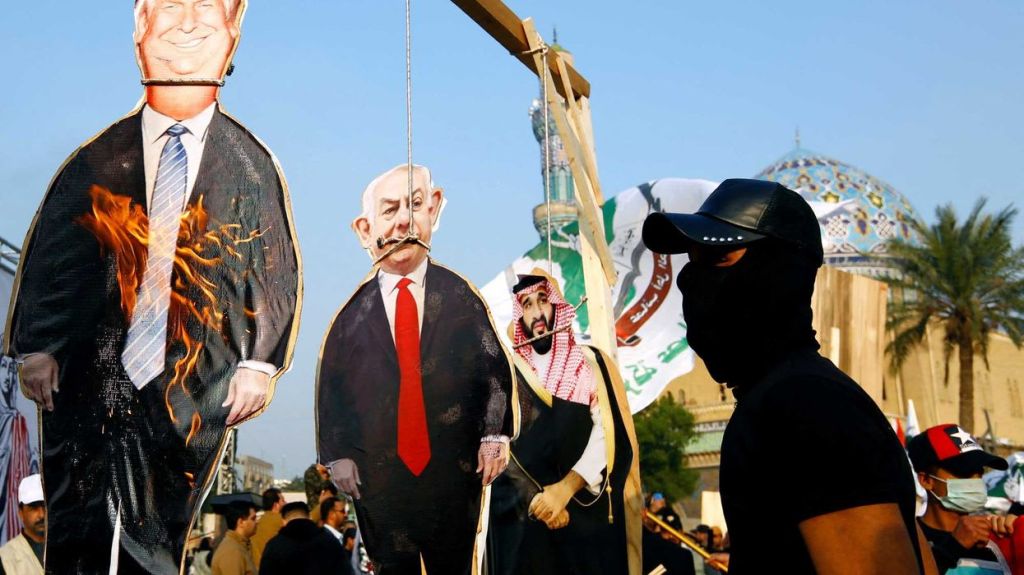
On Monday, the Secretary of DefensePete Hegseth conducted a media update Pete Hegseth gave a press conference Pete Hegseth held a media briefing Pete Hegseth addressed the press Pete Hegseth held a news briefing Pete Hegseth met with journalists Pete Hegseth provided a press statement Pete Hegseth held a press meetingto validate the conflict in Iran. Commending Donald Trump’s disregard for the law, hesaid, “America, regardless of what so-called international institutions say, is launching the most deadly and accurate air power campaign ever … Nostupid rules of engagement, no nation-building trap, no democracy promotion effort, no politically correct conflicts. We fight to achieve victory.
Other than this dangerous arrogance typical of a 12-year-old boy, the most alarming part of Trump bombing Iran withoutConstitutional or Congressional authority is that the administration’s “planning” does not seem to match or even appreciate the risks involved.
Also Read: Trump is on the verge of receiving a harsh historical education
Many security analysts agree with Senator Mark Kelly (R-AZ) andTrump stated that Iran should never be permitted to possess nuclear arms, asno state that exports jihadist martyrdom should have nuclear weapons.
But the instability of confronting a country supposedly onlyone week awayfrom nuclear capabilities require accuracy and realistic goals, not threats orchanging rationalesposted at 2 a.m.The Trump administration’s lenient and unlawful communicationindicates either cold detachment, absence of control, or unauthorized motives, all of which are perilous traits when it comes to nuclear arms.
Seeking additional updates on political developments?Click to view the most recent news updates on Raw Story.
Trump has not provided clear political or military goals, nor has he outlined how the use of force at this moment serves our country’s best interests. Instead, Trump’sreasons for war continue to change, from immediate national security threats, to humanitarian issues, to changing leadership, implying Israeli Prime MinisterBenjamin Netanyahu played Trumpto undertake what no other president had the audacity to attemptin service to Israel’s interests, not our own.
Even the commendable objective of eradicating Iran’s nuclear capabilities appears questionable in light ofTrump’s global victory tour last June, stating that air strikes had “completely eliminated” Iran’s stockpile of enriched uranium.
On June 25, 2025, theThe White House issued a formal announcement.titled “Iran’s Nuclear Facilities Have Been Destroyed — and Claims to the Contrary Are False News.” Either Trump was lying then or he is lying now. It’s never wise to trust liars when it comes to issues of life and death.
Anti-American sentiment
Human rights organizations reported that tens of thousands of Iranian citizenswere put to death in January for opposing their oppressive rule underAyatollah Ali Khamenei. He has passed away. Apart from anapproximately 15 percent of IraniansThose who back the Islamic Republic’s theocracy will not mourn him, especially not the families of those he tortured and killed.
But for all concerned, in the absence of a clearstrategy, aim, approach, or schemefor what is to follow, the most dependable indicator of the result is the immediate history.
This is not the first instance of the U.S. engaging in conflict in the Middle East with the aim of altering regimes. We have attempted this on several occasions, andin every casewe have discovered that the early success of removing a leaderis notfollowed by the creation of a long-lasting, secure, or Western-aligned substitute.
Instead, the reverse occurs. When we establish a power vacuum, an individual even more dangerous, extreme, and confrontational comes to power. Indeed, Khamenei ascended to power as a direct consequence of thelastthe moment the United States aimed for a shift in leadership in Iran.
Regime change efforts
Americans who now work under algorithms may have forgotten that it was we who set the Islamic Revolution in motion. In 1953, the CIA and British intelligence orchestrated a coup to remove the Prime Minister.Mohammad Mossadegh, who was elected through democratic means, as he took control of the Iranian oil industry. (Sound familiar?)
Following the coup, the U.S. brought back Shah Mohammad Reza Pahlavi, who introduced a more and more dictatorial regime that led the Iranians to start todislike both him and the U.S., for enabling his rise to power. Dislike for the Shah resulted in strong anti-American feelings. The 1979 Islamic Revolution aimed at removing the Shah concluded with the establishment of a new Islamic Republic that granted power to Ayatollah Khomeini and his radical faction,stone-women-to-death-for-showing-their-hair clericsWe are currently bombing Iran in an attempt to overthrow the government we are responsible for.
Past events indicate that we might be making similar errors as seen in other Middle East engagements:
・Iraq:In 2003, the United States launched an invasion of Iraq based on the assertion that it was producing weapons of mass destruction. The invasion led to the removal ofSaddam Hussein, resulting in a power vacuum, sectarian conflicts, and the emergence of extremist organizations such as ISIS. Over 20 years later, Iraq continues to experience instability.
・Afghanistan:In the aftermath of 9/11, the United States launched an invasion of Afghanistan to overthrow the Taliban regime. Following two decades of presence and U.S.-driven initiatives aimed at building a stable nation,the Taliban regained control in 2021, following Joe Biden’s withdrawal of U.S. troops.
・Libya: In 2011, a U.S.-led NATO interventionwas intended to safeguard civilians by eliminating Muammar al-Qaddafi. Similar to the situation in Iran today, there was no strategy following the regime change, resulting in a power vacuum that turned Libya into a failed state marked by extensive suffering, and now serves as a breeding ground for militant extremists.
・Syria: Also in 2011, the United States offered support and military help toopposition factions during the Syrian Civil Warwith the stated goal of compelling Bashar al-Assad to step down. He continued to maintain control over a significant portion of the country until 2024, even utilizingchemical substances used against his own people.
The findings are evident and uniform: removing authoritarian regimes in the Middle East has, in each instance, resulted in the rise of more extreme groups, leading to increased threats andunintended national security consequences for America.
Within a little more than a year, while striving to be seen as a “peacemaker,” Trump has approved military operationsin seven nations.In Iran, we are once more turning a blind eye to history, this time within a government that appears incapable of understanding laws, standards, or subtleties.
・Sabrina Haake is a journalist and veteran federal trial lawyer with over 25 years of experience focusing on 1st and 14th Amendment defense. She contributes to the Substack,The Haake Take.
Recommended Links:
- Pete Hegseth reacts angrily to a reporter’s ‘gotcha’ question regarding the conclusion of the Iran conflict
- “Act like a man”: Pete Hegseth criticized for ‘childish’ outburst regarding war deaths
- Hegseth has created a ‘disturbing’ image and shocked his own team: specialist
- A journalist claims Pete Hegseth biased the press conference by inviting MAGA-aligned reporters
- Pete Hegseth prohibits military personnel from ‘woke’ elite universities that he has attended

 jasdooit
Leave a comment