
Analysts suggest that Donald Trump’s focus on Tehran could make Pyongyang feel ‘justified’ in pursuing nuclear weapons for its own protection.
A planned operation targeting Washington in Iran could make Pyongyang feel “justified” in advancing its nuclear arsenal for self-protection, prompting it to strengthen ties with China and Russia to enhance its defensive strategies, as per experts.
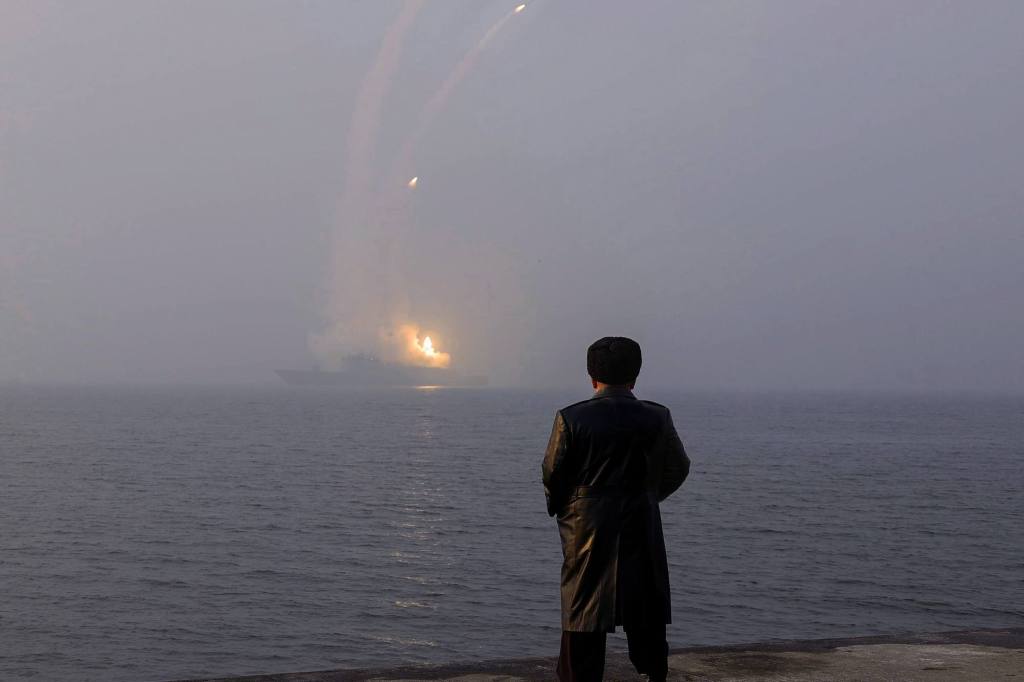
On Wednesday, the leader of North KoreaKim Jong-un inspected the test firingregarding what the nation’s state-run media referred to as a “strategic cruise missile” launched from the newly commissioned 5,000-tonne naval destroyer Choe Hyon prior to its formal induction.
Kim praised the warship as a “new emblem of maritime defense strength” following its trial voyage during the destroyer’s sea testing on Tuesday.
Are you curious about the most significant issues and developments happening globally? Find the answers withSCMP Knowledge, our latest platform offering handpicked content including explainers, FAQs, analyses, and infographics, presented by our acclaimed team.
The leader of North Korea stated that his nation has made “satisfactory progress” in developing “the most powerful navy” featuring nuclear-capable systems.
“Our naval capabilities for conducting attacks from both beneath and on the surface of the water will expand quickly … All these achievements mark a significant shift in safeguarding our maritime sovereignty, a goal we have not reached in the past fifty years,” Kim stated, as reported by the state-run Korean Central News Agency.
If any forces feel worried about our attempts to enhance our defensive strengths, it indicates that they are indeed our adversaries.
North Korea’s trial of the latest naval missile system occurred just under a week afterThe United States and Israel carried out aerial attacks on Iran., murdering its top leader, Ayatollah Ali Khamenei, and other high-ranking political and military officials.
For many years, Pyongyang and Tehran have sustained a strategic alliance, characterized by shared resistance against the US and its local allies, as well as their efforts to develop nuclear capabilities.
The collaboration has led to strong military coordination, including North Korea’s alleged technological support for Iran’s missile program in Tehran.
The two nations also keep strong connections with China and Russia, with Beijing being a significant purchaser of Iran’s oil exports and a partner in North Korea’s total trade, while Moscow serves as a crucial supporter for their military technology.
U.S. President Donald Trump viewed the American airstrikes as a means of preventing Iran from developing nuclear capabilities, while still expressing willingness to resume the nuclear disarmament talks with North Korea that he began during his initial term in office.
Furthermore, Trump’s expected visit to ChinaBy April, it is generally considered as potentially setting the stage for a U.S.-North Korea meeting.
During the Ninth Congress of the ruling Workers’ Party of North Koreaheld in Pyongyang last month, Kim stated that his nation had “no reason not to maintain good relations” with Washington provided the US abandoned its “hostile approach” toward North Korea.
Nevertheless, following Washington’s airstrikes against Iran, Pyongyang has intensified its anti-American statements.
One day following the air strikes, the North Korean foreign ministry characterized the actions of the US and Israel as an “illegal act of aggression and the most abhorrent form of sovereignty violation, encompassing every aspect from A to Z.”
It stated that Pyongyang “strongly denounces the disgraceful reckless action of the US and Israel” for using “military power to achieve their self-serving and dominant goals.”
Ramon Pacheco Pardo, a lecturer in international relations at King’s College London, stated that Kim wouldfeel “vindicated”his nation’s choice to establish an independent nuclear weapons program to “endure” a potential attack by the United States.
“He will also feel justified in North Korea’s decision not to depend on China and Russia for its security,” Pacheco Pardo added.
The cases of Iran, Syria, or Venezuela demonstrate that neither Beijing nor Moscow are capable of supporting their allies if the US is directly or indirectly involved in a conflict.
Analysts believe that after the US military actions targeting Iranian and Venezuelan leaders, Pyongyang will likely strengthen its ties with Beijing and Moscow in the near future, avoiding communication with Washington. Former Venezuelan leader Nicolas Maduro is awaiting trial in New York on U.S. criminal charges after he wascaptured in January.
As per Pacheco Pardo, “North Korea will continue to be open to dialogue with the United States, as it possesses the ultimate threat through its nuclear arsenal … North Korea remains interested in discovering what benefits it can gain from a better relationship with the US.”
“Nonetheless, in the short term, I believe North Korea will aim to strengthen its ties with China and Russia to demonstrate that it is not alone and to enhance its deterrence against a potential US attack,” he stated.
Lim Eul-chul, a professor at the Institute for Far Eastern Studies at Kyungnam University in Seoul, stated that U.S. and Israeli airstrikes against Iran would not only change the political map of the Middle East but also “naturally” put to the test and strengthen the anti-American alliance made up of North Korea, China, and Russia.
“Exploiting the US’ involvement in the Middle East conflict, North Korea is expected to enhance its nuclear defense capabilities and deepen ties with China and Russia to ease US pressure,” Lim added.
From China’s point of view, watching the Iranian air strikes and seeing the [Donald] Trump administration’s ‘peace through strength’ turn into real military action may result in an increased evaluation of North Korea’s strategic importance.
Lim stated that with China’s growing dominance rivalry against the United States, North Korea was expected to be viewed as an “essential strategic asset” by Beijing.
Professor Kang Jun-young from Hankuk University of Foreign Studies in Seoul referred to the US and Israeli airstrikes on Iran as a “Trump-style targeted approach,” merging significant intelligence capabilities with strong military operations.
Kang mentioned that North Korea would be “very worried” about Trump’s method of addressing issues potentially being used against them.
He added, ‘North Korea is fully aware that facing the US by itself is challenging, and therefore probably thinks that enhancing unity with China and Russia would be a much more successful approach.’
Nevertheless, although China and Russia strongly criticized the US strike against Iran, they were avoiding any actions that might directly anger Washington, Kang mentioned.
“Beijing, aware of Trump’s visit to China in late March or early April, is unlikely to provoke the US, and Russia also recognizes that increasing its offensive against Washington while waging the Ukraine war would not serve its own interests,” he said.
Thus, although emotional support against the US might be feasible, meaningful and effective collaboration will likely face challenges, as the Iranian situation indicates a potential for continuation. This might intensify Trump’s reactions.
More Articles from SCMP
The economic powerhouses in eastern and southern China compete for supremacy in innovation.
Press freedom demands a quicker path to Transport Department information
This piece was first published on the South China Morning Post (www.scmp.com), a top news outlet covering China and Asia.
Copyright (c) 2026. South China Morning Post Publishers Ltd. All rights reserved.

 jasdooit
Leave a comment