
Ho Chi Minh City is considering a proposal to operate express metro services between Tan Son Nhat and Long Thanh airports, reducing the journey to approximately 30 minutes for a distance of around 60 km, according to the city’s highest official.
Party Committee Secretary Tran Luu Quang described the situation at a voter meeting on March 10, stating that the trains would bypass intermediate stops to meet the desired schedule. This plan is part of the urban railway system that Ho Chi Minh City is rapidly developing during this term.
Two different routing methods are being evaluated. The first option involves passengers from Tan Son Nhat taking Metro Line 6 along the Pham Van Dong-Phu Huu route, then transferring to the Thu Thiem-Long Thanh railway to arrive at the new airport. The second option entails passengers traveling via the metro system to central Ben Thanh, crossing over to Thu Thiem, and proceeding on the same railway line to Long Thanh.
The Line 6 metro is set to pass through Tan Son Nhat Airport along the Pham Van Dong corridor, with the initial segment from Tan Son Nhat to Phu Huu scheduled for completion between 2026 and 2030. The Thu Thiem-Long Thanh railway, a distinct 42-km route featuring 20 stations, was approved in January 2026 as a public-private partnership valued at VND84.7 trillion (US$3.2 billion), with construction expected to start in late 2026 and operations to commence by 2030.
When there are sufficient passenger numbers, the city would arrange direct express services between the airports, according to Quang. If there is a need to serve intermediate regions, trains might make stops at key stations, although this would result in travel times longer than 30 minutes.
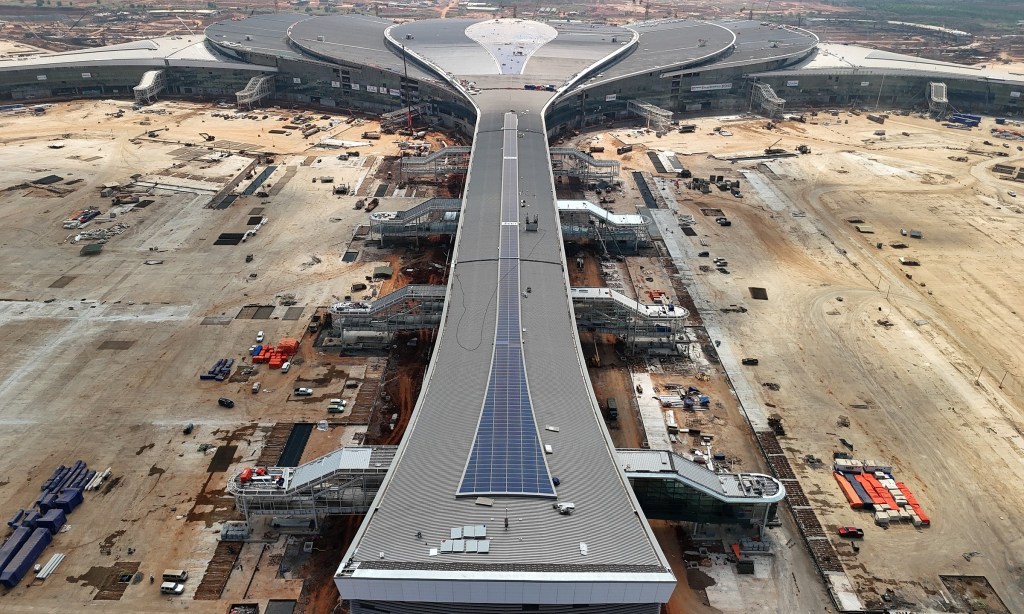
The drive for connectivity follows the preparation of Long Thanh Airport, a major national project spanning approximately 5,000 hectares with a total investment of nearly VND337 trillion ($12.9 billion), set to start commercial operations in June 2026.
In its initial stage, the airport, which has a planned capacity of 25 million passengers annually, is expected to mainly cater to travelers from Ho Chi Minh City and nearby areas. Current transportation connections depend on the Ho Chi Minh City-Long Thanh-Dau Giay Expressway and National Highways 1 and 51.
Quang mentioned that some have proposed that Long Thanh manage all international flights, with Tan Son Nhat focusing solely on domestic routes, but he warned against such a strict separation. He referenced Tokyo, where Haneda and Narita airports handle both international and domestic flights depending on market needs and airline choices, rather than a fixed division.
What is important, he stated, is managing the airport system effectively.
The General Secretary of the Party, To Lam, has assigned Ho Chi Minh City the responsibility of addressing the connectivity issue between the two airports.
Quang also recognized challenges within the local area. The traffic near Tan Son Nhat continues to be disorganized, and moving between its three terminals is a significant issue. Terminal T3, which was introduced in April 2025 as a new domestic terminal, is located separately from the older T1 and T2 buildings. A traveler who arrives at the incorrect terminal might have to spend up to an hour getting to the right one during busy times.
According to Quang, the underlying reason is that there was never a thorough overall plan for linking the airport with other forms of transportation. The infrastructure was developed incrementally over the years to address immediate needs, resulting in an inconsistent network.
Regarding the long-awaited underground parking structure at Tan Son Nhat, Quang mentioned that the city “takes responsibility” for the delayed development. Constructing an underground parking lot using public money is extremely costly, and private investors have been hesitant due to the challenging sustainability of the revenue model.
“If you charge 1 million VND ($38) per hour per vehicle, that is unacceptable. However, charging tens of thousands or even 100,000 VND ($3.80) would not be sufficient to cover expenses,” he said.
The municipality intends to investigate funding options for investors, possibly via land distribution or financial incentives.



 jasdooit
Leave a comment