
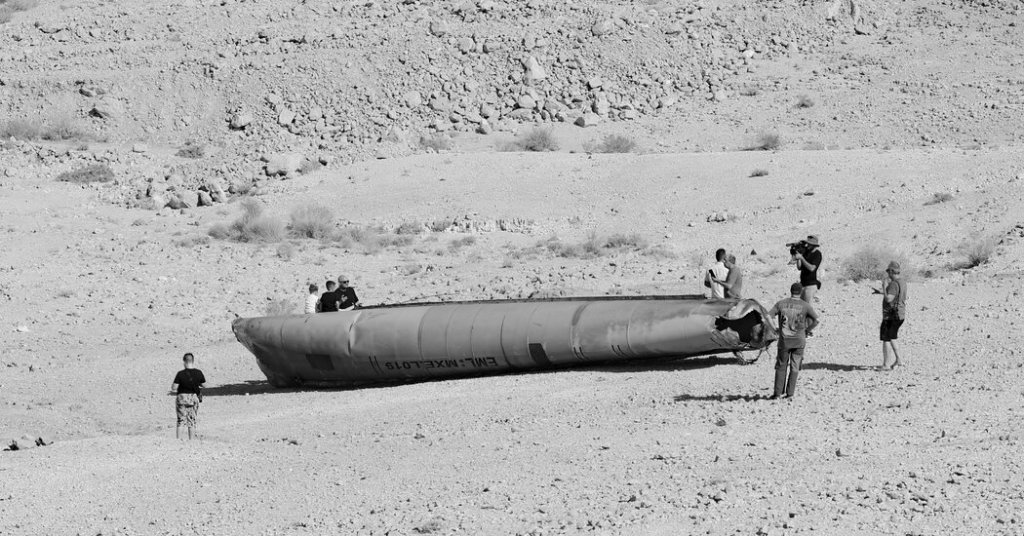
A leader from the organization that won the Nobel Peace Prize raises concerns about the potential deliberate or accidental deployment of weapons
The ongoing conflicts in the Middle East have brought back worries regarding Israel’s well-documented yet unofficially recognized nuclear capability, as an expert has cautioned about devastating outcomes should these weapons be deployed in the fighting.
As stated by Alicia Sanders-Zakre, the policy head at the Geneva-based International Campaign to Abolish Nuclear Weapons (ICAN), it is “generally recognized by specialists that Israel possesses nuclear capabilities, although this has not been officially confirmed by either Israel or the United States”.
“This is, naturally, extremely risky since as long as a nation has a nuclear arsenal, there’s a possibility that nuclear weapons could be deployed either on purpose or by mistake,” Sanders-Zakre stated on Tuesday.
Are you curious about the major issues and developments happening globally? Find the solutions withSCMP Knowledge, our latest platform offering carefully selected content including explainers, FAQs, analyses, and infographics, presented by our acclaimed team.
In 2023, concerns emerged about whether Israel might deploy nuclear arms in the conflict in Gaza, following a statement by Israeli politician Revital Gotliv calling for the use of a “doomsday weapon” that could be delivered via Israel’s Jericho ballistic missiles.
On February 28, after the initiation ofUS and Israeli airstrikes against Iran, worries emerged about the possibility of nuclear escalation.
On March 7, Israeli Prime Minister Benjamin Netanyahu stated themilitary operation against Iran would persistwith “full strength,” including “numerous surprises to destabilize the government.”
Although numerous international organizations and nations claim that Israel possesses a nuclear arsenal, the country has consistently adhered to a stance of nuclear ambiguity.
According to ICAN, a 2017Nobel Peace Prizerecipient, nine nations across the globe possess nuclear arms: the United States, Russia, the United Kingdom, France, China, India, Israel, Pakistan, and North Korea.
It is reported by ICAN that Israel is believed to possess approximately 90 nuclear warheads.
As per the US-based non-profit Center for Arms Control and Non-Proliferation, “Israel is commonly thought to have 90 nuclear warheads based on plutonium and has manufactured sufficient plutonium for 100-200 weapons”.
The warheads might be deployed by Israel’s American-made aircraft and German-produced submarines, as both are capable of carrying nuclear weapons.
Israel also possesses its own Jericho ballistic missiles capable of carrying nuclear warheads, as stated by the center.
Sanders-Zakre stated that Israel had not issued an explicit or implicit nuclear threat during the Iran conflict, but due to the “secrecy” surrounding Israel’s nuclear weapons, “it’s not something they would openly threaten or discuss.”
She further stated that any use of nuclear weapons would be “catastrophic,” noting that it could result in a death toll reaching into the hundreds of thousands or even millions if exploded in a densely populated region.
Sanders-Zakre mentioned that it might also result in long-term effects, including environmental pollution and health issues across generations, such as cancer.
She mentioned that it is challenging to measure the probability of nuclear deployment, referencing a persistent danger of incidents, misjudgments, or accidental activation.
Although we certainly hope no one would intentionally consider the immense devastation caused by nuclear weapons, the reality is that there will always be a risk of their use as long as they remain in existence.
Only the United Kingdom, China, France, Russia, and the United States are officially recognized as “nuclear-armed states” according to the Treaty on the Non-Proliferation of Nuclear Weapons. This particular classification is in place because these five nations developed and conducted nuclear tests with an explosive device prior to 1967.
Although the treaty has almost universal participation – such as Iran – India, Israel, and Pakistan have never ratified it. North Korea was initially a signatory to the treaty but left in 2003.
The agreement mandates global inspections of nations without nuclear weapons to confirm that nuclear materials are not diverted to a weapons program, which Sanders-Zakre described as “almost impossible” to achieve within the framework of the conflict involving Iran.
The United States and Israel have consistently claimed that Iran is near developing a nuclear weapon and have maintained that the recent air strikes andoffensive in June of last yearwere warranted as they aimed to prevent Tehran from ever acquiring nuclear weapons.
Sanders-Zakre stated that after the United States exited the nuclear accord, Tehran violated the deal’s restrictions by increasing uranium enrichment to levels that could be further processed into weapons-grade material.
Nevertheless, she stated, “there is still genuinely no reliable proof that [Iran] has moved forward to actually create a weapons program.”
As per Sanders-Zakre, the key agreement for Israel to consider is the Treaty on the Prohibition of Nuclear Weapons (TPNW), an accord that any nation, including those possessing nuclear weapons, can participate in to advance the removal of their nuclear arms.
According to Article 4, any nation possessing nuclear weapons that becomes a party to the TPNW is required to promptly take its nuclear arsenal out of active service. Additionally, within 60 days after the treaty comes into effect for that country, it must present a legally enforceable, time-limited proposal for the confirmed and permanent dismantling of its nuclear weapons program.
However, none of the nine countries with nuclear weapons have joined the TPNW.
“Most nations across the globe do not ensure protection for their people via nuclear arms,” Sanders-Zakre stated.
They recognize that these weapons are excessively destructive and too dangerous to contemplate owning, and they learn another lesson to safeguard their security through alternative methods.
More Articles from SCMP
As some Singapore apartments exceed 60 floors, will residents encounter stricter regulations?
Drink in Focus: DDL Old Fashioned at Terrible Baby
This piece was first published on the South China Morning Post (www.scmp.com), a top news outlet covering China and Asia.
Copyright (c) 2026. South China Morning Post Publishers Ltd. All rights reserved.


 jasdooit
Leave a comment