

A historic heatwave is expected to impact millions in the Southwest, with temperatures exceeding 100 degrees three months ahead of the official start of summer in the US.
The alarming prediction was set in motion by a large ‘heat dome’ developing across 14 states, includingCalifornia, Nevada, Arizona, Utah, New Mexico, Colorado and Wyoming.
Parts of Oregon, Idaho, Montana, Nebraska, Kansas, Oklahoma and Texas will also experience the impact, as meteorologists from AccuWeather have cautioned that temperatures during the week will be 15 to 30 degrees higher than usual for mid-March.
A high-pressure system acts as a cover, forming above and holding hot air near the ground, reducing cloud formation and increasing solar radiation.
The long-term warming pattern is anticipated to continue until Thursday, with many cities across the area likely to break daily temperature records between March 17 and March 19.
By Wednesday, temperatures in Los Angeles, Phoenix and Las Vegasare anticipated to remain around 100 degrees Fahrenheit, a temperature usually reached by mid-June.
Temperatures in California’s Death Valley, the hottest and most arid national park, could climb to 108 degrees by Wednesday, potentially setting a record for the earliest extreme heat.105 degrees ever recorded.
The AccuWeather team mentioned that ‘minimal changes’ were anticipated as the weekend approached, indicating that the intense heat might continue past Thursday, possibly resulting in unforeseen wildfires across the region.Texas, Oklahoma and New Mexico.
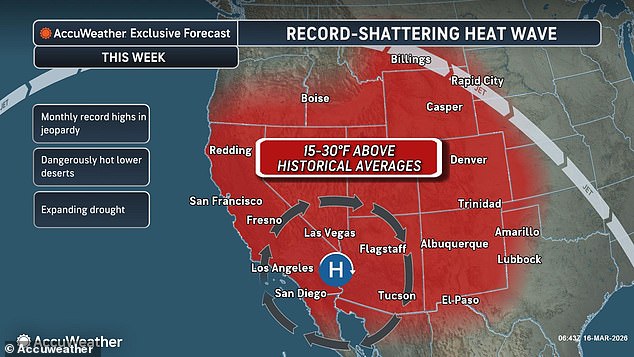
A thermal dome occurs when the jet stream, a swift current of air located high above the United States, creates a bulge or high-pressure ridge.
This elevation forms a barrier that disrupts typical weather systems, causing warm air to descend and remain confined beneath the ‘dome,’ while preventing storms and colder air masses from approaching.
Senior Meteorologist Alan Reppert from AccuWeather stated: ‘Heat domes are similar to a balloon. They grow and shrink throughout the day, and when you’re within one, it can be quite hot.’
In this scenario, the severe conditions have created an environment where numerous climate records could be broken within four days this week, even as much of the US continues to face intense winter weather.
Weather experts predicted that Los Angeles would hit 98 degrees on Wednesday. Nevertheless, if the heat dome causes temperatures to rise to 100, officials stated that it would surpass the record for the earliest day reaching 100 degrees, which was established in 1874.
Phoenix, Arizona is anticipated toexperience consecutive 100-degree days on Wednesday and Thursday,reaching 101 and 104, respectively.
The city usually has temperatures in the mid to high 70s during March. Up until this week, the only day Phoenix has ever recorded 100 degrees in March was on March 26, 1988.
In Las Vegas, Nevada, temperatures during mid-March typically remain in the low 70s. Exceeding 100 degrees this week would set a new record, surpassing the previous milestone for the earliest day reaching 100 degrees, which was on May 1, 1947.
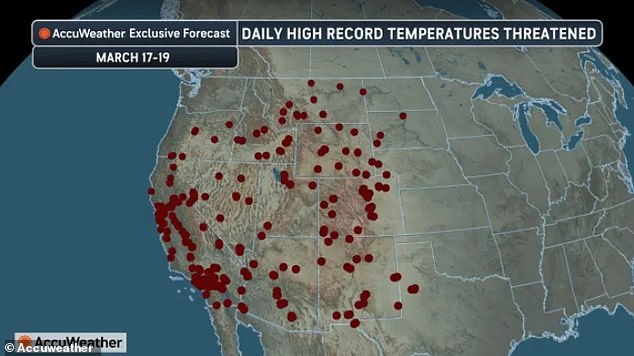
Although certain regions may not hit 100 degrees, the majority of the Southwest is forecasted to rise into the 90s this week.
In Denver, Colorado, people are anticipating the first 90-degree day of the year to occur earlier than any time since 1992. The previous record for this temperature was set on April 30, indicating that this heatwave is expected to break that mark by five weeks.
Meteorologists also cautioned that the extreme heat could lead to flowers withering during a phase known as ‘superbloom’ — a unique ecological occurrence where vast quantities of wildflowers erupt in bloom simultaneously across desert regions.
The rising heat will rapidly dry out plants, raising the chances of fire starting,the AccuWeather team added.
Lakes that appear temporarily during the winter, like those in Death Valley, could alsowither because of the initial heat of summer.
AccuWeather meteorologist Elizabeth Danco stated: ‘This heat is occurring much sooner than usual, with temperatures in certain areas of the Southwest being one to two months ahead of typical averages.’



 jasdooit
Leave a comment