
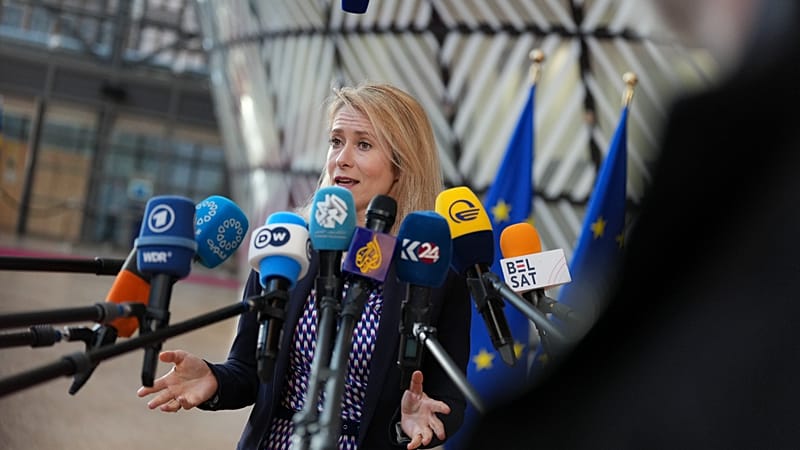
Kaja Kallas, the European Union’s top diplomat, stated on Monday that there is “no interest” in prolonging the EU’s naval operation Aspides into the Strait of Hormuz, even as there are increasing demands for Europe to assist in safeguarding the passage and avoid significant interruptions in global oil supplies.
It was discussed that Aspides should be reinforced since it doesn’t have a large number of naval resources,” Kallas said to reporters during a press conference after a meeting of foreign ministers in Brussels. “However, the discussion about whether we should also expand this mandate to include the Strait of Hormuz (…) there was no interest from the member states to do so.
“Nobody is eager to participate in this conflict,” she added.
Kallas commented following a meeting of the EU’s 27 foreign ministers in Brussels, where they deliberated on Europe’s approach to addressing the consequences of the conflict with Iran. This conflict has caused what experts call the most significant disruption to global oil supplies ever recorded and pushed oil prices beyond $100 per barrel.
Her comments also followed a day in which US president Donald Trump urged Europe to assist in safeguarding the Strait of Hormuz, cautioning that NATO could face a “very poor” future if its members do not support Washington’s position.
Ministers specifically addressed the possibility of enhancing Aspides, a defensive initiative launched in February 2024 in response to ongoing assaults by Iran-backed Houthis on global maritime traffic.
Aspides focuses on defending ships, ensuring the freedom of maritime movement, and overseeing the sea conditions across a wide region that includes the Strait of Hormuz, as well as the Red Sea, Gulf of Aden, Arabian Sea, Gulf of Oman, and the Persian Gulf.
However, on Monday, Trump’s appeal yielded minimal success as EU nations were unwilling to broaden the scope of Aspides.
Entering the meeting, German Foreign Affairs Minister Johann Wadephul excluded any involvement of Germany in the operation, while his Romanian counterpart, Oana-Silvia Toiu, indicated that Bucharest does not wish to participate in the Aspides mission, as the country must maintain its concentration on its naval capabilities in the Black Sea.
Luxembourg’s foreign minister, Xavier Bettel, expressed similar concerns and emphasized that the EU is not directly engaged in the conflict.
“Through satellites and communication systems, we are pleased to be of assistance, but please don’t inquire about troops and machinery,” he stated to journalists before the Foreign Affairs Council.


 jasdooit
Leave a comment