
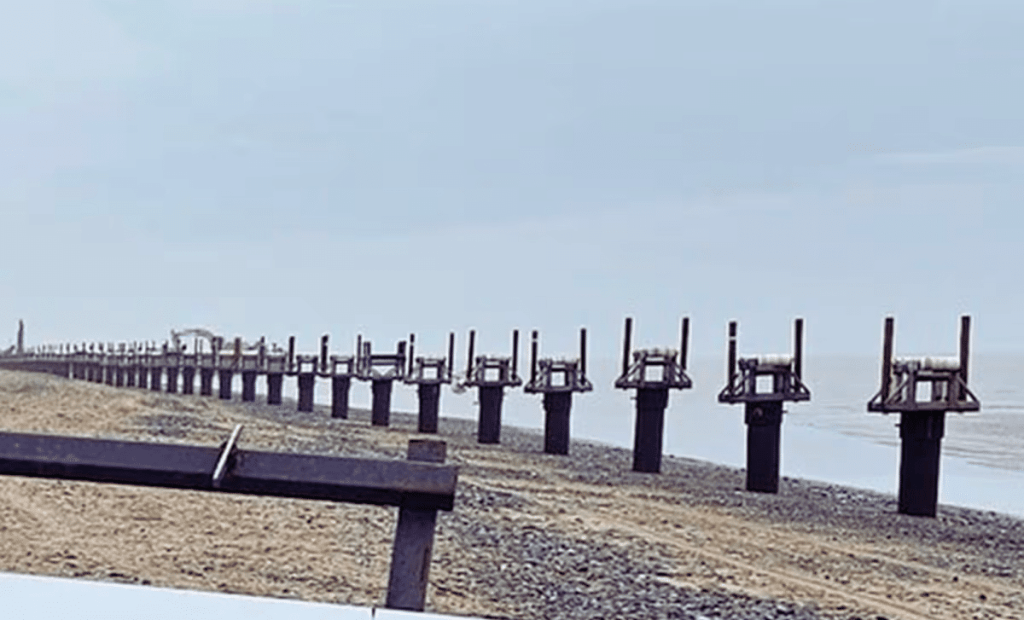
The iconic Talacre Beach in Flintshire, North Wales,is currently hosting unusual steel structures that have confused both residents and tourists. These temporary displays, labeled as a “pipeline welding highway” by signs at the location, are part of the large-scale HyNet initiative designed to cut down on carbon emissions. Nevertheless, the sight of these odd structures along the coast has sparked inquiries, as their final function is key to grasping how the UK is addressing climate change. As per North Wales Live reports, the works, although temporary, are crucial for a new pipeline network connected to carbon capture and storage technology. The installation will proceed until the summer of 2026, with assurances that everything will be completely removed once the project is done.
The Concept Behind the Unusual Buildings
Initially, the lines of steel supports at Talacre Beach appear to be an unattractive industrial feature, yet the true story behind them is much more important. As reported byNorth Wales Live, these structures are part of the multi-billion-pound HyNet initiative, aimed at loweringcarbon emissionsby moving captured CO₂ from industrial locations to underwater storage areas. As part of this process, a new pipeline will be installed between the Point of Ayr gas terminal and a subsea location in Liverpool Bay, where the captured CO₂ will be stored under the ocean floor.
The requirement for a new pipeline arises from the current system’s failure to handle CO₂ transportation. As oneHyNet spokesperson explained,
This cable will provide the necessary power and enhanced communication capabilities to facilitate the receiving and transporting of CO₂ to the storage locations.
This framework plays a vital role in the UK’s broader initiative to reduce industrial carbon emissions and combat climate change, positioning Talacre Beach as an unforeseen battleground in this worldwide struggle.
How “Trenchless” Technology Functions
A significant aspect of this project involves the application of “trenchless” methods for laying the underground pipeline without affecting the terrain. These approaches, including Horizontal Directional Drilling (HDD), let cables and pipelines be installed beneath the surface without requiring large-scale excavation or causing harm to the natural surroundings. This method is especially beneficial in locations such as Talacre Beach, where the sand dunes are a protected area that needs to stay untouched.
A representative from HyNet added further details,
HDD enables us to install cables beneath the ground without affecting the surface, requiring only minimal excavation on both sides of the area.
This cautious method minimizes ecological effects, enabling the project to be finished while honoring the nearby terrain. These methods facilitate the placement of new electrical and communication lines, essential for upcoming CO₂ control, while guaranteeing the site is restored to its original condition after building.
Timeline of the Building Process
The work on Talacre Beachis not anticipated to remain indefinitely. The steel structures currently visible on the beach are part of a temporary arrangement for the pipeline construction. As per the HyNet project schedule, the pipeline installation is planned to occur between February and April 2026. Following this, a cable-laying ship will be employed to pull the cables from the shore to the offshore storage facility, an operation expected to take place from June to August 2026.
Once construction is complete, HyNet Has pledged to return the site to its initial condition. “This implies that there will be no noticeable facilities on the beach once the construction is finished,” stated a representative, emphasizing the company’s dedication to eliminating all temporary structures and keeping the beach as clean as possible. This meticulous planning demonstrates the project’s goal of combining contemporary energy infrastructure with the preservation of natural surroundings.
Effect on Residents and Tourists
Although the structures are temporary, they have not escaped the attention of the local residents. Several people have expressed disapproval of these industrial facilities, referring to them as an“eyesore” that disturbs the otherwise peaceful beach setting. Although there have been these complaints, HyNet has made efforts to reduce the disturbance caused by the project, such as putting up protective screens to decrease dust and hide the sight of the construction work.
For those visiting the beach, this summer might seem different as the shoreline changes, but the long-term advantages may be greater than the short-term inconveniences. The initiative is part of a larger strategy to makeNorth Wales a key figure in the UK’s approach to carbon capture and storage, anticipated to greatly cut down on industrial CO₂ emissions.
Enjoyed this article? Sign up for our complimentary Newsletterfor captivating narratives, unique material, and up-to-the-minute updates.


 jasdooit
Leave a comment