
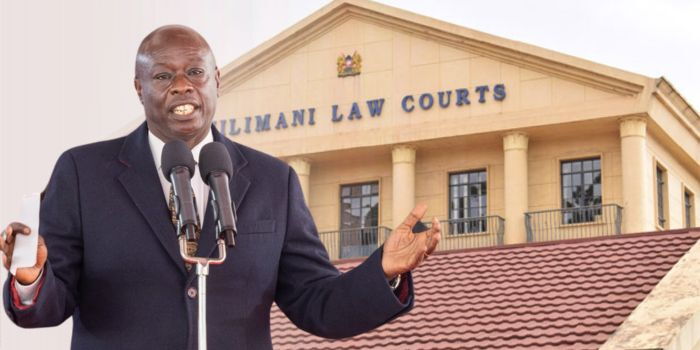
Petitioner Joseph Enock Aura has indicated his plan to appeal following the High Court’s rejection of his proposal for a larger panel of five judges to consider his revised constitutional petition aimed at removing Kithure Kindiki from his position as Deputy President.
A panel of three judges, including Justices Anthony Mrima, Eric Ogola, and Freda Mugambi, on Thursday rejected Aura’s request to increase the number of judges and to halt the proceedings in the combined legal cases.
Aura stated he had been excluded from those proceedings, which deal with the same central matter as the impeachment of Rigathi Gachagua.
The court stated that it did not have the authority to direct the expansion or restructuring of the bench, pointing out that the responsibility to appoint judges is solely vested in the Chief Justice according to Article 165(4) of the Constitution.
In their decision, the judges made a difference between the judicial duty of determining if an issue involves significant constitutional matters and the administrative task of forming a panel.
“Once the High Court has fulfilled its judicial responsibility by recognizing a petition as presenting a significant legal issue, and the Chief Justice has subsequently carried out her constitutional duty by forming a bench, the procedure is concluded,” the judges said.
Aura, via his attorney Harrison Kinyanjui, requested that the revised petition be heard by a five-judge panel, contending that the case involves new and significant constitutional matters related to Kindiki’s appointment.
He argues that Kindiki’s selection as Deputy President earlier this year is unconstitutional because he had not officially stepped down from his role as Cabinet Secretary for Interior prior to assuming the new position.
Aura also claims that no official notice was published to officially confirm Kindiki’s departure from the Cabinet.
He further argues that Musalia Mudavadi was named as acting Cabinet Secretary on October 31st, 2024, to take over from Kindiki via Executive Order Number 5 of 2024. However, a comparable Executive Order Number 5 of 2024 was already released on July 5th, 2024, and he claims that it is not legally possible for two executive orders to be issued in this manner.
Aura claims that due to this, Mudavadi was unable to take up the role, and thus no legal public holiday was announced on November 1, 2024, for Kithure Kindiki’s inauguration as Deputy President.
The participants, including Parliament and the Speaker of the National Assembly, rejected the request, stating that the Chief Justice holds exclusive authority to select judges and that the court lacks the power to oversee or modify this procedure.
Aura maintained that his request for the certification of the issues referred to the Chief Justice had been initiated by the Chief Justice herself.
He mentioned that he was not requesting the court to instruct the Chief Justice on how to use her discretion in any manner that goes beyond what the Constitution requires.
The court determined that after a case has been approved and a panel of judges appointed by the Chief Justice, the procedure is finalized and cannot be reconsidered via new requests.
Such applications, the judges cautioned, might result in an increase of interim conflicts and weaken the effectiveness and conclusiveness of the judicial process.
“The constitutional document does not consider a situation where parties might frequently go back to court asking for new certification or referral in order to obtain a different panel of judges,” they said.
Soon following the judgment, Kinyanjui requested permission to appeal, showing that his client was unhappy with the outcome.
The bench approved the request and instructed the Deputy Registrar to issue certified copies of the decision and related documents to support the appeal.
In an appeal notice submitted on the same day, Aura indicated his plan to contest the decision and directives in front of the Court of Appeal.
Aura’s revised petition is part of multiple connected cases involving former Deputy President Rigathi Gachagua, with the main petition requesting damages related to his removal from office.
Attorney Kinyanjui also expressed worries that splitting the cases might harm his client, possibly restricting his capacity to thoroughly present his arguments because of the res judicata principle.
“My client is deeply concerned about the clear and undeniable injustice that could be imposed on him. The bias is that the principle of res judicata will prevent him from discussing issues that another panel might address regarding the same matters he is presenting,” he stated.
Although there was a setback regarding the bench’s composition, the revised petition contesting Kindiki’s term is still ongoing and will move forward for a hearing unless the appellate court steps in.
The issue is set to be discussed on April 23, 2026, for additional instructions.
Provided by SyndiGate Media Inc.Syndigate.info).



 jasdooit
Leave a comment