
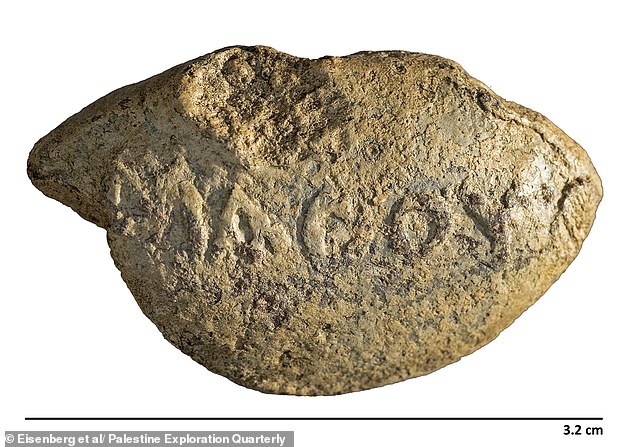
Archaeologists have discovered a sling bullet dating back 2,000 years, featuring a mocking message directed at its intended recipient – “Learn your lesson.”
A tiny, almond-shaped weapon, which would have been fired from a hand-held projectile device, was discovered among the ruins of the ancient city of Hippos inIsrael.
It has dimensions of 3.2 x 1.95cm (3.2 x 0.76 inches), weighs 38 grams, and probably belonged to the Greek defenders of the city.
Although many lead sling bullets have been discovered at the location, this particular one is notable – as it is the first to feature this specific engraving.
“Sling bullets were an inexpensive type of ammunition, a hand-throwing projectile, utilized for thousands of years,” said Michael Eisenberg, an archaeologist from the University of Haifa, to the Daily Mail.
This marks the first occurrence of the Greek word ‘learn’ found on sling bullets – likely reflecting the local defender’s sense of humor.
His group think the term could be understood as a sarcastic command directed at adversaries moving along the road.
And it joins other similar inscriptions found in the area, featuring dark humor – such as those that say ‘catch’ and ‘take a taste’.
The text was probably made by pouring molten lead into a mold that had the Greek letters ΜΑΘΟΥ engraved on it.
The writers have understood the inscription as a variation of the word ‘mathaíno’, meaning ‘to learn’, and they think the spelling suggests it was a directive implying ‘learn your lesson’.
“This reflects the city’s defenders’ local sarcastic humor, as they aimed to impart a lesson to their adversaries with a hint of irony,” Dr. Eisenberg stated.
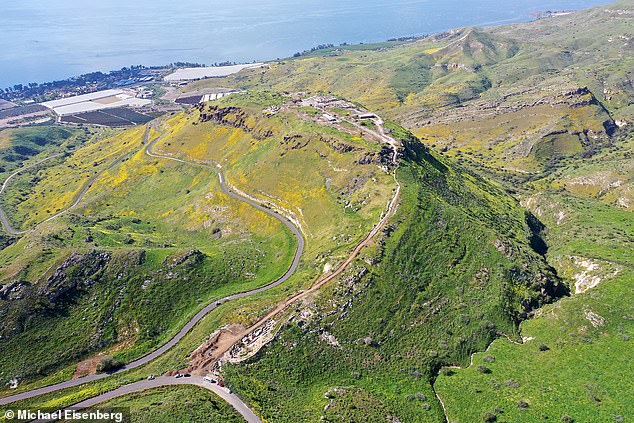
The old city of Hippos, also referred to as Sussita, was situated approximately a mile east of the Sea of Galilee.
The archaeologists think the bullet was shot by someone defending the city from the walls, which had a view of a road.
It was discovered using a metal detector in 2025, near a location that would have been “the most practical point of attack on the city’s main gate.” It was located 260 meters (853 feet) away from the city walls, showing the remarkable range they could achieve.
One edge of the bullet was damaged due to a strong collision, and specialists believe it initially had a mass of 45 grams.
“Within close range, they were very effective in targeting individuals, but at greater distances, they worked well against groups of enemies,” said Dr. Eisenberg.
Although the majority of sling bullets are unmarked, some have been discovered to feature the names of deities, military groups, cities, individual names, and expressions of triumph, the team stated in the journal.Palestine Exploration Quarterly.
‘While some feature a scorpion or a thunderbolt, the bullet mentioned in this paper is the first with an engraving,’ they noted.
Sling bullets were some of the most widely used ammunition during that period, according to the researchers, since they were inexpensive and simple to produce.
Examination of this sling bullet suggests it originates from the latter part of the second century, or the early first century BCE.
Dr. Eisenberg mentioned that it’s possible the bullet was fired during the conflict between the Jewish Hasmonean kingdom, which was advancing into the Galilee and the Golan.
“In 101 BC, Alexander Jannaeus was attempting to take control of Hippos and this area,” he added.
He mentioned that other situations could also occur, such as the slingshot being deployed in previous conflicts between various Greek kingdoms or being utilized in training exercises.
“We aren’t sure whether it was a stone or a person, but there was definitely a collision,” he stated.
A projectile shaped like an almond, crafted from lead or stone, would have been inserted into the central pocket of a sling before being launched.
The operator would grip the rope ends and swing the sling quickly above their head or to the side to generate motion energy.
They would subsequently let go of one rope at an exact time, causing the bullet to swiftly move toward an opponent.
Certain calculations indicate the projectile might travel up to 400 meters (1,312 feet).


 jasdooit
Leave a comment