
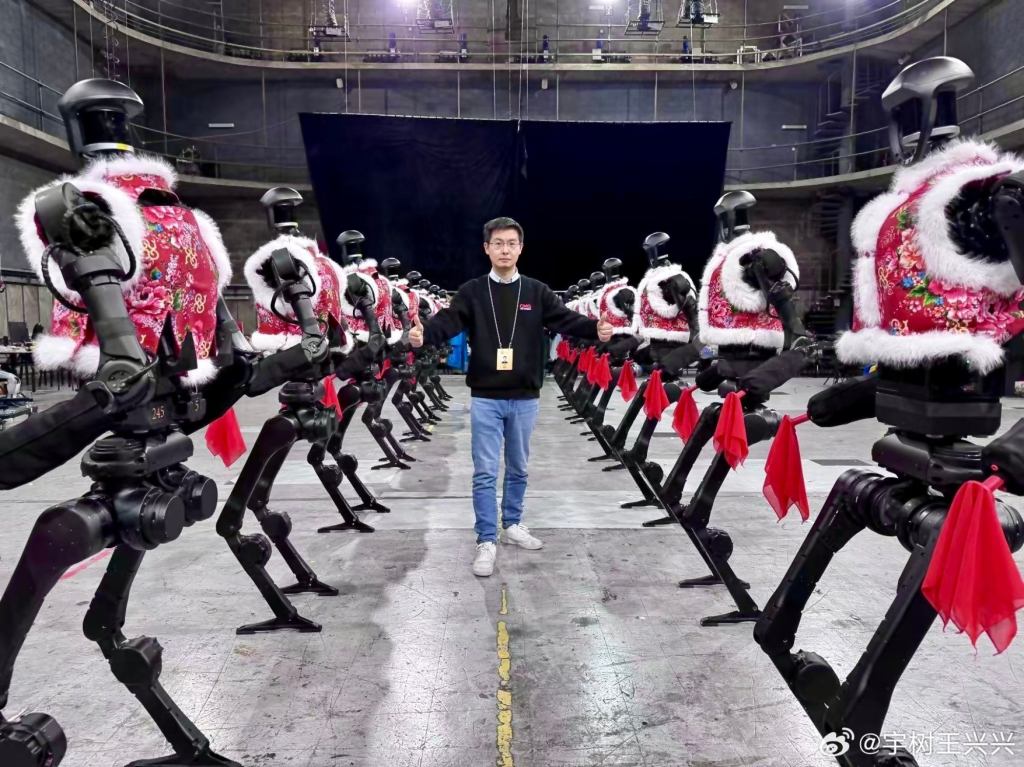
If approved, the listing would serve as an indicator of investor interest in so-called embodied AI companies.
China’s Unitree Robotics has filed for a highly anticipated first public offering (IPO)on Shanghai’s Stock Exchange, aiming to raise approximately 4.2 billion yuan (US$607.8 million).
Regarded as an indicator of China’s developing humanoid robotics sector, Unitree’s potential listing may serve as a significant trial for investor interest in so-called embodied AI enterprises.
Here’s what you should be aware of regarding Unitree, such as how it generates revenue when competitors are still experiencing financial losses, its ownership structure, details about its supply chain, and its list of clients.
Are you curious about the most significant issues and developments happening globally? Find the solutions withSCMP Knowledge, our latest platform featuring curated content including explainers, FAQs, analyses, and infographics, presented by our acclaimed team.
Who is the founder?
Founder Wang Xingxinghas strong control, with a 23.8 percent direct ownership share and almost 69 percent of voting power.
Born in 1990 in Ningbo, Zhejiang province, and having studied at Zhejiang Sci-Tech University in Hangzhou and Shanghai University, Wang established Unitree in 2016. He is reportedly a highly involved CEO,deeply involvedIn research and development (R&D), conducting personal interviews with candidates and managing almost all operational aspects. He gained attention when he was seen sitting in the front row at President Xi Jinping’s event.high-profile business symposium in February 2025.
Who are the investors?
External shareholders include Meituan, HongShan China (formerly known as Sequoia China), and Matrix Partners China, who hold approximately 9.6 percent, 7.1 percent, and 5.5 percent respectively. Tech giants such as Tencent Holdings, Alibaba Group Holding, Ant Group, Xiaomi, and ByteDance have also invested, either directly or indirectly, along with industrial players like BYD and Geely, as well as state-backed funds from cities including Shanghai and Beijing. Alibaba holds the South China Morning Post.
The firm’s latest funding round in June 2025 assigned it a valuation of 12.7 billion yuan. Experts and market analysts anticipate a post-IPO value exceeding 100 billion yuan.
“Thank you for allowing us the chance to invest in Unitree five years back,” said Xiaomi’s CEO Lei Jun to Wang during a Xiaomi press event last week.
What is the financial status of Unitree?
The company achieved its initial profit in 2024, generating 94.5 million yuan on a revenue of 392 million yuan. During the first nine months of 2025, net profit amounted to 105.3 million yuan. The adjusted net profit for last year increased by 674 per cent compared to the previous year, reaching 600 million yuan.
The profit margin for its primary operations has increased consistently, reaching nearly 60 percent in 2025. Humanoid robots generate even greater margins.
Inventory is not accumulating: the sell-through rate was 85 percent for quadrupeds and 96 percent for humanoids during the first nine months of 2025.
The organization employs what it refers to as a “full-stack, internal” development method, implying that it creates its robots and essential parts internally, allowing for greater oversight of hardware expenses. As manufacturing has expanded, its influence over suppliers has increased.
Unit prices have decreased, with quadrupeds averaging 27,200 yuan last year, down from 38,600 yuan in 2022, and humanoids at 167,600 yuan, compared to 593,400 yuan in 2023.
What about R&D expenses?
The financial outlook is positive, yet some analysts have expressed concerns regarding R&D investment. Research and development costs increased from 30 million yuan in 2022 to 90.2 million yuan during the first nine months of 2025. Nevertheless, as a percentage of revenue, this proportion has significantly decreased, dropping from 24.4 percent to 7.7 percent.
The company’s research and development department consists of 175 employees, accounting for approximately 37 percent of the overall workforce, with only four individuals holding doctorates, a composition that differs from competitors who emphasize top academic qualifications as a key feature.
Who buys Unitree’s robots?
A wide-ranging question surrounding the IPO is whether the humanoid robot sector is prepared for commercial success. Currently, 73.6 percent of Unitree’s revenue from humanoids still originates from clients in scientific research and education — a percentage that has been decreasing but continues to be significant. The potential of humanoids revolutionizing industrial production and other sectors remains largely unfulfilled.
What comes next?
Unitree mentioned that it intends to use the funds from the IPO to finance new robot designs, AI models, and increased production capabilities. The biggest portion, exceeding 2 billion yuan, is designated for a project referred to as an “intelligent robot model development.”
With a solid foundation in hardware and motion control—systems that allow robots to walk and move efficiently—Unitree is now focused on developing more advanced “brains,” allowing robots to better comprehend physical environments and carry out tasks independently. This is the competition that the whole industry is engaged in.
The firm’s financial strategy aims to achieve an annual output of 75,000 humanoids and 115,000 four-legged units over the next five years, with estimated revenue reaching 5.7 billion yuan.
Wang concluded the submission with the motto, “Let us collectively bring to life humanity’s ultimate aspiration – [artificial general intelligence].” This concept denotes a theoretical form of AI that can apply knowledge and abilities across various tasks, matching human performance. This differs from specialized AI, which is created for particular functions.
More Articles from SCMP
International investors turn to China’s ‘stability’ during uncertainty: speakers at the Milken forum
What makes China’s ASN-301 suicide drone more lethal compared to its Iranian equivalent?
This piece was first published in the South China Morning Post (www.scmp.com), a top news outlet covering China and Asia.
Copyright (c) 2026. South China Morning Post Publishers Ltd. All rights reserved.


 jasdooit
Leave a comment