

On February 28, 2026, the military forces of the United States and Israel conducted an operation in Iran, targeting the capital city of Tehran. This resulted in the death of Supreme Leader Ali Khamenei and injuries to many others. Following this, Donald Trump declared that the US would continue its operations in Iran until there was a shift in leadership and the dismantling of Iran’s alleged nuclear program. Trump later stated that the attack on Iran was due to a report indicating that Iran planned to strike Israel in the near future. Israeli Prime Minister Benjamin Netanyahu referred to this approach as ‘forward defence’. Over the next 21 days, Donald Trump launched more than 7,000 attacks on Iran, prompting Iran to retaliate with strikes across nine Gulf nations. Over 2,000 individuals have lost their lives in the conflict, which was fueled by Western-made weapons.
Attacks on March 18
On March 18, Donald Trump stated that Israel had killed Iran’s security chief Ali Larijani and commander Gholamreza Soleimani. Larijani was seen as a moderate figure within the Iranian government. He was involved in discussions with the US and Israel aimed at reducing tensions over Iran’s nuclear program and has consistently supported dialogue with Western nations. Some experts suggest this action might be intended to block channels for future negotiations between Israel and Iran. The Iranian government also confirmed the death of intelligence minister Esmail Khatib. Khatib has been in his position since 2021 and was Iran’s leading intelligence official.
The Israeli Defense Forces (IDF) also targeted Iranian energy facilities on March 18. The strikes damaged the South Pars natural gas field and the Asaluyeh processing hub in Bushehr Province, two critical sites for Iran’s domestic natural gas production. The attacks on March 18, which aimed at Israeli officials, have reportedly triggered significant fear within the Iranian government, leading security personnel and officials to seek shelter in cars, mosques, and sports centers. Israeli Prime Minister Benjamin Netanyahu stated that the IDF has authorization to neutralize any high-ranking Iranian official.
“Prime Minister Benjamin Netanyahu and I have given the Israel Defence Forces (IDF) permission to remove any high-ranking Iranian official whose intelligence and operational network has been secured, without requiring further authorization,” – Israeli Defence Minister Israel Katz.
Trump calls out allies
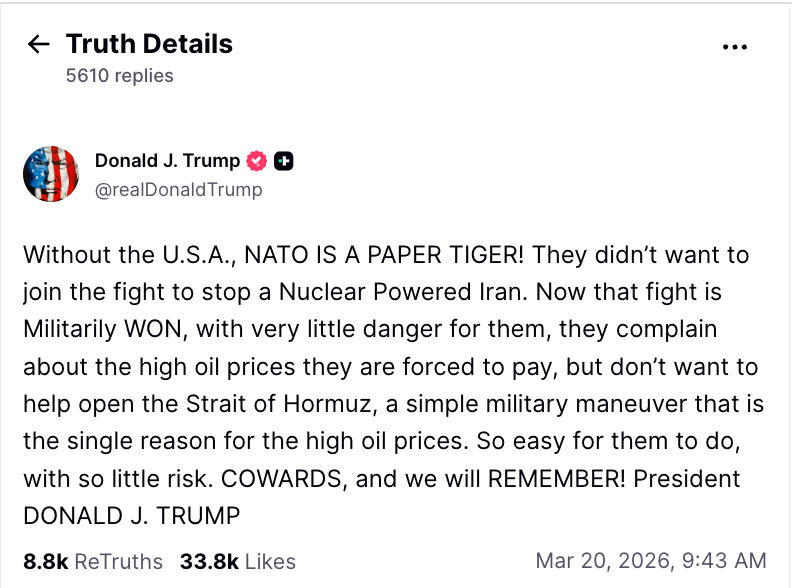
Following the wave of attacks by Israel and Iran on Wednesday, President Trump started to feel anxious. His conflict with Iran has led to a sharp increase in gas prices, making them unaffordable. If these prices keep rising rapidly, the global economy could face serious threats. With Israel posing a threat to the Hormuz Strait, which carries a third of the world’s crude oil, oil prices have surged. Trump has urged his NATO and EU partners to assist the US in securing the Strait, but these allies have declined. On March 18, Trump issued a statement condemning his Western allies, labeling them as weak and timid.
Donald Trump is encountering significant criticism due to the increasing cost of gasoline in the United States. Americans are experiencing the immediate impact of Donald Trump’s created conflict, as fuel prices have increased by over 30% since February 28.th. Donald Trump’s approval rating has dropped to unprecedented lows, and his pledge of ‘no new wars’ is now far behind him; it’s stuck in Canada.
March 19th attacks
On March 19, Israel targeted energy facilities in Iran, leading Iran to retaliate by attacking liquefied natural gas plants in Qatar’s Ras Laffan Industrial City. This industrial area processes one-fifth of the world’s natural gas. It is expected that the damage caused by Iran’s attacks will require several years to fix, and Qatar’s ability to export has been reduced by 17% due to the destruction. Donald Trump condemned Israel for the strike, arguing that Iran was inflicting excessive harm. Trump is now witnessing the repercussions of allowing the US to become involved in a conflict that does not directly concern it. As Iran demonstrates its capacity to continue military responses despite US and Israeli attacks, there remains no definitive schedule for resolving this conflict. Iranian missiles have repeatedly penetrated Israel’s Iron Dome defense system, and nearly 4,000 Israelis have been injured in Iranian attacks.
On March 19, Iran carried out strikes in six different nations, including Saudi Arabia, Kuwait, Bahrain, the UAE, and Iraq, which all confirmed experiencing attacks. The Iranian strikes primarily targeted energy facilities and military installations. Bahrain International Airport was also among the locations hit. Overall, Iran launched over 25 waves of attacks across six countries on that day.
Cost of war
As of March 20thPreliminary data reveals alarming numbers of victims in the Middle East. In Iran, over 1,400 individuals have lost their lives due to US and Israeli attacks. US forces have conducted more than 7,000 strikes in Iran, resulting in 1,444 fatalities, 18,500 injuries, and over 3 million displaced people. A US attack on an all-girls primary school killed 168 children last week. In Lebanon, more than 1,000 people have been killed by Israeli strikes, with an additional 2,500 injured and over 1 million civilians forced to flee. Thirteen US military personnel have died, and 18 people have been killed in Israel. Eighty-five individuals have perished from Iranian strikes in Gulf nations.


 jasdooit
Leave a comment