

In response to allegations that a “barrier of information” between investigative bodies contributed to the incident, suspect Kim Hoon, who was subject to an electronic ankle bracelet restriction, killed the victim.
Professor Lee Soo-jung, from the Department of Criminal Psychology at Kyonggi University, appeared on the Chosun Ilbo YouTube channel *Samjadae*, which was posted on the 27th, and stated, “If the police handling the stalking case had been aware that Kim Hoon was wearing an electronic ankle monitor, the tragedy might have been avoided.”
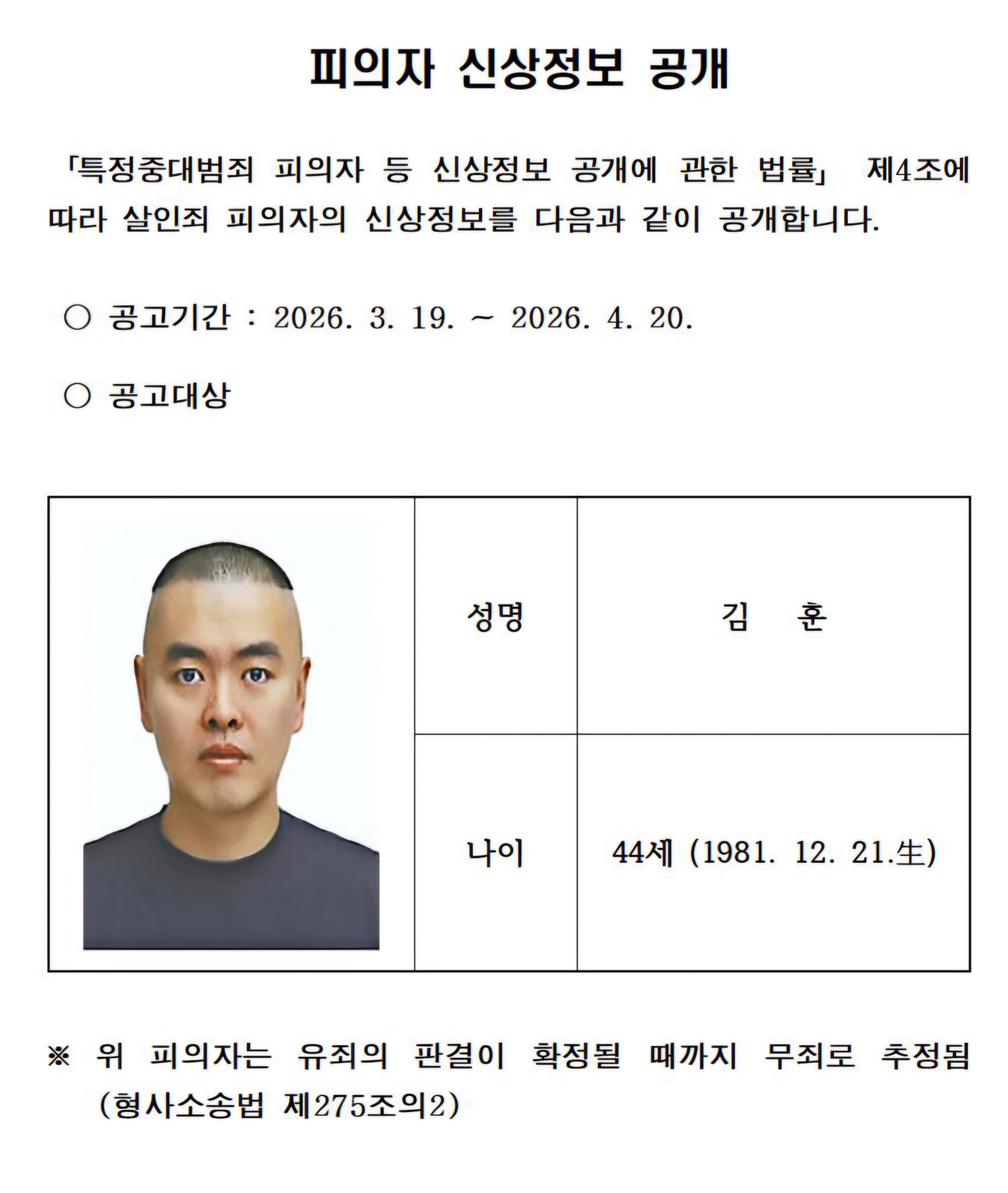
At the time the crime occurred, Kim Hoon had been released from prison following a sentence for a different sexual offense and was subject to an electronic ankle monitor. The victim reported Kim Hoon to the authorities for stalking, and on the 21st of last month, also told them that Kim had placed two location tracking devices beneath her car.
The authorities implemented Temporary Measures 2 and 3 as outlined in the Act for the Punishment of Domestic Violence, along with Provisional Measures 1 to 3 under the Stalking Punishment Act against Kim Hoon. These measures restrict him from coming within 100 meters of the victim’s home and place of work. A smartwatch was also given to the victim.
Professor Lee said, “The police who took actions concerning stalking were not aware that Kim Hoon had been required to wear an electronic ankle monitor because of a previous sexual offense.” He mentioned, “Only approximately 1% of all sexual offenses lead to an order for an electronic ankle monitor, as it is only used for the most severe cases,” and noted, “Nevertheless, since the electronic ankle monitor is handled by the Ministry of Justice, the police responsible for the victim were unable to obtain the details.”
In situations where judicial police officers have investigative powers, they are able to review a suspect’s previous criminal records and are informed if the individual has been required to wear an electronic ankle monitor. However, in the case of Kim Hoon, the Act on Special Cases Concerning the Punishment of Domestic Violence was implemented, which emphasizes separating the victim from the perpetrator and preventing future incidents rather than focusing on criminal penalties.
Professor Lee stated, “As Kim Hoon was not considered a criminal suspect, the police handling the stalking case could not access his previous records.”
He stated, “If they had been aware sooner, they could have exchanged the smartwatch for a newer version to stop the crime.” He further mentioned, “If there had been a new smartwatch connected to the electronic ankle monitor, Kim Hoon’s actions could have been intercepted earlier.”
In the end, Professor Lee mentioned that systemic gaps had a major impact on this situation. Because of the high obstacles set by the Personal Information Protection Act, the police and the Ministry of Justice found it difficult to exchange information regarding the suspect, ultimately leading to the failure to stop the murder.
Professor Lee advocated for a system similar to the UK’s *Clare’s Law*, which enables partners to ask about previous records of violence. *Clare’s Law* was established following the murder of Clare Wood, a British woman, by her boyfriend in 2009. It was discovered that the offender had a history of domestic abuse, which prompted the creation of a law allowing individuals to check the past records of their partners or spouses.
He stated, “Rather than a basic criminal history check, a ‘Right to Ask’ system should be implemented, allowing the police to notify potential victims about a offender’s previous record when it is in the public interest and necessary for safety.” Additional information is available on the Chosun Ilbo YouTube channel *Samjadae*.




 jasdooit
Leave a comment