
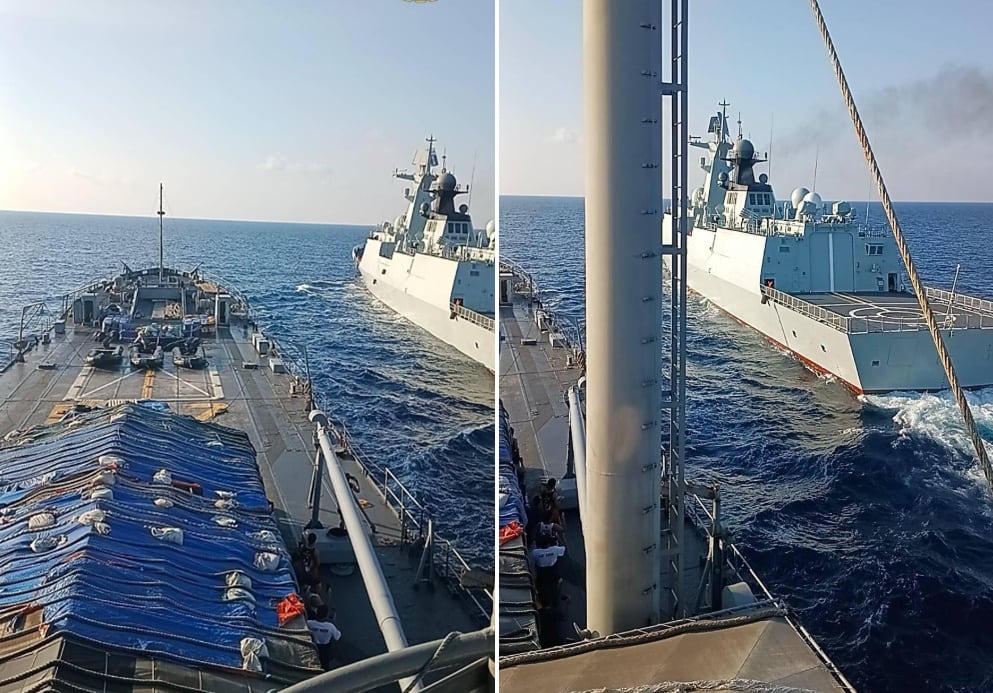
A scenario unfolded in which Chinese and Philippine naval ships came dangerously close to each other in a territorial conflict in the South China Sea, almost resulting in a collision. As tensions between the two nations continue to rise over the South China Sea, both sides exchanged sharp words during high-level discussions but agreed on the importance of addressing tensions through dialogue and communication.
As reported by USNI, a media platform focused on maritime security under the U.S. Naval Institute, on the 29th, the Chinese People’s Liberation Army Navy’s 054A-class guided missile frigate Binzhou came very close to the port side of the Philippine Navy’s BRP Benguet on the 25th, nearly resulting in a collision between the two vessels.
The Western Command, which oversees military activities in the South China Sea involving the Philippines, mentioned that the incident took place when the Philippine Navy crew changed their course to avoid the Binzhou, which had initially approached in a threatening manner. In a statement, the Western Command said, “This hazardous action was provocative and clearly breached the International Regulations for Preventing Collisions at Sea (COLREGs).” It further noted, “However, the BRP Benguet’s calm and firm reaction stopped the situation from escalating while safeguarding everyone on board.” Video released by the Western Command depicted the Binzhou quickly moving toward the port side of the BRP Benguet.
This marked the second reported confrontation between the navies of the two countries in the South China Sea this month. Earlier in the month, a Chinese military ship caused controversy by activating a fire-control radar on a Philippine frigate near Sabina Reef in the Spratly Islands. Furthermore, over recent years, several incidents have occurred in the region, including China carrying out aggressive maneuvers, collisions, water cannons, and other non-lethal actions against the Philippines.

Nevertheless, the Chinese party asserted that the Philippine naval ship deliberately came close in a hazardous manner, disregarding repeated radio alerts. As reported by the Chinese state media outlet CCTV, Zhaishichen, a representative from the Southern Theater Command of the Chinese People’s Liberation Army, mentioned, “While carrying out regular patrols within Chinese territorial waters, we detected a Philippine Navy ship and tried to notify it through radio communication. However, the Philippine vessel dismissed the repeated warnings and intentionally turned in the same direction.”
China denied the Philippines’ assertion that its vessel had approached in a threatening manner. Zhaishichen stated, “The operations of the Philippine Navy vessel were hazardous and unprofessional, posing a risk of a maritime incident. The Philippine side is making false accusations by claiming that the Chinese vessel acted dangerously.” He further mentioned, “The Philippine side should strictly regulate its maritime and air activities, immediately cease all provocative actions, and stop defaming and spreading propaganda against China.”
Amid these changes, China and the Philippines conducted the 11th session of their bilateral consultation mechanism (BCM) regarding the South China Sea issue in Fujian Province on the 28th. Throughout the meeting, China reiterated its previous position that the Philippines was accountable for the rising tensions in the South China Sea. Nevertheless, both parties acknowledged the importance of maintaining stability to avoid unintended confrontations. They agreed to enhance maritime communication and dialogue, manage maritime situations appropriately, and promote practical collaboration.




 jasdooit
Leave a comment