
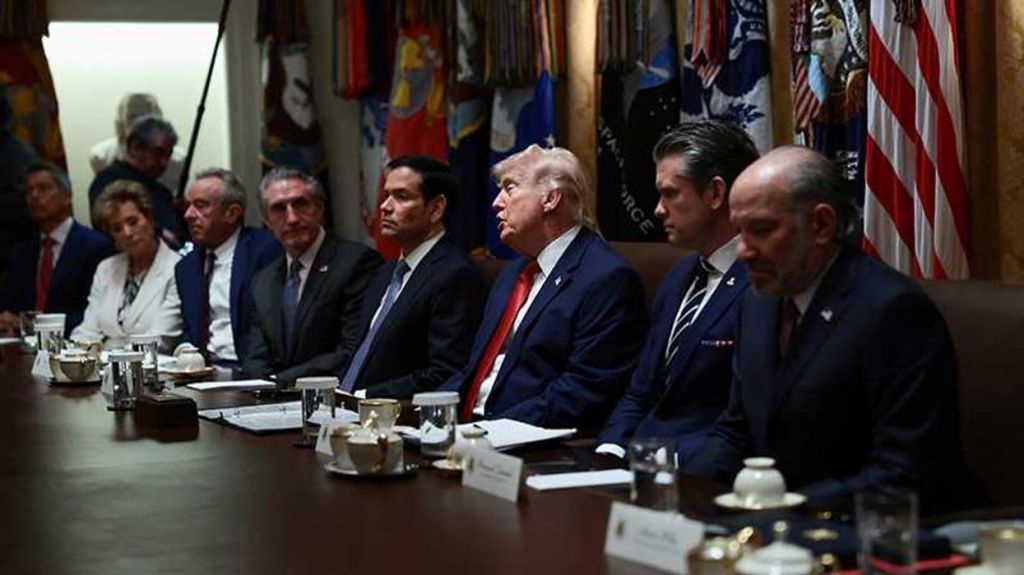
The management of elections has changed significantly over time.
This article was originally published by Votebeata non-profit news group focused on local election management and voter accessibility.
When Steve Simon, the Minnesota Secretary of State, began his role in 2015, he often had to clarify the responsibilities of his position to others.
No longer, he states, largely due to President Donald Trump.
Simon, a member of the Democratic Party, and former Alabama Secretary of State John Merrill, a Republican, met with Votebeat’s editor-in-chief Carrie Levine on Wednesday to explore how the Trump administration has been altering election processes and the potential effects on the 2026 midterm elections.
If you didn’t catch it, you cancatch a repeat of it hereHowever, one key lesson was that although regular people have more knowledge about elections than before, the details of how they function—such as the laws related to them and the balance of priorities needed to manage them effectively—are not as central to the discussion as they should be.
“That’s the most significant event, which is that the president has highlighted what many viewed as a routine, almost automatic duty,” Merrill stated.
Trump’s second term started in a similar fashion to how his first one concluded: with the president determined to alter voting processes according to his preferences. This time, that has manifested as hisMarch 2025 executive orderand his determined effort to urge Congress topass the SAVE America Act, which aims to put into practice elements of the executive order thatcourts have halted, such as mandating voters to present evidence of citizenship.
Simon stated that Minnesota was among several states that filed a lawsuit regarding the proof-of-citizenship requirement in the president’s executive order, and the states prevailed by highlighting that, regardless of the policy’s merits, the Constitution does not grant the president power over elections.
Our Founding Fathers assigned the responsibility for elections to the state level, entrusting it to our individual member states,” Merrill stated. “That is where it should continue to be.
Nevertheless, Simon suggested, it’s possible the White House recognized the executive order was legally uncertain, yet is attempting to push the boundaries of election law and the Constitution with these measures.
And the executive order is not the only method the administration is using to get involved in how states manage elections. The Department of Justice hassued 29 states, including Minnesota, for unredacted versions of their voter registration lists, supposedly to check if the states are correctly adhering to the Help America Vote Act,a 2002 lawthat revised voter registration and electoral management.
Several states, including Minnesota, are claiming that privacy regulations stop them from providing the records. To date, no court has required a state to release its voter list, although one state (Oklahoma) did so last week.agreed to transfer the information opted to provide the data approved the release of the details gave permission to hand over the information accepted to deliver the data allowed the transfer of the information concurred in providing the data sanctioned the sharing of the details acknowledged the handover of the information supported the exchange of the dataas part of a legal agreement. Three of the caseshave been dismissed, although appeals are moving through the judicial system.
The following day after the Votebeat event,CBS News also reportedthat Simon’s office had been served with a subpoena by the Department of Justice and Department of Homeland Security requiring it to provide the records of over 125 Minnesota voters.
However, whether a citizenship verification requirement is eventually implemented or the Department of Justice prevails in its legal challenges, the federal government is already influencing the administration of the 2026 midterm elections. States have followed Trump’s example by enacting their own citizenship verification rules (South Dakota became the latest state to join the expanding list last week).reverted mail-in voting provisions. (Simon also mentioned a lawsuit regarding the legality of mail-in ballots received after Election Day, which the U.S. Supreme Courtheard discussions on last Monday, shared a significant amount of DNA with Trump’s executive order.)
Countries are also getting ready for other methods the Trump administration might attempt to influence elections, beyond just advocating for the president’s preferred policies. Simon mentioned that election officials are consistently preparing for a wide range of potential disruptive situations that may not actually occur — from bomb threats to weather-related issues. Now, one addition to this list is federal agents arriving at polling places, a situation he believes has a “nonzero chance” of taking place.
“We’re brainstorming what that might look like in our minds,” Simon said, noting that his office has been examining Minnesota laws about law enforcement at polling stations and whether they apply to federal agents.
We are convinced the answer is affirmative and ready to implement it.
He is not by himself. In response to those same worries, New Mexico has recentlypassed a lawcompletely prohibiting federal law enforcement from entering voting areas.
However, as Simon pointed out, election officials are facing a delicate challenge. How can they get ready for this potential interference, and communicate with the public, without causing unnecessary worry and deterring people from casting their votes?
“We aim to identify it and give it a name, rather than shying away from it, while simultaneously informing people about the solutions,” he said.
Generally, it’s beneficial that due to Trump, more individuals are now focusing on election administration matters, according to Merrill. However, the discussion lacks sufficient understanding.
Merrill voiced irritation that some of the most vocal individuals commenting on election management matters have only engaged with the voting system as a voter.
They have never been involved in the voting process and have no experience with how it functions, how it is structured, or the specific procedures that are in place.
To address this, individuals should reach out to their local authorities and observe the procedure firsthand, Merrill stated. He has discovered that, when people do so, they frequently recognize how effectively the system operates.
There’s definitely a significant demand for election workers, and maybe if more individuals took Merrill’s guidance, there would be fewer issues in the functioning of democracy.
Carter Walker works as a journalist for Votebeat, in collaboration with Spotlight PA. Reach out to Carter atcwalker@votebeat.org.
Votebeat is a non-profit media outlet that focuses on local election fairness and voter accessibility. Subscribe to their newsletters.here.
Related Articles:
・Trump’s final option: Behind his four-part strategy to undermine American democracy
・What Trump is hiding from you regarding the 2026 elections
・The concealed ‘justification’ Trump may employ to undermine the midterms: election rights specialist
・Trump’s most recent effort to influence the midterms has simply ‘failed’

 jasdooit
Leave a comment