
The journey highlights Washington’s dissatisfaction with the budget deadlock, although experts indicate that the true authority regarding Taiwan policy lies with the White House.
Four senior American senators are currently in Taiwan for a two-day trip aimed at advocating for the passage of a NT$1.25 trillion (US$40 billion) legislation.special defence budgetsuggested by the island’s administration but delayed by the opposition amid rising military pressure from Beijing.
The visit, viewed as indicating increasing frustration in Washington due to the delays, occurs as Taipei deals with an approaching payment deadline.deadlinesmultiple US-sanctioned arms shipments, with financial details remaining undecided because of the political deadlock.
Taiwanese leader William Lai Ching-te, who met the bipartisan group at his office on Monday, stated that the delays were due to “political factors” but emphasized that Taipei’s dedication to enhancing its defense capabilities and increasing collaboration with the United States “has remained unchanged in every way.”
Are you curious about the most significant issues and developments happening globally? Find the solutions withSCMP Knowledge, our latest platform offering handpicked content including explainers, FAQs, analyses, and infographics, presented by our acclaimed team.
“The exclusive budget is a detailed strategy aimed at quickly boosting military strength and addressing possible dangers,” Lai stated, calling on legislators from all political factions in Taiwan to back the initiative.
The trip, which continues until Tuesday, is co-led by Jeanne Shaheen, a Democrat from New Hampshire and ranking member of the Senate Foreign Relations Committee, along with John Curtis, a Republican from Utah. Additionally, it features Thom Tillis, a Republican from North Carolina, and Jacky Rosen, a Democrat from Nevada.
Shaheen stated that the visit highlighted the US Congress’ “strong and lasting dedication” to Taiwan, based on the Taiwan Relations Act and “years of support for peace and stability in the Taiwan Strait.”
“We acknowledge and appreciate the measures Taiwan has implemented to enhance its defense and preparedness – these are essential for maintaining deterrence,” she stated.
Curtis, who once served as a young missionary in Taiwan, stated that the island’s security is “critical” for the United States and that initiatives to increase military funding are being closely monitored in Washington.
“When the United States is focusing on security in this area, we hope Taiwan is making similar efforts – that we progress collectively,” he stated.
After the meeting, Curtis clearly supported the suggestion when speaking with journalists.
“I’d like to personally support the special defense budget and let you know that, back in Washington, my colleagues are paying attention — this is significant,” he stated.
Rosen reemphasized the United States’ dedication to peace and stability in the Taiwan Strait, yet highlighted that “Taiwan needs to keep investing in its own defense measures, as deterrence plays a crucial role in ensuring stability.”
The suggested financial plan has beenblocked repeatedlyin the legislative body since the announcement was made at the end of last year, with opposition parties advocating for reduced packages and enhanced monitoring.
This month, legislators decided to start examining the bill along with other proposals, such as a NT$380 billion initiative introduced by the Kuomintang (KMT), the primary opposition party on the island, and a NT$400 billion proposal from its smaller allied party, the Taiwan People’s Party.
A KMT legislator, Hsu Chiao-hsin, justified the delays, stating that all political parties agreed on enhancing national defense, while also noting that the US visit offered a chance to “clear up misconceptions” via direct dialogue.
Experts advised a careful understanding of the visit, noting that congressional support did not automatically mean solid strategic assurances.
Dennis Lu-Chung Weng, an associate professor of political science at Sam Houston State University in Texas, stated that the visit seemed supportive at first glance but was actually a demonstration of pressure from the sidelines.
“The main concern is not who is coming, but the extent of power these people still hold,” he stated.
In truth, the political significance of this delegation is not as substantial as it seems – it is indeed bipartisan, yet also a faction functioning on the edges of power.
Weng mentioned that as US President Donald Trump got ready for possible discussions with Chinese leader Xi Jinping, the actual authority to make decisions regarding Taiwan policy resided in the White House.
“Congress can express views, but it doesn’t always influence the result of discussions,” he stated.
The importance of the visit has been increased due to a more rigid purchasing schedule.
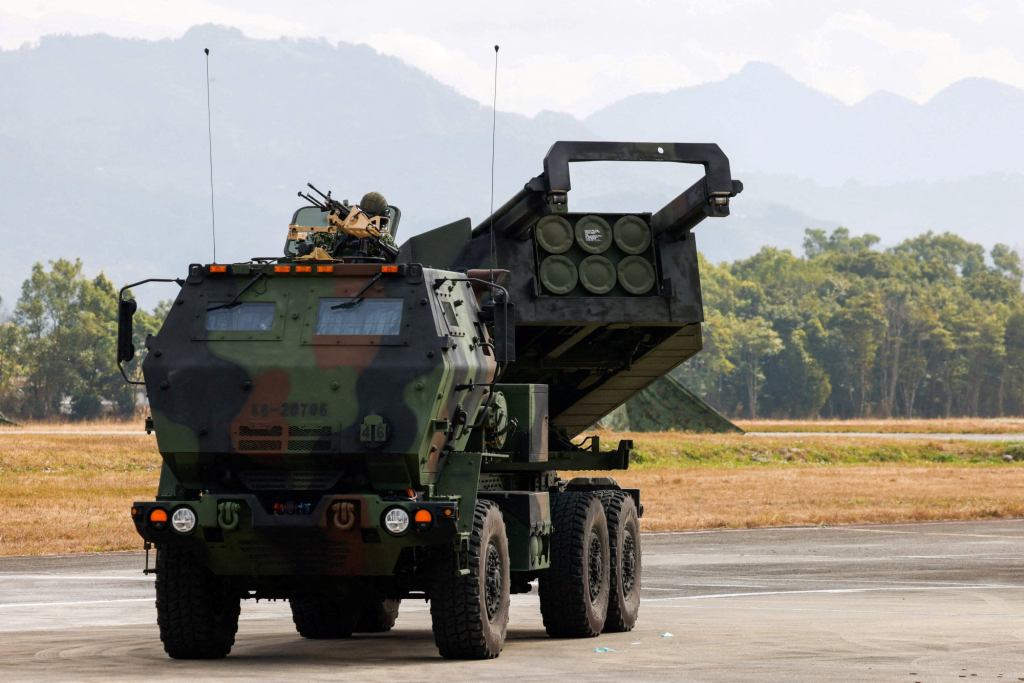
Taiwan’s Defense Minister Wellington Koo Li-hsiung stated on Monday that several military acquisitions—such as M109A7 self-propelled howitzers and additional orders for Javelin and Tow anti-tank missiles—are set to reach their first payment deadlines by March 31, but the necessary funding has not yet been secured.
Although the deadline for the Himars rocket systems has been pushed back to May, Koo mentioned that Taiwan would only have five days to finish the payment after the contract discussions ended.
Time is very limited,” he said to legislators. “If the first payment isn’t made, it will certainly impact the following delivery and training timelines.
Beijing considers Taiwan a part of China that should be reunified, even if force is required. Most nations, including the United States, do not acknowledge Taiwan as a separate country. However, Washington opposes any effort to seize the island through force and remains dedicated to providing it with military equipment.
More Articles from SCMP
Angus Chung aims for Group Two Chairman’s Trophy success on his “best horse I’ve ridden yet”
‘To accomplish something no one has’: quantum physicist Zhu Zijie departs Europe for China
Hong Kong sailor Tiger Mok created a milestone at sea – following a failure in his autopilot system
This piece was first published on the South China Morning Post (www.scmp.com), a top news outlet covering China and Asia.
Copyright (c) 2026. South China Morning Post Publishers Ltd. All rights reserved.

 jasdooit
Leave a comment