
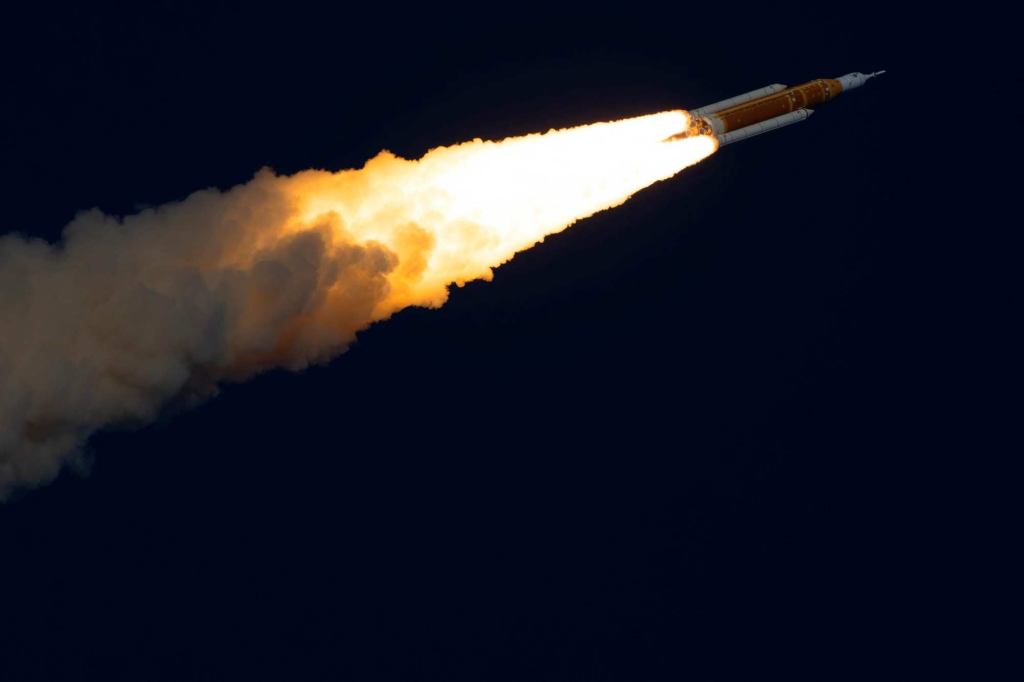
Four astronauts have been given permission to activate the Orion capsule’s engine for the first crewed lunar fly-by in 50 years.
NASA approved the four Artemis astronauts, who are orbiting Earth, on Thursday to travel to the moon and perform the first crewed lunar fly-by in over 50 years.
NASA Flight Director Jeff Radigan informed the astronauts that the mission management team had given the go-ahead to ignite the engine of their Orion capsule, directing the spacecraft toward a path leading to the moon.
A 5-minute and 49-second burn is planned to occur at 7:49 pm Eastern Time, propelling the astronauts beyond Earth’s orbit and starting a three-day journey to the moon, the first such mission since 1972.
Are you curious about the most significant issues and developments from across the globe? Find the solutions withSCMP Knowledge, our latest platform offering handpicked content including explainers, FAQs, analyses, and infographics, presented by our acclaimed team.
NASA stated that flight controllers will closely track engine performance, guidance, and navigation data during the maneuver to ensure the Orion spacecraft stays accurately positioned for the outbound trip.
The massive orange-and-white Space Launch System (SLS) rocket, which includes the Orion capsule, successfully launched from Kennedy Space Centre in Florida on Wednesday, beginning a highly anticipated trip around the moon.
The astronauts — Americans Reid Wiseman, Victor Glover, and Christina Koch, along with Canadian Jeremy Hansen — spent their initial hours in space conducting inspections and addressing small issues — such as a communication problem and a faulty toilet.
Prior to obtaining a few hours of rest, they activated the spacecraft’s primary engine to position it in a high Earth orbit, according to the US space agency.
Artemis II astronauts are in good shape,” said NASA administrator Jared Isaacman in a social media update. “The Orion vehicle is functioning well within an impressive elliptical orbit.
Orion will orbit the moon during the 10-day Artemis II mission, which is designed to prepare for a lunar landing in 2028.
Prior to their break, the astronauts conducted multiple inspections to confirm the dependability and security of a spacecraft that has not previously transported people.
One of the issues they noted was a “controller problem with the toilet during its activation,” stated Amit Kshatriya, NASA’s associate administrator.
Isaacman, the NASA leader, mentioned that a communication issue was fixed and the astronauts were “in high spirits.”
The mission represents a collection of historic achievements: dispatching the first person of color, the first female, and the first non-American to the moon.
If everything goes as planned, the astronauts will break the record by traveling further from Earth than any person has before — over 250,000 miles (400,000km).
It also marks the first manned mission of the SLS, NASA’s new lunar rocket.
SLS is intended to enable the United States to regularly return to the moon, with the aim of creating a lasting base that will serve as a foundation for additional exploration.
It was supposed to launch as early as February following years of delays and significant budget increases.
However, ongoing failures delayed the process and even required moving the rocket back to the hangar for maintenance.
The present phase of U.S. lunar funding is often depicted as a move to rival China, which seeks to send humans to the moon by 2030.
After a post-launch meeting, Isaacman mentioned that competition was “an effective method to harness a nation’s resources.”
Competition can be beneficial,” he stated. “And we definitely face competition today.
The Artemis program has faced pressure from U.S. President Donald Trump, who has urged for an accelerated timeline, aiming for astronauts to set foot on the moon before his second term concludes in early 2029.
However, the planned 2028 landing date has caused concern among certain specialists, partly due to Washington’s significant dependence on advancements made by the private sector.
More Articles from SCMP
How Donald Trump might reshape US objectives in the Iran conflict to support concluding it
Tai Po fire investigation: property company did not detect, monitor fire risks
This piece was first published on the South China Morning Post (www.scmp.com), a top news outlet covering China and Asia.
Copyright (c) 2026. South China Morning Post Publishers Ltd. All rights reserved.



 jasdooit
Leave a comment