
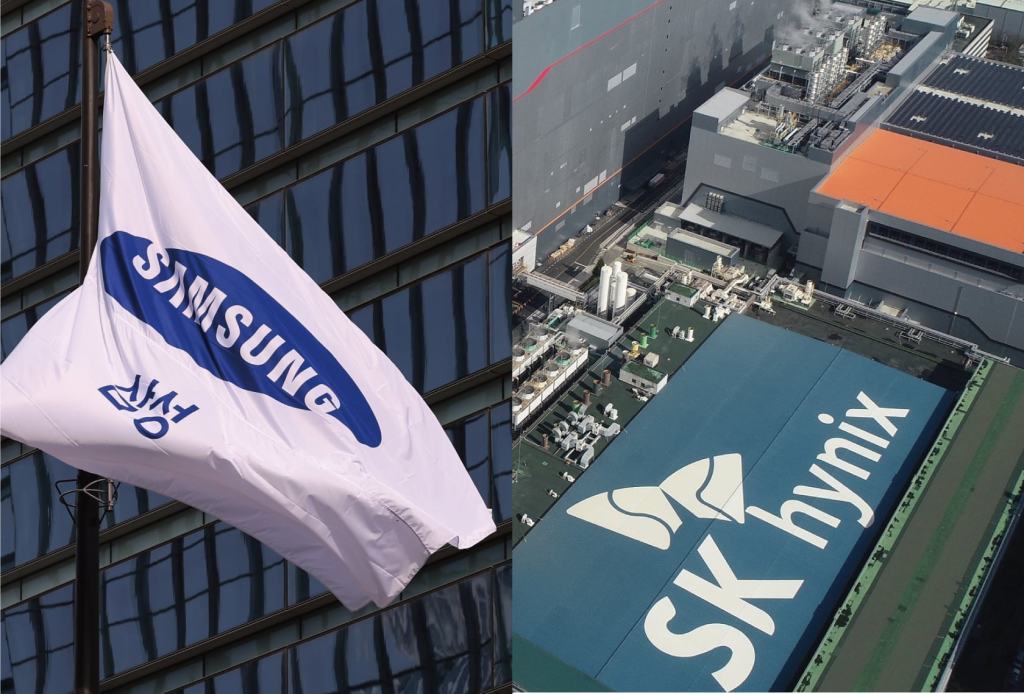
Amid increased instability in the local stock market caused by external factors like conflict-related variables, concern among retail investors regarding Samsung Electronics and SK Hynix is quickly increasing. After recent significant drops in share prices, individual investors saw this as a chance to purchase at lower prices and injected substantial funds. However, with stock prices not recovering, the number of investors experiencing losses has also risen. Financial experts believe that the upcoming earnings reports scheduled for next week may act as a pivotal moment for future stock price trends.
◇ 6 out of 10 SK Hynix Shareholders Suffering Losses…Quick Turnaround in Two Weeks
As reported by NH Investment & Securities on the 2nd, as of the end of last month, 61.8% of SK Hynix shareholders were experiencing losses. This figure marks a significant rise from approximately 27% just two weeks prior, indicating a sharp increase in the number of investors facing losses.
Samsung Electronics followed a comparable pattern. In the same timeframe, the loss rate for Samsung Electronics investors reached 41.57%, increasing by more than 20 percentage points from 21% on the 15th of last month. This swift decline in returns for individual investors is due to the significant short-term drop in major semiconductor stocks.
The real losses experienced by investors are also increasing. Mr. Kim, a 40-year-old employee working at a company in Gangnam-gu, Seoul, reportedly invested in a leveraged exchange-traded fund (ETF) that had a large share of Samsung Electronics and SK Hynix right after the war began. Mr. Kim said, “When Samsung Electronics’ stock price dropped below 200,000 won, I thought this was the bottom, but it has kept falling since then, and I am now facing ‘negative compounding.’ I now just hope for a single-digit negative return.”
◇Despite a Decline of More Than 20% in Stock Prices…Individuals Purchased Additional Shares
Despite the fact that major semiconductor stocks, which had previously risen above “200,000-won Samsung Electronics” and “1 million-won SK Hynix,” started to decline after last month’s conflict, it is believed that retail investors have become more aggressive in their purchases, viewing each drop as a “low-cost buying” chance.
As reported by the Korea Exchange on the 2nd, the stock prices of Samsung Electronics and SK Hynix dropped by 23.3% and 26.5% respectively in March. On the same day, following comments from U.S. President Donald Trump that reduced hopes for a temporary ceasefire, Samsung Electronics ended trading at 178,400 Korean won, reflecting a 5.91% decline from the previous day’s closing price, while SK Hynix also finished at 830,000 Korean won, down 7.05%.
Nevertheless, the top two stocks purchased by individuals during the same period were these two. Individuals net-bought 16.8172 trillion Korean won worth of Samsung Electronics and 7.0705 trillion Korean won worth of SK Hynix. Notably, even after the significant drop in stock prices following Google’s “TurboQuant” announcement on the 26th of last month, individuals bought more than 1.9 trillion Korean won and 1.1 trillion Korean won worth of each, respectively, showcasing their “buying at lower prices” approach.
The volume of purchases increased significantly. In February, individual net purchases reached 7.4974 trillion Korean won for Samsung Electronics and 4.5466 trillion Korean won for SK Hynix, but both stocks experienced nearly double the buying activity in March. This suggests a stronger influx of individual investor funds during the market downturn.
◇”Earnings Are Robust”… Next Week Could Be a Pivotal Moment
The securities sector asserts that the semiconductor industry continues to be strong despite temporary fluctuations in stock prices. There is a high likelihood of “earnings surprises” in the upcoming first-quarter reports next week. As per FnGuide, the projected first-quarter operating profit for Samsung Electronics this year is 32.4681 trillion South Korean won, and for SK Hynix, it is 31.1761 trillion South Korean won.
Chaeminsook, a researcher with Korea Investment & Securities, mentioned, “Memory contract prices are increasing quickly irrespective of current market prices,” and highlighted, “It is important to recognize that DRAM prices have hit record high levels, significantly changing the profit model from previous times.”
However, geopolitical risks continue to be a factor. Extended conflicts in the Middle East might lead to higher oil prices and disrupt supply chains, possibly increasing short-term instability. Song Myungseop, a researcher at iM Securities, stated, “Rising target stock prices are only possible if the conflict ends quickly,” and further mentioned, “In the case of a prolonged war, stagflation and lower liquidity would make downward adjustments to target prices unavoidable.”



 jasdooit
Leave a comment