
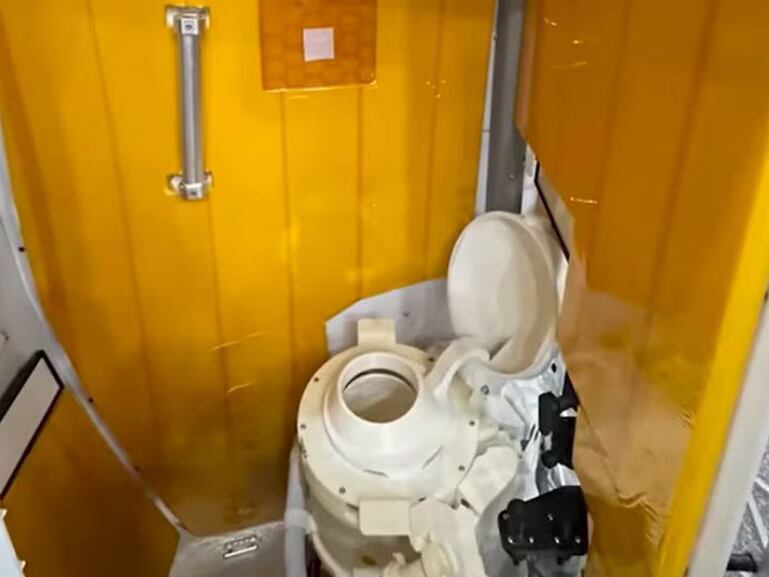
The U.S. National Aeronautics and Space Administration’s (NASA) manned Artemis II mission, set to travel to the Moon for the first time in 54 years, faced an unforeseen problem shortly after liftoff. A space toilet developed by NASA, which cost around 45 billion South Korean won, failed, leading some astronauts to use temporary solutions for urine processing.
As per NASA on the third, Christina Koch, a member of the Artemis II crew, noted an issue with the toilet system in the Orion spacecraft right after launch. The fan that aids in drawing urine in microgravity ceased functioning, causing operational challenges. Consequently, some crew members had to utilize an additional device resembling a funnel and a plastic bag.
Luckily, the ground control team took remote action, bringing the toilet back to normal function within hours of liftoff. The astronauts stated, “We are excited because the toilet problem has been fixed.”
In contrast to Earth-based systems, space toilets utilize air flow instead of water for waste management. A fan within the toilet generates a pressure difference to draw waste away. Urine and feces are handled separately. Urine is kept in a tank and occasionally released into space, whereas feces are gathered in bags, sealed in containers, and returned to Earth. These bags are engineered to release gas while keeping solids contained, also preventing odors and pressure accumulation.
In a microgravity environment, the body remains suspended, which means footrests and handholds are essential for maintaining position. If not properly aligned, waste might drift around, necessitating careful handling. A comparable system is employed on the International Space Station (ISS), where urine and sweat are processed and recycled into potable water. However, Artemis II does not feature this recycling capability because of its brief 10-day duration.
This event underscores the vital role of space sanitation technology. In the 1972 Apollo 17 mission, astronauts had to use plastic bags, but modern advancements have led to specialized toilets. As NASA aims to establish a lunar base in the 2030s, waste management is more than just a comfort—it’s a fundamental survival necessity. Specialists noted, “Waste treatment and life-support systems are key for extended space living. Stopping microbial growth and recycling materials are essential.”



 jasdooit
Leave a comment