
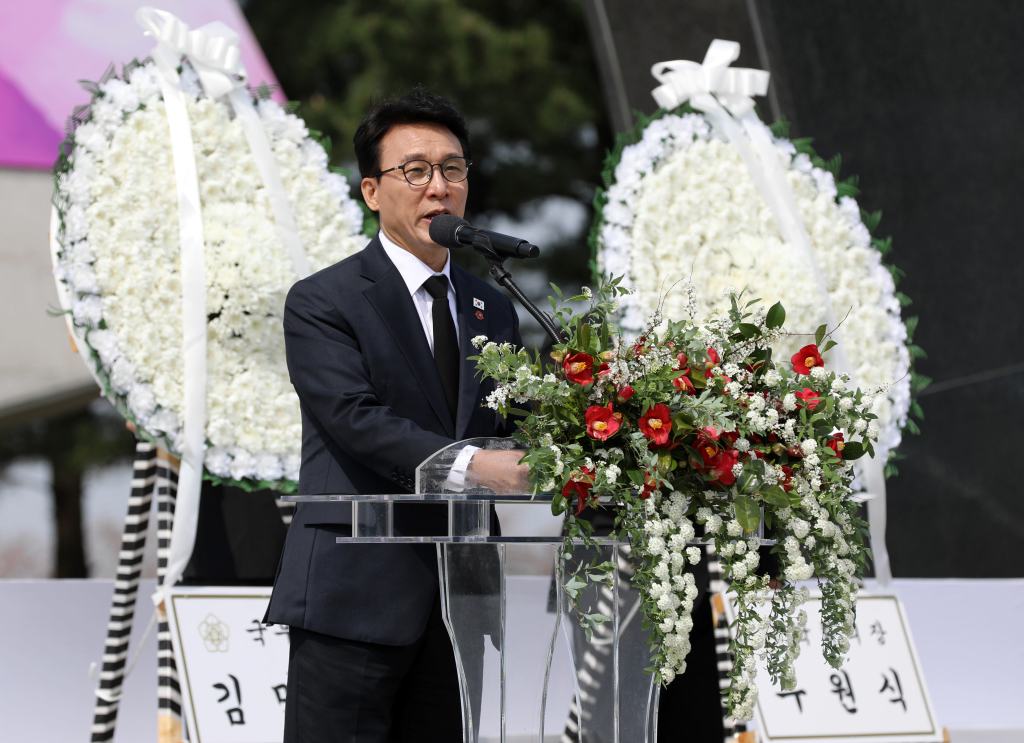
Prime Minister Kim Min-seok, on the occasion of the 78th anniversary of the Jeju 4·3 Incident on the 3rd, remarked, “The heart of the tragic event 78 years ago was an unlawful military regime,” and further noted, “The residents of Jeju Island, who have not let this history fade, safeguarded South Korea’s democracy against the unlawful military rule in 2024.”
The prime minister delivered this statement during a memorial speech at the Jeju 4·3 Peace Park on the same day’s morning. The Rhee Syng-man administration imposed martial law on Jeju Island on November 17, 1948, while quelling an armed uprising led by the South Korean Workers’ Party, which marked the first instance of such a declaration since the government’s formation. This decision has been contentious because it was issued prior to the passage of the Martial Law Act, making it unlawful.
Prime Minister Kim stated, “On December 3, 2024, when the threat of illegal martial law reemerged following the declaration by former President Yoon Suk-yeol, the Jeju Provincial Council was the first local council to pass a resolution calling for the president’s removal, and the residents of Jeju strongly rejected martial law with determined voices.”
In this regard, the prime minister said, “The residents of Jeju Island, who have not forgotten the events of 4·3, along with our citizens, safeguarded South Korea’s democracy. I express profound respect and appreciation.”
Prime Minister Kim stated, “The path of 4·3 has now started once more.” He highlighted, “Facing the reality of 4·3 and documenting the accurate history is a historical and significant task that we all need to accomplish,” and further mentioned, “The government based on people’s sovereignty will strive to fully uncover the truth behind 4·3 and restore the dignity of the victims and their families.”
◇ Full Text of Prime Minister Kim Min-seok’s Memorial Speech
Blossoms heralding the arrival of spring have flourished abundantly throughout Jeju.
Nevertheless, spring seems far away in the hearts of Jeju’s people.
This is due to the deep-seated pain within the hearts of Jeju’s people, who were forced to stay quiet for a long time following a tragedy that took more than 30,000 lives—family members and neighbors—over a period of seven years and seven months, leaving enduring scars similar to the red camellia flowers.
I respectfully lower my head and offer a prayer for the peace of the innocent lives that were lost.
I extend heartfelt sympathy to the grieving families who have gone through difficult years.
Dear survivors and families of the 4·3 victims, as well as fellow residents of Jeju, 78 years ago, an unlawful military regime was at the center of this heartbreaking event.
On December 3, 2024, the threat of illegal martial law reemerged, prompting the Jeju Provincial Council to be the initial local body to pass a resolution calling for the president’s removal from office, as the residents of Jeju strongly protested against the imposition of martial law.
The residents of Jeju, who have not let the events of 4·3 fade from memory, along with our fellow citizens, safeguarded South Korea’s democracy.
Once more, I express profound respect and appreciation.
The adventure of 4·3 has started once more.
President Lee Jae Myung, who recently traveled to Jeju, mentioned that the government plans to create criteria for revoking honors given for roles in suppressing the 4·3 Incident and will advance laws to eliminate the statute of limitations and civil extinction period for criminal prosecution.
Facing the reality of 4·3 and documenting the accurate past is a historical and epoch-making task that we all need to accomplish.
The administration based on popular sovereignty will strive to conduct a comprehensive inquiry into the events of April 3rd and restore the dignity of the victims and their families.
We will carry forward the initiatives of the Kim Dae-jung administration, which passed the Special Act regarding the Jeju 4·3 Incident, the Roh Moo-hyun administration, which delivered the first official apology from the government, and the Moon Jae-in administration, which established legislation for compensation for 4·3 victims.
In February of this year, the Jeju 4·3 Incident Truth-Finding and Honor-Restoration Committee took its initial step in acknowledging four grieving family members as offspring of the victims.
I extend heartfelt sympathy to Ko Gye-soon, Kim Jeong-hae, Kim Soon-ja, and Lee Ae-soon, who have finally managed to add their fathers’ names to the family register.
Dear residents, in the previous year, more than 14,000 4·3 entries were added to the UNESCO Register of the World’s Cultural Heritage.
The book “We Do Not Part” authored by Han Kang, which portrays the anguish of 4·3, has consistently received significant literary honors in Europe and the United States.
The essence of 4·3, transformed into the principles of truth, healing, and living together, has been acknowledged globally.
Continuing to keep in mind, celebrate, and contemplate the legacy of 4·3, we will cultivate a more robust democracy grounded in peace and human rights.
We will never separate from Jeju 4·3.
I am confident that our outstanding people will remain by our side until the conclusion. Thank you.
 jasdooit
Leave a comment