
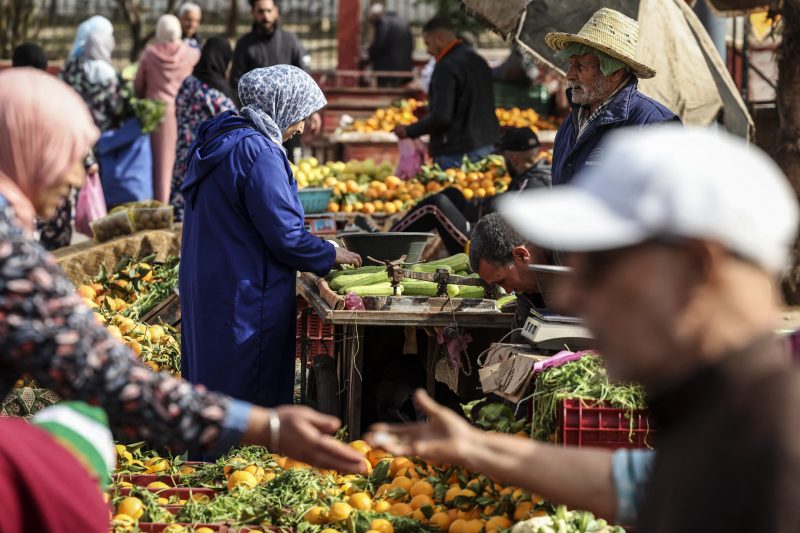
Worries are increasing that increased fuel costs may lead to higher prices for fruits and vegetables in Morocco, as transport companies keep expressing dissatisfaction with the amount of government support.
Although industry experts state that the prices of agricultural products are mainly influenced by supply and demand, consumer advocacy organizations are urging for more robust governmental actions to protect families’ buying capacity.
Hicham Meknassi, a merchant operating at the wholesale fruit and vegetable market in Meknes, stated that the industry is “heavily influenced by supply and demand,” highlighting that prices vary considerably and farmers frequently face market fluctuations on their own.
In an interview with AR, Meknassi mentioned that increasing fuel and input costs do not always lead to higher prices in the market. “Farmers might face significant expenses, but when they go to the market, they have to sell at current prices determined by demand, which could result in losses,” he stated.
He rejected the idea of a direct connection between transportation expenses and higher food prices, referring to it as a “pretext” often used to support price hikes. “Neither sellers nor buyers have control over prices; the market does. When demand goes up, prices go up even if costs are minimal, and the reverse is also true,” he stated.
Meknassi mentioned that increased transportation expenses, approximately 3% because of higher fuel prices, are usually taken on by merchants instead of the drivers. For instance, if the cost of a truck journey goes from 9,000 to 10,000 dirhams, merchants cover the extra amount from their profits without any assurance of recouping it via retail prices.
Bouazza Kherrati, head of the Moroccan Federation for Consumer Protection, condemned what he referred to as a “rent-seeking” framework within the transportation industry. He mentioned that fuel subsidies provided to truck and bus operators in recent years have not reached the end consumers.
“The end-user has not noticed any beneficial effect on prices, buying capacity, or service standards,” Kherrati stated, noting that the subsidies are not adequately monitored or held responsible.
He also highlighted what he referred to as extensive irregularities within the industry, where certain taxi and bus operators failed to follow set fare guidelines, especially during busy times, even though they were receiving government assistance.
Kherrati linked this issue to insufficient oversight systems, stating that it has led to reliance among certain operators who take advantage of financial support without delivering equitable service or adhering to price regulations.
He suggested establishing a stabilization fund, which would be funded when international fuel prices drop, to mitigate the effects during periods of price rises, akin to a compensation system.
Kherrati also pointed out the absence of a robust regulatory body monitoring the fuel industry since its deregulation, in contrast to other sectors that have specialized regulators.
He advocated for immediate tax relief actions, such as lowering value-added tax and local consumption tax on fuel. “It is unfair for the government to take approximately 45% in taxes per liter,” he stated, recommending a decrease to 25% to alleviate consumer burden and boost buying capacity.
The post Worries increase about rising fuel prices affecting Morocco’s agricultural expenses appeared first on English – Morocco News.



 jasdooit
Leave a comment