
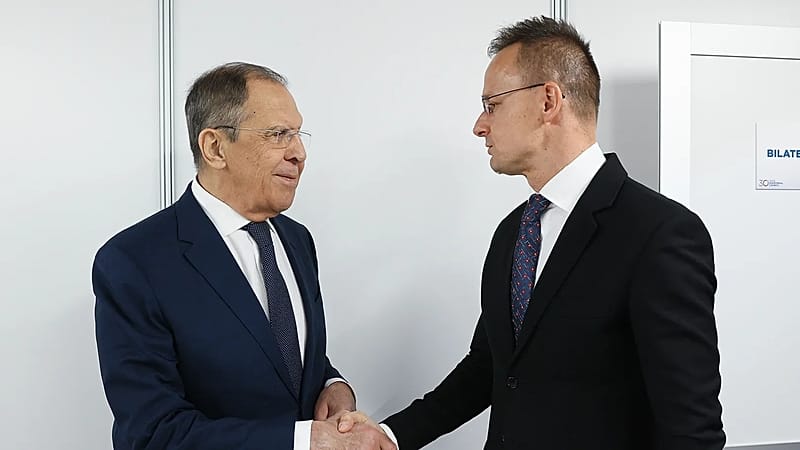
A team of investigative reporters published a phone conversation on Tuesday between Hungary’s Foreign Minister Péter Szijjártó and Russia’s Foreign Minister Sergey Lavrov, during which Szijjártó proposed to help eliminate the sister of a Russian oligarch from EU sanctions as requested by Lavrov.
In a 94-second video uploaded to YouTube and revealed by the investigative platform Insider, Lavrov requested Szijjártó’s assistance in removing Gulbahor Ismailova — the sister of Russian billionaire Alisher Usmanov — from the EU’s sanctions list.
I am reaching out at Alisher’s request, and he just had me remind you that you were working on something concerning his sister,” Lavrov said to Szijjártó. The Hungarian minister replied by stating, “Alongside the Slovaks, we are presenting a proposal to the European Union to remove her from the list.
The recording arrives as Szijjártó is involved in a dispute after a Washington Post article revealed he has been passing confidential details to Russia during Foreign Affairs Council sessions in Brussels.
The controversy has come to light as Hungary gets ready for parliamentary elections on April 12, with external meddling and the administration’s strong connections to Moscow being central topics in the campaign.
Szijjártó has justified his actions, stating that communicating with Russian officials before and after these meetings is a standard part of diplomatic procedures.
The dialogue between Szijjártó and Lavrov took place on August 30, 2024, as captured by unidentified individuals, following Szijjártó’s return from Saint Petersburg to Budapest.
Szijjártó informed Lavrov that he would present a proposal to remove Ismailova’s name from the EU sanctions list “next week,” and “as the new review period starts, it will be added to the agenda — we will do everything possible to have her removed,” Szijjártó stated.
According to EU regulations, sanctions need to be reauthorized every six months with unanimous agreement. Ismailova, together with Russian entrepreneur Viacheslav Moshe Kantor and sports minister Mikhail Degtyaryov, was taken off the EU sanctions list in March 2025.
The European Union cut political connections with Russia after its large-scale invasion of Ukraine in 2022 and has encouraged its member countries to progressively eliminate Russian fossil fuels.
Hungary and Slovakia have kept up consistent high-level communications with Russian authorities and still purchase large amounts of Russian energy.
After the release of the recording, Szijjártó minimized the event and alleged that foreign intelligence agencies had intercepted his phone.
It has long been recognized that foreign intelligence agencies — with the active involvement of Hungarian journalists — have been tapping into my phone calls. Today, the listeners made another significant “discovery”: they demonstrated that I express the same views publicly as I do over the phone. Well done!” he wrote.
The minister stated that his government had never approved sanctions against entities essential to Hungary’s energy security and had resisted including individuals on lists when the sanctions lacked a clear objective. “We will maintain this strategy moving forward,” he mentioned.
The European Commission previously stated that the claims about Szijjártó’s behavior during Foreign Affairs Council meetings are a point of concern and necessitate an explanation from Budapest.
In the recording, Lavrov also informed Szijjártó that the Hungarian minister has been getting significant attention in Russian media.
“Did I say something inappropriate?” Szijjártó questioned.
“No. They were merely stating that you are practically advocating for your nation’s interests,” Lavrov responded.
 jasdooit
Leave a comment