
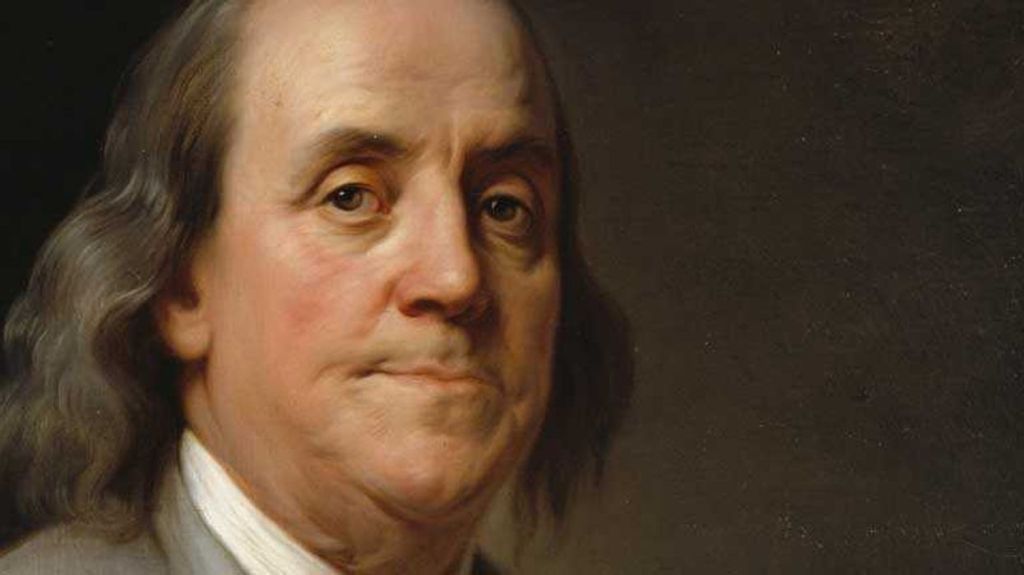
In theory, “A Great Awakening” could have been an intriguing movie. It portrays thethe genuine friendship between American founding father Benjamin Franklin and George Whitefield, one of the pioneers of the evangelical movement. Franklin was aa deist in intellect and a former Puritan in emotion, while Whitefield was a Calvinist.
However, “A Great Awakening” shows no interest in examining their relationship in a meaningful or dramatically engaging manner.
It’s clear why that occurred. Although “A Great Awakening” centers on religion, it is not a sincere film, at least in the sense that it seems to aim primarily at entertaining, informing, or otherwise enhancing the experience of its viewers. Director Joshua Enck, along with co-writers Jeff Bender and Jonathan Blair, have crafted a dishonest film, a hidden form of Christian nationalist propaganda disguised as a heartfelt homage to two 18th-century figures. Blair also appears as Whitefield, and the film’s only redeeming quality is that his acting is so bad, it turns into unintentional comedy (more about that later). Blair’s co-star John Paul Sneed, alongtime expert in Christian Right low-budget productions, portrays Benjamin Franklin with such lack of enthusiasm that I laughed when my autocorrect attempted to change his last name to “Snooze.” Sneed could gain much from cinema’s finest depiction of Franklin,Howard Da Silva in “1776.”
The messaging behind “A Great Awakening.”
The film’s main storyline suggests that George Whitefield influenced Benjamin Franklin to advocate for human equality; because of this, I can’t discuss it with any sense of intellectual integrity without exploring the narrative. Although Franklindid inquire about the 1787 Constitutional Conventionto begin its daily sessions with prayer, he was not especially religious and appeared to do so because — similar to millions of Americans today — he wanted to be on good terms with God without also being a theocrat. However, the film relies on a disputed accountby a man called William Steele, written nearly 40 years following the incident and based solely on Steele’s unconfirmed accounts passed on by New Jersey representative Jonathan Dayton. Steele was later refuted by Virginia representative, future president, and the Constitutional counterpart of a social media personality James Madison, who remembered that Franklin, who represented Pennsylvania (the location where much of the film takes place),had not askedRegarding that prayer, which Steele described in a very dramatic way. Madison was certain that Franklin’s “proposal was received and given the respect it deserved; however, the passage of time, along with the growing anxieties that came from it, resulted in limiting the actions taken to referring the proposal to a very respected Committee.”
Madison stated, “It is certain that the communication [Steele’s version of Dayton’s testimony] was incorrect; whether due to misunderstanding or faulty memory, remains unclear.”
Scholar Louis J. Sirico, Jr., noted in 2018 (Benjamin Franklin, Prayer, and the Constitutional Convention: History as Narrative, 10 Legal Comm. & Rhetoric 89 (2013)) that we have limited information about either William Steele or Jonathan Steele. ‘We know that William Steele was a veteran of the Revolutionary War, born in New York, residing in New Jersey, married to Mary Dayton, possibly related to Jonathan Dayton, and later relocated to upstate New York. He was an active Presbyterian who frequently composed poetry for his family. Jonathan D. Steele emerged as a successful businessman and held the position of president at the Niagara Fire Insurance Company.’
Sirico stated, “No information in the existing historical records provides any understanding of how the misleading story originated.”
Sirico is not the only one questioning the reliability of the Steele dossier. John Fea, a Professor of American History and Chair of the History Department at Messiah, a private Christian college in Pennsylvania,wrote for Commonwealth MagazineIn 2024, it was stated that “the Awakening was not connected to the American Revolution (and, in fact, may not have even occurred in the first place),” and that there is indeed a “twenty-five-year difference between the First Great Awakening and the Revolutionary Period.” He noted that a 1981 thesis by historian Jon Butler, which refuted any connection between the two events (to the extent that the Awakening took place beyond some local instances), was “innovative and persuasive.”
However, with influential Christian nationalists such as former Trump advisor Steve Bannon and long-time theocrat David Barton promoting the false claim that the Great Awakening influenced the American Revolution, “A Great Awakening” is likely to attract a ready audience, particularly since it is being released by a major studio like Roadside Attractions.
This takes us back to the film currently playing.
Movies from the Christian Right are widely known for being of low quality.
Only individuals who intentionally numb their sensibilities to become insensitive nubs in order to “own the libs” or those who find amusement (often with dark humor) in the mere existence of these films seem to appreciate them. Notable examples within this category are “Kirk Cameron’s Saving Christmas,” “War Room,” and the five “God’s Not Dead” films. None of them hold much value as serious or even genuinely humorous movies, but similar to “A Great Awakening,” each is wildly entertaining if you have a preference for the particular kind of low-quality content created by these exceptionally untalented individuals.
“A Great Awakening” offers many such moments, especially when Blair is baring his teeth, twisting his face, and otherwise overacting as the most unlikable and dramatic Whitefield ever portrayed by an actor. There’s a sentimental scene of foot washing where Blair and an extra appear to compete in overacting, a self-indulgent “self doubt” sequence that made me agree with a John Wesley insult, and several obvious uses of African Americans as props, even though in reality Whitefield hadextremely complex connection with race. My most cherished moment was when Blair’s Whitefield criticizes the religious community in a scene meant to appear as progressive but ends up being unnecessarily harsh. He is ordered that he can no longer “preach inside.” With an expression of victory, he states, “Then I will preach outside!”
I make an effort to be courteous during films, but at that moment I couldn’t hold back and laughed so loudly my voice actually echoed off the walls of the auditorium. Where else would he go? Fortunately, the theater was empty besides me, so I wasn’t really being impolite.
Yet I don’t believe those theaters will stay empty (I attended an early morning showing and paid because it’s, in a way, the price a film critic must pay), as much as I hope my skepticism is wrong. I’ve seen ads for “A Great Awakening” everywhere, and if you check my previous list of Christian Right films that ordinary people mock, you’ll notice that some of them were financial hits. The viewers of these movies aren’t the 21st-century versions of Franklin or Whitefield or the many followers of either man from the 18th century, but rather people from that time who were too unremarkable to be remembered. Those who genuinely back “A Great Awakening” or similar low-quality films consider themselves superior while the world wonders how such dull content can even sustain itself financially. Unfortunately, since they think they’re defeating their ideological rivals, millions of these average individuals are out there, eager to spend their money to make a point.
The unfortunate part is, as I stated before, it didn’t need to turn out like this.I recall “Citizen Twain,”An obscure play, directed, written by, and starring Val Kilmer as an American secularist as renowned as Benjamin Franklin and Mark Twain, who maintained a respectful yet critical relationship with Christian Science founder Mary Baker Eddy. Kilmer (who once gave me a hard time when he noticed a journalist in the audience) delivered a touching performance, vividly portraying the brilliant characters and their sharply contrasting views. Kilmer’s passion project, which unfortunately was never turned into a film, moved me because it stemmed from genuine curiosity and was skillfully executed. In contrast, “A Great Awakening” aims only to manipulate, and it does so poorly.
Like every film produced by the Christian Right aimed at spreading their beliefs, “A Great Awakening” is filled with simplistic explanations, dull conversations, and awkward attempts to glorify conservative ideals. This film is so foolish that it dares to have a character say, “How long will you hide behind your wit?”, as though there’s any real amount of that valuable thing present in this movie.
Related Articles:
・The single factor that might clarify all of Trump’s choices
・This is precisely what the Founders cautioned us against.
・Trump, Benjamin Franklin and the extensive history of referring to immigrants as ‘snakes’
・What Ben Franklin’s insights reveal about the impeachment of Donald Trump




 jasdooit
Leave a comment