
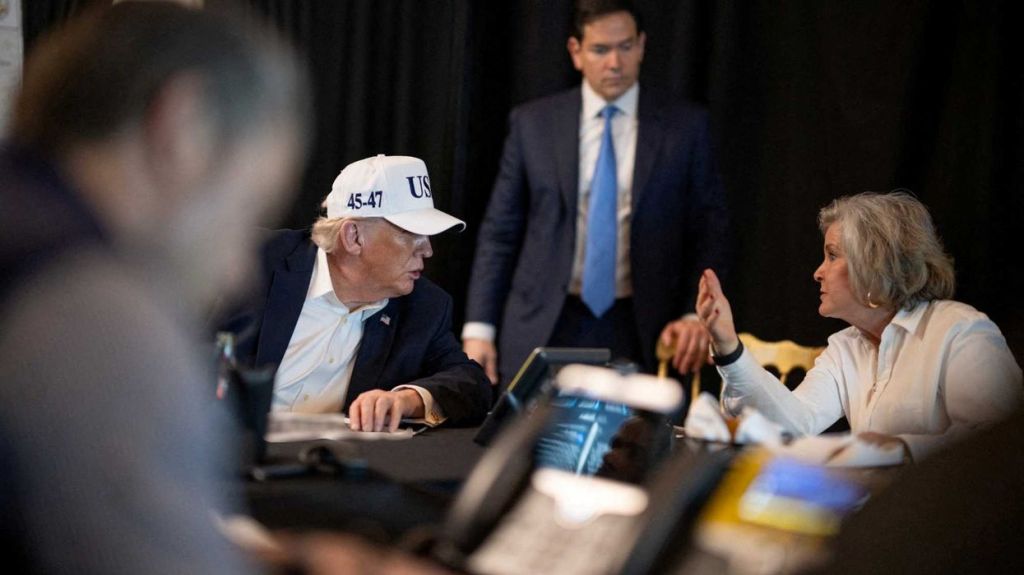
U.S. President Donald Trump is justifying his conflict with Iran as a fight against terrorism and radicalism, consistently stating that the government in Tehran should not be permitted to create nuclear weapons. However, opponents of Trump’s approach towards Iran, includingformer U.S. Army Lieutenant General Mark Hertling— former head of U.S. Army Europe — feels that he is contributing to the unrest in that region.
Another reviewer is Erfan Fard, a counterterrorism expert based in Virginia.
In an opinion piece published by The Hill on April 3, Fard claims that Trump’s conflict might result in Iran having a military-dominated government that is even more hazardous and extreme compared to the existing Shia fundamentalist administration.
In public, the Shiite mullahs hold power in Iran, but over time, actual control has shifted to the security forces — the Islamic Revolutionary Guard Corps, the intelligence agencies, and the security networks,” Fard states. “Conflict has only sped up this change. Faced with external pressure, the regime has therefore moved away from reform or dialogue and instead toward military buildup. The killing of top commanders and the targeting of key centers have undermined the system, yet they have also provided an opportunity for more extreme factions to rise.
The United States has a prolonged record of advocating for changes in Iran’s leadership. During the early 1950s, Iranian Prime Minister Mohammad Mosaddegh, who followed socialist principles, was removed from power with the assistance of the CIA.
Following this, Iran’s Shah, Reza Pahlavi, and later Mohammad Reza Pahlavi, governed the nation for numerous years until he was deposed in 1979. Pahlavi maintained a dictatorial regime, but he supported a progressive interpretation of Islam and maintained strong ties with the United States and other Western democracies. In 1979, the Pahlavi regime was succeeded by a strict theocracy rooted in Shiite Islam, led by the late Ayatollah Ruhollah Khomeini.
The conflict led by Trump, Fard points out, will not mark the conclusion of stringent Islamist governance in Iran — and may even exacerbate the situation.
Interestingly, U.S. and Israeli air capabilities might manage to weaken the regime’s military forces and nuclear facilities without diminishing — and possibly even enhancing — Tehran’s influence,” Fard notes. “This outcome could lead to a less powerful but more extreme and authoritarian state positioned at the Strait of Hormuz. Such a scenario may pose an even greater threat to regional stability and the world economy than the system it is replacing.
Related Articles:
・The New York Times accuses Trump of ‘concealing the facts’
・Trump’s unsuccessful gambits regarding Iran reveal the emptiness of his warnings: analysis
・CNN presents a painful compilation of Trump’s incorrect statements
・Iran truly has Trump in a position of weakness — regarding oil.
 jasdooit
Leave a comment