
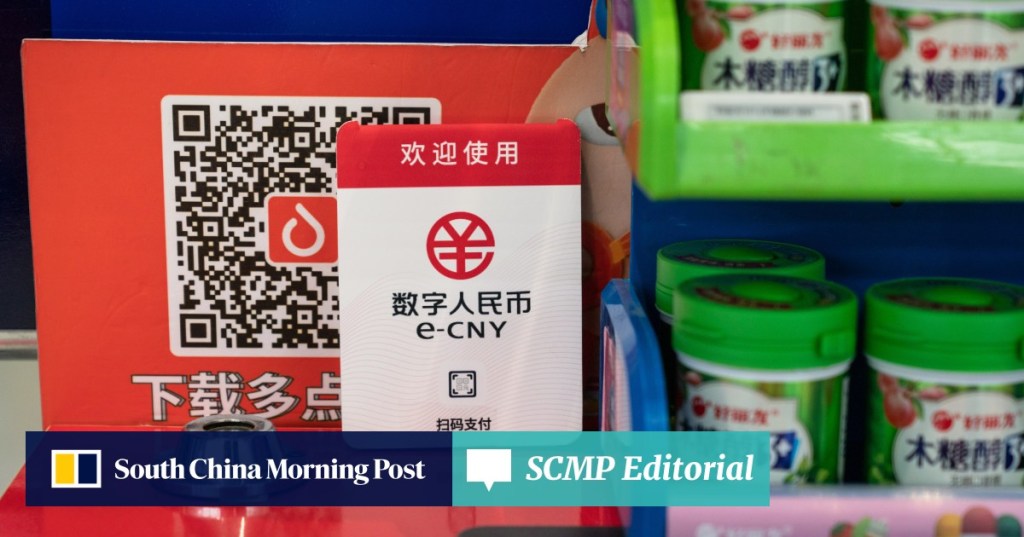
Audience members debate the city’s plans for a stablecoin, the adoption of electronic payments, and the potential impact of eHealth on preventing strokes.
Strongly feel about these letters or other news elements? Express your opinions by sending us your Letter to the Editor via email. letters@scmp.com or filling in this Google form. Submissions must not go beyond 400 words
As Hong Kong gets ready to release itsfirst stablecoin licences, much of the discussion portrays stablecoins in Hong Kong, China’s digital yuan, and US dollar-backed tokens as competing currencies racing on the same track.
However, this comparison runs the risk of overlooking the main issue.
Are you curious about the most significant issues and developments happening globally? Find the solutions withSCMP Knowledge, our latest platform offering carefully selected content including explainers, FAQs, analyses, and infographics, presented by our acclaimed team.
Although these tools are becoming more intertwined in payments and international settlement, they were not created to address identical issues. Hong Kong’s significance in the global financial landscape has never been based on issuing a fiat currency. Instead, its power comes from free movement of capital, regulatory trustworthiness, and its function as a bridge between financial systems.
The aim of Hong Kong’s stablecoin approach appears not to focus on growth or widespread consumer use, but rather on whether stablecoins can function under a strictly regulated system that satisfies institutional requirements regarding governance, reserve handling, anti-money laundering measures, and financial security.
Stablecoins in Hong Kong, therefore, are most effectively viewed not as consumer payment instruments, but as supervised bridges—facilitating the flow of capital between conventional finance and worldwide blockchain markets in a compliant setting. This reflects its established function as an offshore gateway for capital and financial intermediation, a function that is growing in importance as digital assets develop.
China’s digital yuan operates under a distinct principle. From the beginning, eCNY has been recognized as a digital version of legal currency, matching the value of physical cash and issued by the central bank. Its implementation has centered on domestic, real-economy applications like retail transactions and public services, where dependability, transparency, and regulatory oversight are emphasized. Although cross-border trials are developing, it continues to be an extension of the nation’s monetary system.
Dollar-pegged stablecoins form a third category. They grew naturally through market acceptance, similar to the way the dollar has operated worldwide for years—supported by demand, availability, and network advantages rather than direct central bank control. Stablecoins bring this concept into the digital world, serving as private-sector means of providing dollar liquidity during a period when some regions are looking into local currency transactions and options beyond traditional dollar-based systems.
These methods function at various levels within the financial system: Hong Kong focuses on regulated interconnection, China strengthens its own monetary control, and the US promotes market-oriented distribution. Their common ground is in implementation, not in fundamental intent.
This is the reason the digital currency environment is unlikely to settle on one model, but instead will likely consist of a multi-layered structure, where various tools fulfill distinct roles—sometimes operating side by side, sometimes working together.
Hong Kong’s moment with stablecoins is not so much about entering a competition as it is about establishing its position: facilitating the secure clearing, settlement, and exchange of value across different systems in a more divided, multi-currency digital environment, rather than striving to determine the currency itself.
Winnie Li, a manager and expert in new technologies, Edelman
Following taxis, wet markets should implement electronic payments
Last week, the taxi industry in Hong Kong commencedoffering e-paymentchoices. Better late than never.
I have always maintained detailed records of my cash expenses. Since January 1, except for taxis and shopping at wet markets, all my payments have been processed through Octopus, Alipay, WeChat Pay, credit cards, or other digital platforms, each of which maintains a record of every transaction in its own manner.
I am not going to guess the reasons why taxi drivers had to be strongly encouraged to use electronic payments, but I am taken aback that numerous vegetable, meat, and seafood sellers in our wet markets are still hesitant to move towards a cash-free system.
It would be beneficial if the government mandated that all retail stores provide at least two digital payment methods, similar to how taxis operate. Hong Kong takes pride in being a pioneer in information technology, but when it comes to cash transactions, we are behind mainland China. In that region, using cash is so rare that a customer handing over bills might feel out of place.
I wish to witness Hong Kong mostly cash-free by 2027.
Venkitaraman Krishnan, Cha Kwo Ling
Boost eHealth to aid in stroke prevention
We mention “Hong Kong to extend program reducing stroke patient transfer time by 80 minutes”March 11). As the stroke diversion pilot initiative, which highlights the city’s dedication to advancing emergency care, grows, we suggest improving it by incorporating strategic eHealth solutions.
By analyzing patients’ medical records in eHealth systems, a classification mechanism could be created to detect those at significant risk of stroke using machine learning techniques and large-scale data, a strategy being implemented by at least one hospital in Singapore. These classifications would assist emergency responders at incident sites in making quicker choices regarding whether to take patients directly to public hospitals that have the necessary surgical capabilities. Utilizing big data analysis on stroke risk elements could enhance the distribution of governmental resources among hospitals and areas.
These improvements rely on increased data exchange from private hospitals and clinics within the eHealth network. At present, minimal involvement from the private sector restricts the system’s ability to predict outcomes. Improved data sharing would result in a detailed stroke risk database, allowing for early detection of patients at high risk and better allocation of resources.
The present initiative’s achievements lay the groundwork for a data-focused growth that may revolutionize Hong Kong’s stroke treatment from being reactive to proactive.
He Jinyi and Pang Hoi-lam, Kowloon Tong
More Articles from SCMP
China reduces the price of military-grade infrared chips to as low as a few dozen dollars
Kitchee international star set on Hong Kong League Cup triumph to kick off a significant week
This piece was first published in the South China Morning Post (www.scmp.com), a top news outlet covering China and Asia.
Copyright (c) 2026. South China Morning Post Publishers Ltd. All rights reserved.




 jasdooit
Leave a comment