
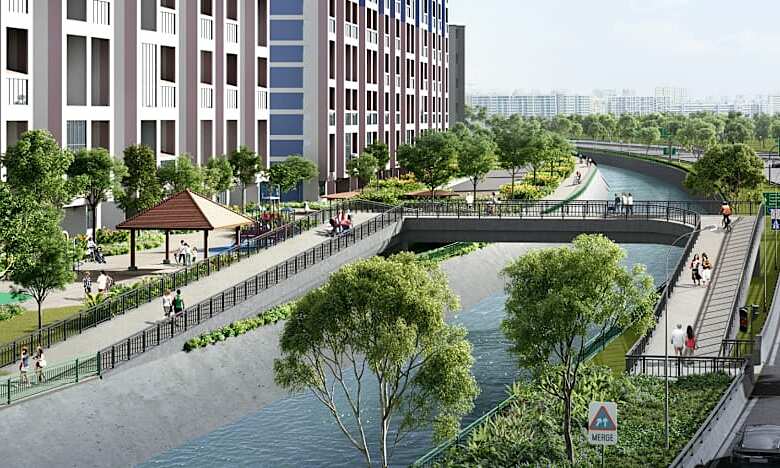
The Land Transport Authority of Singapore has revealed intentions to construct the nation’s initial 3D-printed concrete footbridge, which is anticipated to be finished and operational by 2028, aiming to reduce commuting time between the Jurong West and Tengah residential zones.
The bridge will measure 10 meters in length and 5 meters in width, intended for use by both walkers and cyclists. The trial initiative is a part of Singapore’s initiatives to implement 3D concrete printing technology in order to enhance construction efficiency due to a lack of labor.
The initiative is being carried out in partnership with the Singapore Center for 3D Printing at Nanyang Technological University (NTU), engineering firm Witteveen+Bos, and construction company CES_Innovfab.
The team working on the project has created cement-based materials appropriate for 3D printing, designed the bridge’s structure, and built a scaled model to evaluate its structural strength. Structural testing of the model was finished last month, and the findings are now being analyzed prior to starting the construction of the full-sized bridge.
A three-dimensional concrete printing technique involves the automated extrusion of concrete via a nozzle, building structures layer by layer without the necessity of formwork. As stated by LTA, this innovation has the potential to greatly cut down on labor demands and project duration, especially in areas with limited workforce availability such as Singapore, by reducing reliance on temporary supports and manual tasks.
The technology enables engineers to produce intricate geometric shapes and unique architectural designs that are challenging to realize with conventional building techniques. Nevertheless, LTA mentioned that 3D concrete printing is still an evolving technology in infrastructure development, and the bridge project will act as a trial to evaluate its viability for certain infrastructure uses.
The bridge consists of 10 concrete sections that will be put together and connected with steel cables throughout its full length. These cables will be secured to concrete foundations at each end and tightened through a post-tensioning method to press the segments into one continuous bridge deck.
A model that is 10 meters long and 2.5 meters wide, which is half the width of the real bridge, was tested in water tanks to check its safety and strength. Allan Yeo, Deputy Director for street design and infrastructure technology at LTA, stated that the bridge’s ability to hold weight is similar to that of traditional pedestrian bridges. In the tests, 18 water tanks, each weighing approximately one tonne, were used to represent the loads.
The LTA mentioned that the model’s testing has been finished, and data gathered from sensors is currently being examined to confirm theoretical design computations and guarantee the structure’s strength. Should the outcomes be favorable, work on the full-sized bridge will commence, followed by additional assessments prior to the structure’s opening for public use.




 jasdooit
Leave a comment